

266
Antoni Escarre, Ferran Rodil, Jaume Terradas and Xavier Mayor
Nutrient use efficiency:
element productivity (A)
C
120 r---~---'----~--~---'
-5~ 100
~o
' 1§:9 80
::J::l
8.~ 60
c .2
0.0
40
''=; (I)
g£
e.s 20
a..
0
40
35
-.:30
~
(I)
25
,§ 20
CD
>
15
0
c
:;
I10
5
a
N
P
K
Ca
Mg
Mean residence time (111..)
N
p
K
Ca
Mg
Overall nutrient use efficiency:
A x 111..
2500 r----,----,-----r'E
Q)
· s 2000
c~
_0)
'§El15oo
'-'0
(1)(1)
Q.e
:52
-=(1)
0 ' -
:I
e a..
1000
500
N
p
K
Ca
Mg
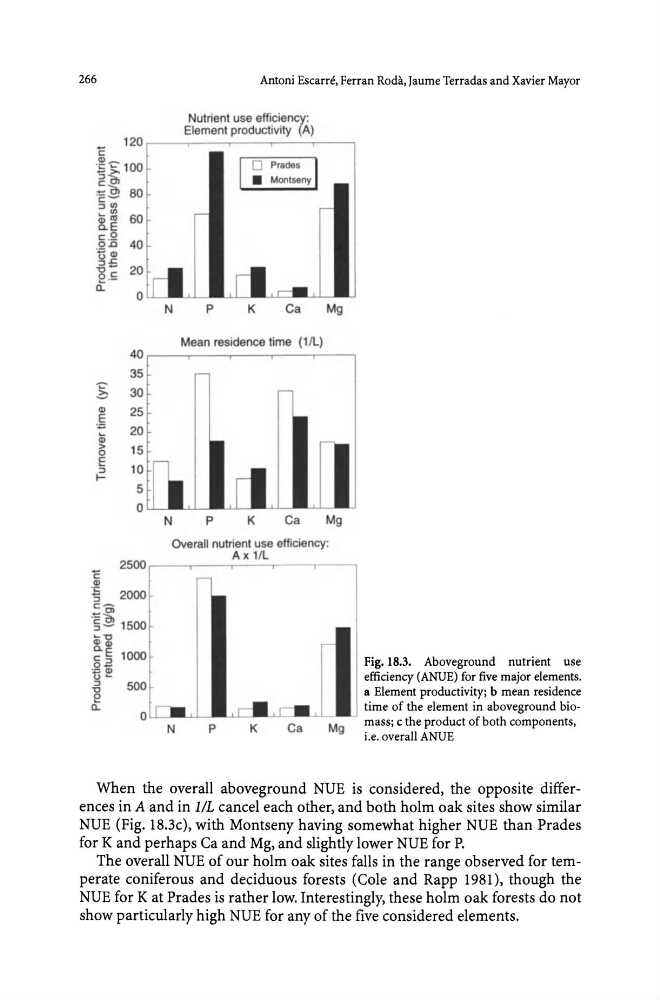
Fig. 18.3. Aboveground nutrient use
efficiency (ANUE) for five major elements.
a Element productivity; b mean residence
time of the element in aboveground biomass; c the product of both components,
i.e. overall ANUE
When the overall aboveground NUE is considered, the opposite differences in A and in 1/L cancel each other, and both holm oak sites show similar
NUE (Fig. 18.3c), with Montseny having somewhat higher NUE than Prades
for K and perhaps Ca and Mg, and slightly lower NUE for P.
The overall NUE of our holm oak sites falls in the range observed for temperate coniferous and deciduous forests (Cole and Rapp 1981), though the
NUE for K at Prades is rather low. Interestingly, these holm oak forests do not
show particularly high NUE for any of the five considered elements.
Antoni Escarre, Ferran Rodil, Jaume Terradas and Xavier Mayor
Nutrient use efficiency:
element productivity (A)
C
120 r---~---'----~--~---'
-5~ 100
~o
' 1§:9 80
::J::l
8.~ 60
c .2
0.0
40
''=; (I)
g£
e.s 20
a..
0
40
35
-.:30
~
(I)
25
,§ 20
CD
>
15
0
c
:;
I10
5
a
N
P
K
Ca
Mg
Mean residence time (111..)
N
p
K
Ca
Mg
Overall nutrient use efficiency:
A x 111..
2500 r----,----,-----r'E
Q)
· s 2000
c~
_0)
'§El15oo
'-'0
(1)(1)
Q.e
:52
-=(1)
0 ' -
:I
e a..
1000
500
N
p
K
Ca
Mg
Fig. 18.3. Aboveground nutrient use
efficiency (ANUE) for five major elements.
a Element productivity; b mean residence
time of the element in aboveground biomass; c the product of both components,
i.e. overall ANUE
When the overall aboveground NUE is considered, the opposite differences in A and in 1/L cancel each other, and both holm oak sites show similar
NUE (Fig. 18.3c), with Montseny having somewhat higher NUE than Prades
for K and perhaps Ca and Mg, and slightly lower NUE for P.
The overall NUE of our holm oak sites falls in the range observed for temperate coniferous and deciduous forests (Cole and Rapp 1981), though the
NUE for K at Prades is rather low. Interestingly, these holm oak forests do not
show particularly high NUE for any of the five considered elements.