

240
S 160
E 120
:a 80
> 40
(a)
Nuria Melia, Juan Bellot and V. Ramon Vallejo
Rainfall
1200 -I-'UJ.LLL-IJ~UlllJ..l.Lo~J..I..LI........LLLf-'-'-ll~w::'~"-----!
1000
'76 800
~ 600
:::l..
~ 400
u
~ 200
o
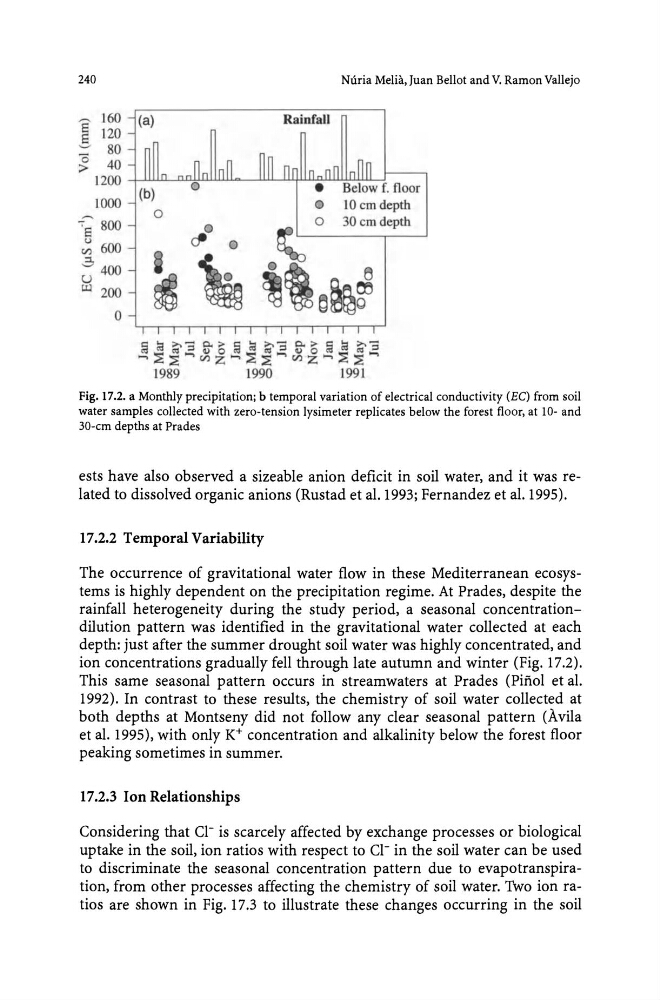
Fig. 17.2. a Monthly precipitation; b temporal variation of electrical conductivity (Ee) from soil
water samples collected with zero-tension lysimeter replicates below the forest floor, at 10- and
30-cm depths at Prades
ests have also observed a sizeable anion deficit in soil water, and it was related to dissolved organic anions (Rustad et al. 1993; Fernandez et al. 1995).
17.2.2 Temporal Variability
The occurrence of gravitational water flow in these Mediterranean ecosystems is highly dependent on the precipitation regime. At Prades, despite the
rainfall heterogeneity during the study period, a seasonal concentrationdilution pattern was identified in the gravitational water collected at each
depth: just after the summer drought soil water was highly concentrated, and
ion concentrations gradually fell through late autumn and winter (Fig. 17.2).
This same seasonal pattern occurs in streamwaters at Prades (Pinol et al.
1992). In contrast to these results, the chemistry of soil water collected at
both depths at Montseny did not follow any clear seasonal pattern (Avila
et al. 1995), with only K+ concentration and alkalinity below the forest floor
peaking sometimes in summer.
17.2.3 Ion Relationships
Considering that CI- is scarcely affected by exchange processes or biological
uptake in the soil, ion ratios with respect to CI- in the soil water can be used
to discriminate the seasonal concentration pattern due to evapotranspiration, from other processes affecting the chemistry of soil water. Two ion ratios are shown in Fig. 17.3 to illustrate these changes occurring in the soil
S 160
E 120
:a 80
> 40
(a)
Nuria Melia, Juan Bellot and V. Ramon Vallejo
Rainfall
1200 -I-'UJ.LLL-IJ~UlllJ..l.Lo~J..I..LI........LLLf-'-'-ll~w::'~"-----!
1000
'76 800
~ 600
:::l..
~ 400
u
~ 200
o
Fig. 17.2. a Monthly precipitation; b temporal variation of electrical conductivity (Ee) from soil
water samples collected with zero-tension lysimeter replicates below the forest floor, at 10- and
30-cm depths at Prades
ests have also observed a sizeable anion deficit in soil water, and it was related to dissolved organic anions (Rustad et al. 1993; Fernandez et al. 1995).
17.2.2 Temporal Variability
The occurrence of gravitational water flow in these Mediterranean ecosystems is highly dependent on the precipitation regime. At Prades, despite the
rainfall heterogeneity during the study period, a seasonal concentrationdilution pattern was identified in the gravitational water collected at each
depth: just after the summer drought soil water was highly concentrated, and
ion concentrations gradually fell through late autumn and winter (Fig. 17.2).
This same seasonal pattern occurs in streamwaters at Prades (Pinol et al.
1992). In contrast to these results, the chemistry of soil water collected at
both depths at Montseny did not follow any clear seasonal pattern (Avila
et al. 1995), with only K+ concentration and alkalinity below the forest floor
peaking sometimes in summer.
17.2.3 Ion Relationships
Considering that CI- is scarcely affected by exchange processes or biological
uptake in the soil, ion ratios with respect to CI- in the soil water can be used
to discriminate the seasonal concentration pattern due to evapotranspiration, from other processes affecting the chemistry of soil water. Two ion ratios are shown in Fig. 17.3 to illustrate these changes occurring in the soil