

Precipitation Chemistry and Air Pollution
I
a.
c
ro
<1>
E
(ij
::J
C
C
<{
Montseny
8 ,---------------------------,
7
•
..,
•
• .... -
•
6
..,
..,
• ..,
.., ..
5 ..
•
4
•
•
y - S.3 + 0.062x; r-0.7. p < 0.01
o
5
10
15
20
25
30
35
Red rain contribution to
annual preCipitation volume (%)
199
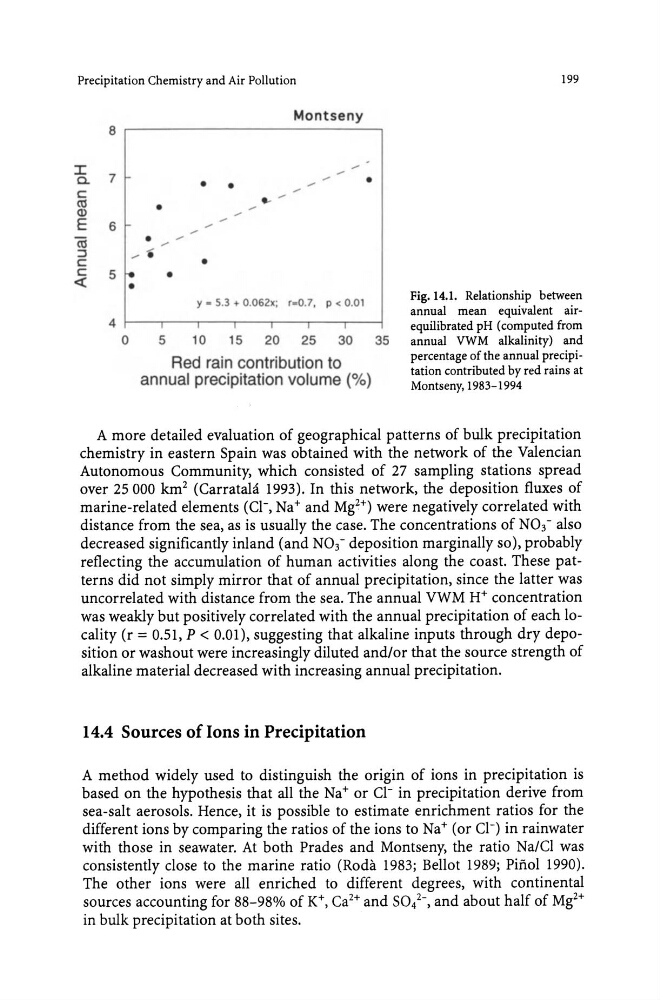
Fig.14.1. Relationship between
annual mean equivalent airequilibrated pH (computed from
annual VWM alkalinity) and
percentage of the annual precipitation contributed by red rains at
Montseny, 1983-1994
A more detailed evaluation of geographical patterns of bulk precipitation
chemistry in eastern Spain was obtained with the network of the Valencian
Autonomous Community, which consisted of 27 sampling stations spread
over 25000 km 2 (Carratahi 1993). In this network, the deposition fluxes of
marine-related elements (Cl-, Na+ and Mg 2 +) were negatively correlated with
distance from the sea, as is usually the case. The concentrations of N03 - also
decreased significantly inland (and N03 - deposition marginally so), probably
reflecting the accumulation of human activities along the coast. These patterns did not simply mirror that of annual precipitation, since the latter was
uncorrelated with distance from the sea. The annual VWM H+ concentration
was weakly but positively correlated with the annual precipitation of each locality (r = 0.51, P < 0.01), suggesting that alkaline inputs through dry deposition or washout were increasingly diluted and/or that the source strength of
alkaline material decreased with increasing annual precipitation.
14.4 Sources of Ions in Precipitation
A method widely used to distinguish the origin of ions in precipitation is
based on the hypothesis that all the Na+ or CI- in precipitation derive from
sea-salt aerosols. Hence, it is possible to estimate enrichment ratios for the
different ions by comparing the ratios of the ions to Na+ (or Cl-) in rainwater
with those in seawater. At both Prades and Montseny, the ratio Na/CI was
consistently close to the marine ratio (Roda 1983; Bellot 1989; Pinol 1990).
The other ions were all enriched to different degrees, with continental
sources accounting for 88-980/0 of K+, Ca 2 + and sol-, and about half of Mg2+
in bulk precipitation at both sites.
I
a.
c
ro
<1>
E
(ij
::J
C
C
<{
Montseny
8 ,---------------------------,
7
•
..,
•
• .... -
•
6
..,
..,
• ..,
.., ..
5 ..
•
4
•
•
y - S.3 + 0.062x; r-0.7. p < 0.01
o
5
10
15
20
25
30
35
Red rain contribution to
annual preCipitation volume (%)
199
Fig.14.1. Relationship between
annual mean equivalent airequilibrated pH (computed from
annual VWM alkalinity) and
percentage of the annual precipitation contributed by red rains at
Montseny, 1983-1994
A more detailed evaluation of geographical patterns of bulk precipitation
chemistry in eastern Spain was obtained with the network of the Valencian
Autonomous Community, which consisted of 27 sampling stations spread
over 25000 km 2 (Carratahi 1993). In this network, the deposition fluxes of
marine-related elements (Cl-, Na+ and Mg 2 +) were negatively correlated with
distance from the sea, as is usually the case. The concentrations of N03 - also
decreased significantly inland (and N03 - deposition marginally so), probably
reflecting the accumulation of human activities along the coast. These patterns did not simply mirror that of annual precipitation, since the latter was
uncorrelated with distance from the sea. The annual VWM H+ concentration
was weakly but positively correlated with the annual precipitation of each locality (r = 0.51, P < 0.01), suggesting that alkaline inputs through dry deposition or washout were increasingly diluted and/or that the source strength of
alkaline material decreased with increasing annual precipitation.
14.4 Sources of Ions in Precipitation
A method widely used to distinguish the origin of ions in precipitation is
based on the hypothesis that all the Na+ or CI- in precipitation derive from
sea-salt aerosols. Hence, it is possible to estimate enrichment ratios for the
different ions by comparing the ratios of the ions to Na+ (or Cl-) in rainwater
with those in seawater. At both Prades and Montseny, the ratio Na/CI was
consistently close to the marine ratio (Roda 1983; Bellot 1989; Pinol 1990).
The other ions were all enriched to different degrees, with continental
sources accounting for 88-980/0 of K+, Ca 2 + and sol-, and about half of Mg2+
in bulk precipitation at both sites.