

192
6
........
' ....
5
>.
'7
nI
4
..r::.
....
'-"
3
nI
2
't:
Q)
....
....
::J
o
Without
Ferran Roda, Xavier Mayor, Santiago Sabate and Victoria Diego
Lltterfall In 1992
~ Others
•
Fruits
o Leaves 1--- -
With
Without
With
Previous irrigation
N fertilization
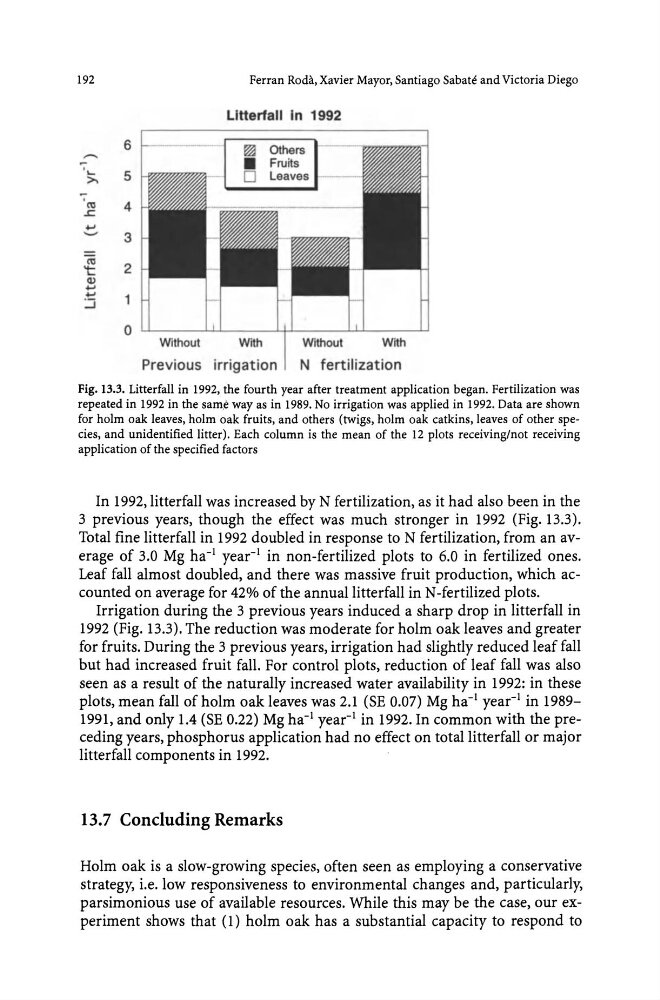
Fig. 13.3. Litterfall in 1992, the fourth year after treatment application began. Fertilization was
repeated in 1992 in the sam, e way as in 1989. No irrigation was applied in 1992. Data are shown
for holm oak leaves, holm oak fruits, and others (twigs, holm oak catkins, leaves of other species, and unidentified litter). Each column is the mean of the 12 plots receiving/not receiving
application of the specified factors
In 1992, litterfall was increased by N fertilization, as it had also been in the
3 previous years, though the effect was much stronger in 1992 (Fig. 13.3).
Total fine litterfall in 1992 doubled in response to N fertilization, from an average of 3.0 Mg ha- 1 year- 1 in non-fertilized plots to 6.0 in fertilized ones.
Leaf fall almost doubled, and there was massive fruit production, which accounted on average for 42% of the annuallitterfall in N-fertilized plots.
Irrigation during the 3 previous years induced a sharp drop in litterfall in
1992 (Fig. 13.3). The reduction was moderate for holm oak leaves and greater
for fruits. During the 3 previous years, irrigation had slightly reduced leaf fall
but had increased fruit fall. For control plots, reduction of leaf fall was also
seen as a result of the naturally increased water availability in 1992: in these
plots, mean fall of holm oak leaves was 2.1 (SE 0.07) Mg ha- 1 year- 1 in 19891991, and only 1.4 (SE 0.22) Mg ha- 1 year- 1 in 1992. In common with the preceding years, phosphorus application had no effect on totallitterfall or major
litterfall components in 1992.
13.7 Concluding Remarks
Holm oak is a slow-growing species, often seen as employing a conservative
strategy, i.e. low responsiveness to environmental changes and, particularly,
parsimonious use of available resources. While this may be the case, our experiment shows that (1) holm oak has a substantial capacity to respond to
6
........
' ....
5
>.
'7
nI
4
..r::.
....
'-"
3
nI
2
't:
Q)
....
....
::J
o
Without
Ferran Roda, Xavier Mayor, Santiago Sabate and Victoria Diego
Lltterfall In 1992
~ Others
•
Fruits
o Leaves 1--- -
With
Without
With
Previous irrigation
N fertilization
Fig. 13.3. Litterfall in 1992, the fourth year after treatment application began. Fertilization was
repeated in 1992 in the sam, e way as in 1989. No irrigation was applied in 1992. Data are shown
for holm oak leaves, holm oak fruits, and others (twigs, holm oak catkins, leaves of other species, and unidentified litter). Each column is the mean of the 12 plots receiving/not receiving
application of the specified factors
In 1992, litterfall was increased by N fertilization, as it had also been in the
3 previous years, though the effect was much stronger in 1992 (Fig. 13.3).
Total fine litterfall in 1992 doubled in response to N fertilization, from an average of 3.0 Mg ha- 1 year- 1 in non-fertilized plots to 6.0 in fertilized ones.
Leaf fall almost doubled, and there was massive fruit production, which accounted on average for 42% of the annuallitterfall in N-fertilized plots.
Irrigation during the 3 previous years induced a sharp drop in litterfall in
1992 (Fig. 13.3). The reduction was moderate for holm oak leaves and greater
for fruits. During the 3 previous years, irrigation had slightly reduced leaf fall
but had increased fruit fall. For control plots, reduction of leaf fall was also
seen as a result of the naturally increased water availability in 1992: in these
plots, mean fall of holm oak leaves was 2.1 (SE 0.07) Mg ha- 1 year- 1 in 19891991, and only 1.4 (SE 0.22) Mg ha- 1 year- 1 in 1992. In common with the preceding years, phosphorus application had no effect on totallitterfall or major
litterfall components in 1992.
13.7 Concluding Remarks
Holm oak is a slow-growing species, often seen as employing a conservative
strategy, i.e. low responsiveness to environmental changes and, particularly,
parsimonious use of available resources. While this may be the case, our experiment shows that (1) holm oak has a substantial capacity to respond to