

11 Modelling Canopy Gas Exchange
During Summer Drought
Anna Sala
11.1 Introduction
The structure and function of woody Mediterranean vegetation is strongly
influenced by the periodical occurrence of a summer dry period. A hierarchy
of structural and physiological adjustments (e.g. changes in leaf area, rooting
depth, and stomatal opening), each operating at different time scales (from
years to minutes) have been shown to be effective mechanisms by which
Mediterranean sclerophylls cope with limited water availability during these
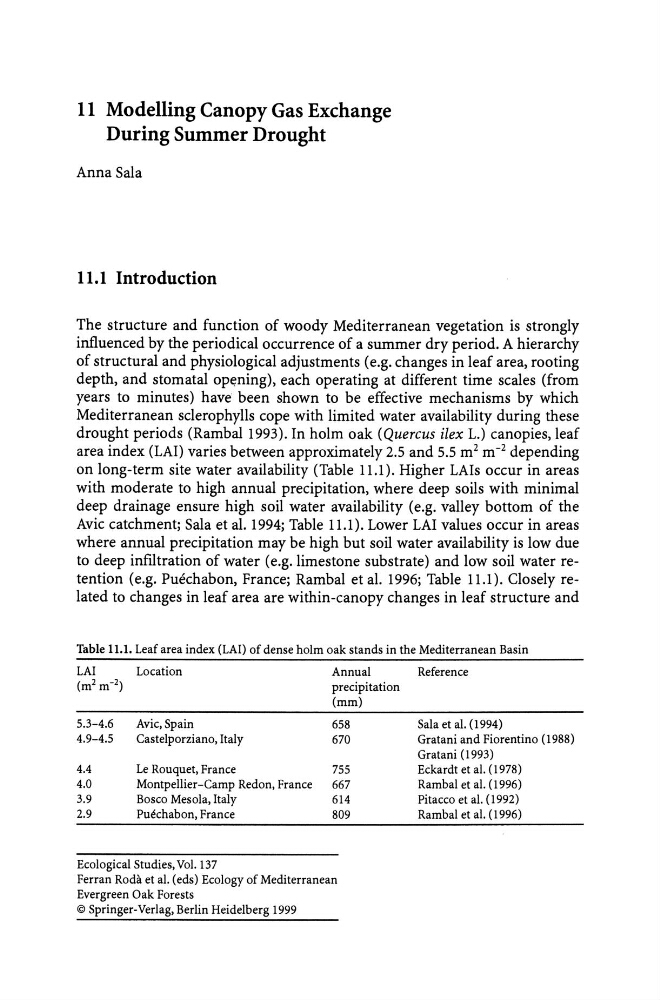
drought periods (RambalI993). In holm oak (Quercus ilex L.) canopies, leaf
area index (LA!) varies between approximately 2.5 and 5.5 m 2 m- 2 depending
on long-term site water availability (Table 11.1). Higher LAIs occur in areas
with moderate to high annual precipitation, where deep soils with minimal
deep drainage ensure high soil water availability (e.g. valley bottom of the
Avic catchment; Sala et al. 1994; Table 11.1). Lower LAI values occur in areas
where annual precipitation may be high but soil water availability is low due
to deep infIltration of water (e.g. limestone substrate) and low soil water retention (e.g. Puechabon, France; Rambal et al. 1996; Table 11.1). Closely related to changes in leaf area are within-canopy changes in leaf structure and
Table 11.1. Leaf area index (LAI) of dense holm oak stands in the Mediterranean Basin
LAI
Location
Annual
(m 2 m- 2 )
precipitation
(mm)
5.3-4.6
Avic,Spain
658
4.9-4.5
Castelporziano, Italy
670
4.4
Le Rouquet, France
755
4.0
Montpellier-Camp Redon, France
667
3.9
Bosco Mesola, Italy
614
2.9
Puechabon, France
809
Ecological Studies, Vol. 137
Ferran Rodil et al. (eds) Ecology of Mediterranean
Evergreen Oak Forests
© Springer-Verlag, Berlin Heidelberg 1999
Reference
Sala et al. (1994)
Gratani and Fiorentino (1988)
Gratani (1993)
Eckardt et al. (1978)
Rambal et al. (1996)
Pitacco et al. (I992)
Rambal et al. (1996)
During Summer Drought
Anna Sala
11.1 Introduction
The structure and function of woody Mediterranean vegetation is strongly
influenced by the periodical occurrence of a summer dry period. A hierarchy
of structural and physiological adjustments (e.g. changes in leaf area, rooting
depth, and stomatal opening), each operating at different time scales (from
years to minutes) have been shown to be effective mechanisms by which
Mediterranean sclerophylls cope with limited water availability during these
drought periods (RambalI993). In holm oak (Quercus ilex L.) canopies, leaf
area index (LA!) varies between approximately 2.5 and 5.5 m 2 m- 2 depending
on long-term site water availability (Table 11.1). Higher LAIs occur in areas
with moderate to high annual precipitation, where deep soils with minimal
deep drainage ensure high soil water availability (e.g. valley bottom of the
Avic catchment; Sala et al. 1994; Table 11.1). Lower LAI values occur in areas
where annual precipitation may be high but soil water availability is low due
to deep infIltration of water (e.g. limestone substrate) and low soil water retention (e.g. Puechabon, France; Rambal et al. 1996; Table 11.1). Closely related to changes in leaf area are within-canopy changes in leaf structure and
Table 11.1. Leaf area index (LAI) of dense holm oak stands in the Mediterranean Basin
LAI
Location
Annual
(m 2 m- 2 )
precipitation
(mm)
5.3-4.6
Avic,Spain
658
4.9-4.5
Castelporziano, Italy
670
4.4
Le Rouquet, France
755
4.0
Montpellier-Camp Redon, France
667
3.9
Bosco Mesola, Italy
614
2.9
Puechabon, France
809
Ecological Studies, Vol. 137
Ferran Rodil et al. (eds) Ecology of Mediterranean
Evergreen Oak Forests
© Springer-Verlag, Berlin Heidelberg 1999
Reference
Sala et al. (1994)
Gratani and Fiorentino (1988)
Gratani (1993)
Eckardt et al. (1978)
Rambal et al. (1996)
Pitacco et al. (I992)
Rambal et al. (1996)