

138
-
11
E
--10
"0 9
c:
:::J
8
0
'7
C)
Q)
6
.c
- 5
Q)
> 4
0
.0
3
ctl
- 2
.c
C)
'(j)
I
0
0,00
/
/
.I
Robert Save, Carles Castell and Jaume Terradas
,
I
.'
f
I
- - 1 0.00 h solar time
..... ·12.00 h
- - - 16.00 h
0,02
0,04
0,06
0,08
0,10
0,12
Stomatal conductance (cm 5. 1 )
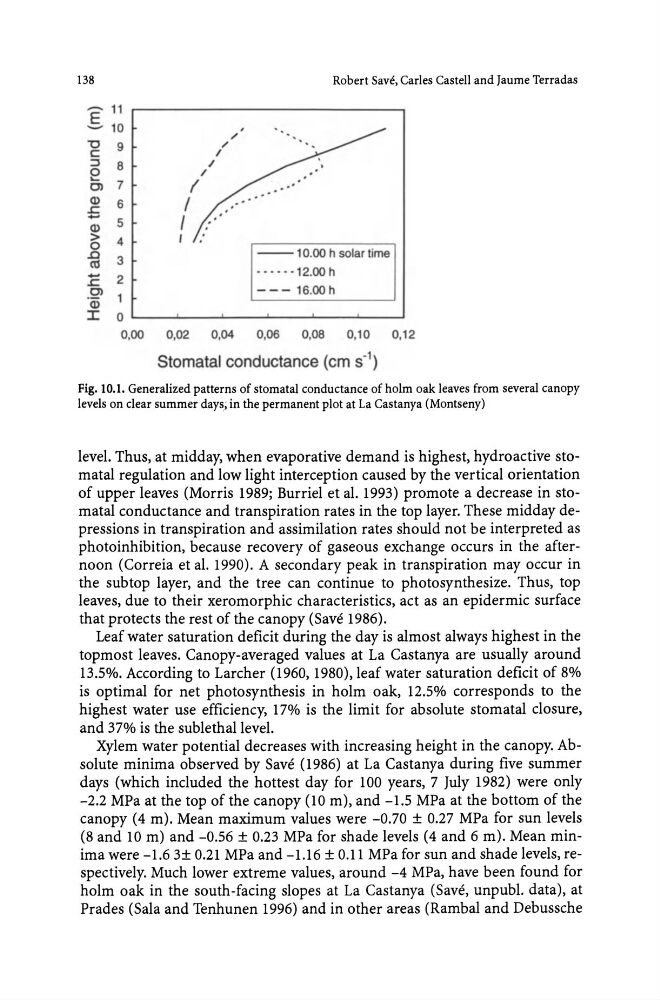
Fig, 10.1. Generalized patterns of stomatal conductance of holm oak leaves from several canopy
levels on clear summer day~; in the permanent plot at La Castanya (Montseny)
level. Thus, at midday, when evaporative demand is highest, hydro active stomatal regulation and low light interception caused by the vertical orientation
of upper leaves (Morris 1989; Burriel et al. 1993) promote a decrease in stomatal conductance and transpiration rates in the top layer. These midday depressions in transpiration and assimilation rates should not be interpreted as
photoinhibition, because recovery of gaseous exchange occurs in the afternoon (Correia et al. 1990). A secondary peak in transpiration may occur in
the sub top layer, and the tree can continue to photosynthesize. Thus, top
leaves, due to their xeromorphic characteristics, act as an epidermic surface
that protects the rest of the canopy (Save 1986).
Leaf water saturation deficit during the day is almost always highest in the
topmost leaves. Canopy-averaged values at La Castanya are usually around
13.5%. According to Larcher (1960,1980), leaf water saturation deficit of 8%
is optimal for net photosynthesis in holm oak, 12.5% corresponds to the
highest water use efficiency, 17% is the limit for absolute stomatal closure,
and 37% is the sublethal level.
Xylem water potential decreases with increasing height in the canopy. Absolute minima observed by Save (1986) at La Castanya during five summer
days (which included the hottest day for 100 years, 7 July 1982) were only
-2.2 MPa at the top of the canopy (10 m), and -1.5 MPa at the bottom of the
canopy (4 m). Mean maximum values were -0.70 ± 0.27 MPa for sun levels
(8 and 10 m) and -0.56 ± 0.23 MPa for shade levels (4 and 6 m). Mean minima were -1.6 3± 0.21 MPa and -1.16 ± 0.11 MPa for sun and shade levels, respectively. Much lower extreme values, around -4 MPa, have been found for
holm oak in the south-facing slopes at La Castanya (Save, unpubl. data), at
Prades (Sala and Tenhunen 1996) and in other areas (Rambal and Debussche
-
11
E
--10
"0 9
c:
:::J
8
0
'7
C)
Q)
6
.c
- 5
Q)
> 4
0
.0
3
ctl
- 2
.c
C)
'(j)
I
0
0,00
/
/
.I
Robert Save, Carles Castell and Jaume Terradas
,
I
.'
f
I
- - 1 0.00 h solar time
..... ·12.00 h
- - - 16.00 h
0,02
0,04
0,06
0,08
0,10
0,12
Stomatal conductance (cm 5. 1 )
Fig, 10.1. Generalized patterns of stomatal conductance of holm oak leaves from several canopy
levels on clear summer day~; in the permanent plot at La Castanya (Montseny)
level. Thus, at midday, when evaporative demand is highest, hydro active stomatal regulation and low light interception caused by the vertical orientation
of upper leaves (Morris 1989; Burriel et al. 1993) promote a decrease in stomatal conductance and transpiration rates in the top layer. These midday depressions in transpiration and assimilation rates should not be interpreted as
photoinhibition, because recovery of gaseous exchange occurs in the afternoon (Correia et al. 1990). A secondary peak in transpiration may occur in
the sub top layer, and the tree can continue to photosynthesize. Thus, top
leaves, due to their xeromorphic characteristics, act as an epidermic surface
that protects the rest of the canopy (Save 1986).
Leaf water saturation deficit during the day is almost always highest in the
topmost leaves. Canopy-averaged values at La Castanya are usually around
13.5%. According to Larcher (1960,1980), leaf water saturation deficit of 8%
is optimal for net photosynthesis in holm oak, 12.5% corresponds to the
highest water use efficiency, 17% is the limit for absolute stomatal closure,
and 37% is the sublethal level.
Xylem water potential decreases with increasing height in the canopy. Absolute minima observed by Save (1986) at La Castanya during five summer
days (which included the hottest day for 100 years, 7 July 1982) were only
-2.2 MPa at the top of the canopy (10 m), and -1.5 MPa at the bottom of the
canopy (4 m). Mean maximum values were -0.70 ± 0.27 MPa for sun levels
(8 and 10 m) and -0.56 ± 0.23 MPa for shade levels (4 and 6 m). Mean minima were -1.6 3± 0.21 MPa and -1.16 ± 0.11 MPa for sun and shade levels, respectively. Much lower extreme values, around -4 MPa, have been found for
holm oak in the south-facing slopes at La Castanya (Save, unpubl. data), at
Prades (Sala and Tenhunen 1996) and in other areas (Rambal and Debussche