

Seedling Recruitment
97
1 year after the fire were very large seedlings (Fig. 7.4A). This would seem to
indicate that the survival of holm oak individuals following a fire, as that of
other Mediterranean resprouting species (Moreno and Oechel 1994), is
strongly related to plant size before the fire. Mortality resulting from thinning in the eight sampled plots of the Montseny massif was considerably lower.
Seedling density fell from 83819 to 51 805 seedlings ha- 1 (a 38.2% fall in density). Seedlings of all sizes were affected by thinning (Fig. 7.4B), although the
mortality of small seedlings was greater than that of larger seedlings.
The specific features of each disturbance type also affect the establishment
of new seedlings following the event. Thus, the long-term consequences of
fire are more damaging than those of thinning. Acorn survival and germination after fire are both unlikely because uncovered acorns are sensitive to dehydration and destruction by heat. Thus, the arrival of acorns and the establishment of new seedlings in burned stands (other than the episodic dispersal of acorns by animals in areas adjacent to the unburned area) are delayed
until new resprouts reac~ the reproductive age, which can be anywhere between 4 and 8 years (pers. obs.). In contrast, harvesting preserves, at least
when it is carried out by selection thinning, nearly one third of uncut trees
(ca. 1000 stems ha- 1 ; Retana et al. 1992). Thus, an immediately abundant seed
source can be expected in such thinned stands.
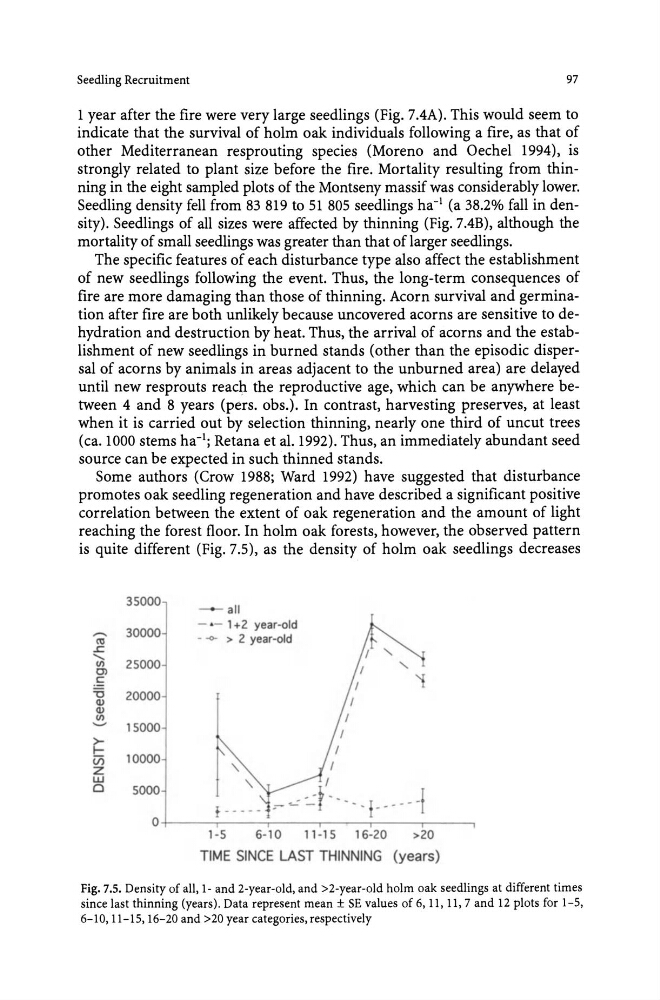
Some authors (Crow 1988; Ward 1992) have suggested that disturbance
promotes oak seedling regeneration and have described a significant positive
correlation between the extent of oak regeneration and the amount of light
reaching the forest floor. In holm oak forests, however, the observed pattern
is quite different (Fig. 7.5), as the density of holm oak seedlings decreases
35000
all
....... 30000
IV
- .- 1 +2 year-old
- -0- > 2 year-old
.s::.
.......
25000
(/)
01
.5
=c 20000
Q)
Q)
(/)
'-'
15000
~ 10000
V>
Z
w
0
5000
I
__ -t...
-f
;--"- - f
...... _ ..... -0
1-5
6-10
11 -1516-20
>20
TIME SINCE LAST THINNING (years)
Fig. 7.5. Density of all, 1- and 2-year-old, and >2-year-old holm oak seedlings at different times
since last thinning (years). Data represent mean ± SE values of 6,11,11,7 and 12 plots for 1-5,
6-10,11 - 15,16-20 and >20 year categories, respectively
97
1 year after the fire were very large seedlings (Fig. 7.4A). This would seem to
indicate that the survival of holm oak individuals following a fire, as that of
other Mediterranean resprouting species (Moreno and Oechel 1994), is
strongly related to plant size before the fire. Mortality resulting from thinning in the eight sampled plots of the Montseny massif was considerably lower.
Seedling density fell from 83819 to 51 805 seedlings ha- 1 (a 38.2% fall in density). Seedlings of all sizes were affected by thinning (Fig. 7.4B), although the
mortality of small seedlings was greater than that of larger seedlings.
The specific features of each disturbance type also affect the establishment
of new seedlings following the event. Thus, the long-term consequences of
fire are more damaging than those of thinning. Acorn survival and germination after fire are both unlikely because uncovered acorns are sensitive to dehydration and destruction by heat. Thus, the arrival of acorns and the establishment of new seedlings in burned stands (other than the episodic dispersal of acorns by animals in areas adjacent to the unburned area) are delayed
until new resprouts reac~ the reproductive age, which can be anywhere between 4 and 8 years (pers. obs.). In contrast, harvesting preserves, at least
when it is carried out by selection thinning, nearly one third of uncut trees
(ca. 1000 stems ha- 1 ; Retana et al. 1992). Thus, an immediately abundant seed
source can be expected in such thinned stands.
Some authors (Crow 1988; Ward 1992) have suggested that disturbance
promotes oak seedling regeneration and have described a significant positive
correlation between the extent of oak regeneration and the amount of light
reaching the forest floor. In holm oak forests, however, the observed pattern
is quite different (Fig. 7.5), as the density of holm oak seedlings decreases
35000
all
....... 30000
IV
- .- 1 +2 year-old
- -0- > 2 year-old
.s::.
.......
25000
(/)
01
.5
=c 20000
Q)
Q)
(/)
'-'
15000
~ 10000
V>
Z
w
0
5000
I
__ -t...
-f
;--"- - f
...... _ ..... -0
1-5
6-10
11 -1516-20
>20
TIME SINCE LAST THINNING (years)
Fig. 7.5. Density of all, 1- and 2-year-old, and >2-year-old holm oak seedlings at different times
since last thinning (years). Data represent mean ± SE values of 6,11,11,7 and 12 plots for 1-5,
6-10,11 - 15,16-20 and >20 year categories, respectively