

92
Javier Retana, Josep Maria EspeJta, Marc Gracia and Miquel Riba
LIGiT ("10 PAR)
80
60
36
16
8
850
700
WATER 550
(mm'yr)
400
250
• •
• •
•
• 0-25% SJrvival
• 25-50 % SJrvival
50-75% SJrvlvaJ
50-100 % SJrvival
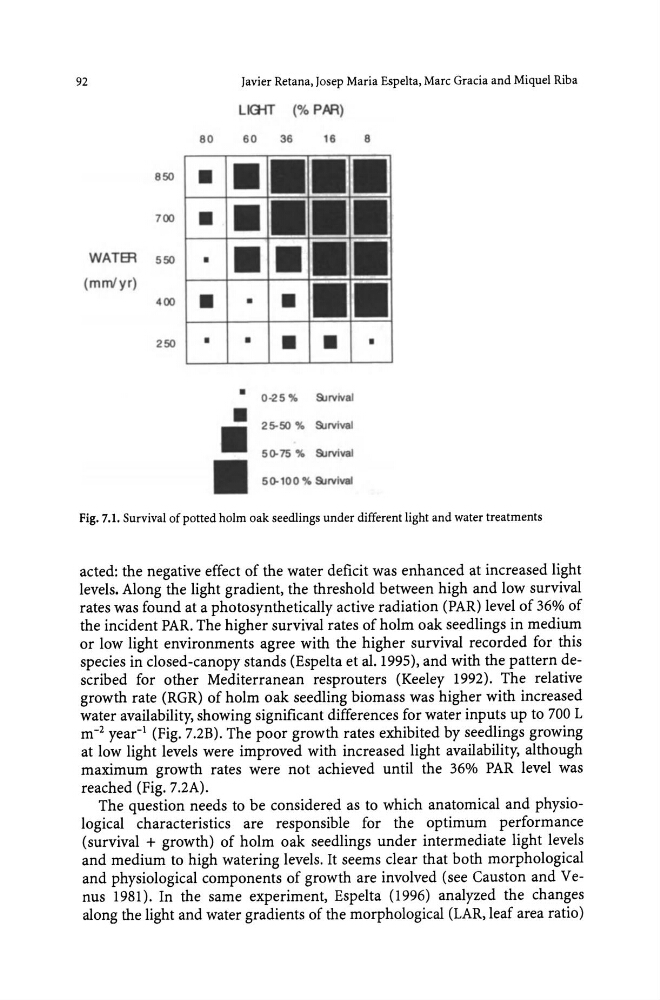
Fig. 7.1. Survival of potted holm oak seedlings under different light and water treatments
acted: the negative effect of the water deficit was enhanced at increased light
levels. Along the light gradient, the threshold between high and low survival
rates was found at a photosynthetically active radiation (PAR) level of 36% of
the incident PAR. The higher survival rates of holm oak seedlings in medium
or low light environments agree with the higher survival recorded for this
species in closed-canopy stands (Espelta et al.1995), and with the pattern described for other Mediterranean resprouters (Keeley 1992). The relative
growth rate (RGR) of holm oak seedling biomass was higher with increased
water availability, showing significant differences for water inputs up to 700 L
m- 2 year- 1 (Fig. 7.2B). The poor growth rates exhibited by seedlings growing
at low light levels were improved with increased light availability, although
maximum growth rates were not achieved until the 36% PAR level was
reached (Fig. 7.2A).
The question needs to be considered as to which anatomical and physiological characteristics are responsible for the optimum performance
(survival + growth) of holm oak seedlings under intermediate light levels
and medium to high watering levels. It seems clear that both morphological
and physiological components of growth are involved (see Causton and Venus 1981). In the same experiment, Espelta (1996) analyzed the changes
along the light and water gradients of the morphological (LAR, leaf area ratio)
Javier Retana, Josep Maria EspeJta, Marc Gracia and Miquel Riba
LIGiT ("10 PAR)
80
60
36
16
8
850
700
WATER 550
(mm'yr)
400
250
• •
• •
•
• 0-25% SJrvival
• 25-50 % SJrvival
50-75% SJrvlvaJ
50-100 % SJrvival
Fig. 7.1. Survival of potted holm oak seedlings under different light and water treatments
acted: the negative effect of the water deficit was enhanced at increased light
levels. Along the light gradient, the threshold between high and low survival
rates was found at a photosynthetically active radiation (PAR) level of 36% of
the incident PAR. The higher survival rates of holm oak seedlings in medium
or low light environments agree with the higher survival recorded for this
species in closed-canopy stands (Espelta et al.1995), and with the pattern described for other Mediterranean resprouters (Keeley 1992). The relative
growth rate (RGR) of holm oak seedling biomass was higher with increased
water availability, showing significant differences for water inputs up to 700 L
m- 2 year- 1 (Fig. 7.2B). The poor growth rates exhibited by seedlings growing
at low light levels were improved with increased light availability, although
maximum growth rates were not achieved until the 36% PAR level was
reached (Fig. 7.2A).
The question needs to be considered as to which anatomical and physiological characteristics are responsible for the optimum performance
(survival + growth) of holm oak seedlings under intermediate light levels
and medium to high watering levels. It seems clear that both morphological
and physiological components of growth are involved (see Causton and Venus 1981). In the same experiment, Espelta (1996) analyzed the changes
along the light and water gradients of the morphological (LAR, leaf area ratio)