

47
drainage basin occupies the same biome.
However, pine forest exists in the other basins too
(Pindar, Mandakini and Bhagirathi), but the characteristic taxa are different, probably due to differences in the water characteristics, thus
emphasising the role of proximate factors.
Role of Environmental Variables
Based on the above discussion, it is apparent that
the stations/streams/basins are similar in taxonomic composition despite the latitudinal, foresttype and land-use-type variations within the
mountain biome. Among the array of variables,
slope, forest type, stream order and land use,
slope ( p ≤ 0.042, F 2.2) and forest type ( p ≤ 0.524,
F 0.77) emerge as the main environmental factors
that cause 66.67 % and 33.33 % variation in the
taxonomic composition, respectively. On removing stream order from the analysis, similar results
are obtained. But on removing both (stream order
and slope) from the analysis, land use ( p ≤ 0.652,
F 0.7) emerged as the main environmental factor
causing 100 % variation in the taxonomic composition. These environmental variables are
hence important to distribution of the benthic
macroinvertebrate community in the river basins
of Uttarakhand. The taxa Philopotamidae,
Limnephilidae,
Leptoceridae,
Baetidae,
Perlodidae and Leptophlebiidae are associated
with the slope, while Ephemerellidae and
Coleoptera are associated with the forest type
(Fig. 4.9 ). The taxa associated with the slope are
mainly families of Trichoptera. Ephemerellidae
is related to the pine forest, while Coleoptera to
oak–deodar–fi r forest.
Slope is observed to be an important environmental variable infl uencing taxonomic composition and distribution of caddisfl y with case
(Limnephilidae, Leptoceridae, Philopotamidae)
along with mayfl y (Leptophlebiidae, Baetidae)
and stonefl y (Perlodidae). As slope is a manifestation of altitude, it indirectly indicates the role of
altitude and hence the forest. Land use is an
important factor as it indicates stress due to
human activity. The macroinvertebrate fauna differed signifi cantly among the rivers within biome
due to different land use (Corkum 1991 ; Rundle
et al. 1993 ; Ormerod et al. 1994 ). The assemblages of benthic macroinvertebrate taxa are
affected by current velocity, water conductivity
and substrate size (Miserendino 2001 ), pH and
hardness (Ormerod and Edwards 1987 ).
−1.5
+
1.5
−1.5
1.0
hp
ba
ep
lp
ca
sp
hy
ph
ps
rh
gl
lpc
lm
br
bl
cr
si
dx
pr
po
sa
co
py
dr el
go
ag
hm
pl
ly
lep
Alkanada
Mandakini
Bhagirathi
Yamuna
Ramganga
Pindar
Axis 2
Axis 1
−
−
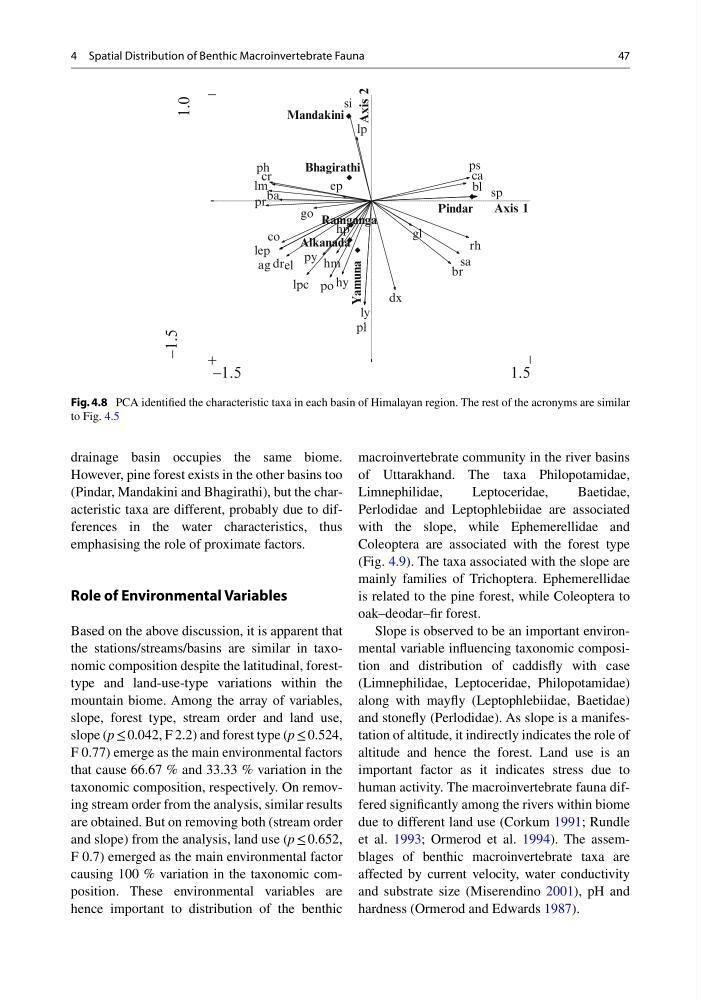
Fig. 4.8 PCA identifi ed the characteristic taxa in each basin of Himalayan region. The rest of the acronyms are similar
to Fig. 4.5
4 Spatial Distribution of Benthic Macroinvertebrate Fauna
drainage basin occupies the same biome.
However, pine forest exists in the other basins too
(Pindar, Mandakini and Bhagirathi), but the characteristic taxa are different, probably due to differences in the water characteristics, thus
emphasising the role of proximate factors.
Role of Environmental Variables
Based on the above discussion, it is apparent that
the stations/streams/basins are similar in taxonomic composition despite the latitudinal, foresttype and land-use-type variations within the
mountain biome. Among the array of variables,
slope, forest type, stream order and land use,
slope ( p ≤ 0.042, F 2.2) and forest type ( p ≤ 0.524,
F 0.77) emerge as the main environmental factors
that cause 66.67 % and 33.33 % variation in the
taxonomic composition, respectively. On removing stream order from the analysis, similar results
are obtained. But on removing both (stream order
and slope) from the analysis, land use ( p ≤ 0.652,
F 0.7) emerged as the main environmental factor
causing 100 % variation in the taxonomic composition. These environmental variables are
hence important to distribution of the benthic
macroinvertebrate community in the river basins
of Uttarakhand. The taxa Philopotamidae,
Limnephilidae,
Leptoceridae,
Baetidae,
Perlodidae and Leptophlebiidae are associated
with the slope, while Ephemerellidae and
Coleoptera are associated with the forest type
(Fig. 4.9 ). The taxa associated with the slope are
mainly families of Trichoptera. Ephemerellidae
is related to the pine forest, while Coleoptera to
oak–deodar–fi r forest.
Slope is observed to be an important environmental variable infl uencing taxonomic composition and distribution of caddisfl y with case
(Limnephilidae, Leptoceridae, Philopotamidae)
along with mayfl y (Leptophlebiidae, Baetidae)
and stonefl y (Perlodidae). As slope is a manifestation of altitude, it indirectly indicates the role of
altitude and hence the forest. Land use is an
important factor as it indicates stress due to
human activity. The macroinvertebrate fauna differed signifi cantly among the rivers within biome
due to different land use (Corkum 1991 ; Rundle
et al. 1993 ; Ormerod et al. 1994 ). The assemblages of benthic macroinvertebrate taxa are
affected by current velocity, water conductivity
and substrate size (Miserendino 2001 ), pH and
hardness (Ormerod and Edwards 1987 ).
−1.5
+
1.5
−1.5
1.0
hp
ba
ep
lp
ca
sp
hy
ph
ps
rh
gl
lpc
lm
br
bl
cr
si
dx
pr
po
sa
co
py
dr el
go
ag
hm
pl
ly
lep
Alkanada
Mandakini
Bhagirathi
Yamuna
Ramganga
Pindar
Axis 2
Axis 1
−
−
Fig. 4.8 PCA identifi ed the characteristic taxa in each basin of Himalayan region. The rest of the acronyms are similar
to Fig. 4.5
4 Spatial Distribution of Benthic Macroinvertebrate Fauna