

331
Table 19.19 Catches of different species fi shes and their
wetland distributions
Group and species
Catch
(%)
Wetland
distribution
Major
Labeo rohita
17
Mid column
Cirrhinus mrigala
8
Bottom
Catla catla
7
Surface
Hypophthalmichthys molitrix
5
Surface
Cyprinus carpio
5
Bottom
Ctenopharyngodon idella
8
Spatial
Channa marulius
3
Spatial
Notopterus chitala
2
Spatial
Intermediate
Notopterus notopterus
6
Spatial
Ompok pabo
1
Spatial
Xenentodon cancila
2
Surface and
peripheral
Clarias batrachus
9
Bottom
Channa punctatus
7
Surface and
peripheral
Minor
Puntius sophore
7
Surface and
littoral
Puntius conchonius
4
Surface and
littoral
Chanda nama
1
Littoral and
bottom
Chanda ranga
1
Surface and
littoral
Mystus vittatus
5
Spatial
Non-piscean
Macrobrachium spp .
2
Bottom and
mixed
Mesocyclops leuckarty, Mesocyclops hyalinus,
Neodiaptomus sp ., Nauplius ( calanoid ) ,
Nauplius ( cyclopoid )
Cladocera
Moina brachiata, Diaphanosoma sp ., Alona affi -
nis, Bosmina longirostris
Macrophy tes : 2.1–7.2 (×̅ .4.65) kg/m
2
Category and Types
Submerged:
Vallisneria spiralis, Niasindica, Hydrilla verticillata, Trapa bispinosa
Floating Leaved:
Euryale ferox, Hygrorhiza sp .
Emergent:
Alpinia sp ., Alocasia sp .
Floating:
Pistia sp ., E. crassipes, Salvinia sp .
Fishes
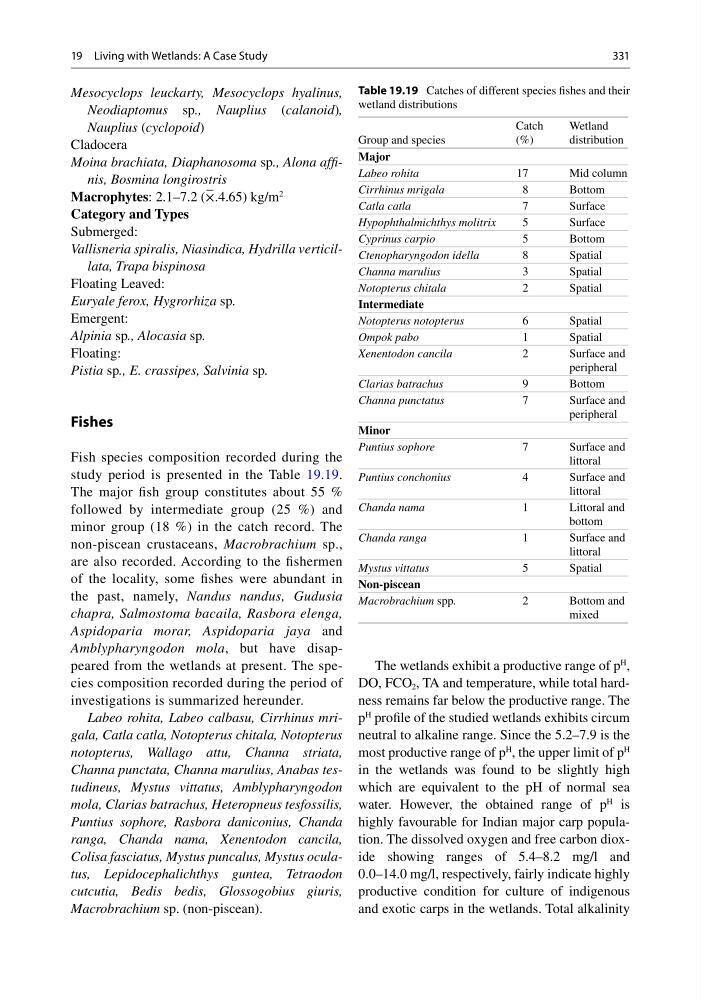
Fish species composition recorded during the
study period is presented in the Table 19.19 .
The major fi sh group constitutes about 55 %
followed by intermediate group (25 %) and
minor group (18 %) in the catch record. The
non-piscean crustaceans, Macrobrachium sp.,
are also recorded. According to the fi shermen
of the locality, some fi shes were abundant in
the past, namely, Nandus nandus, Gudusia
chapra, Salmostoma bacaila, Rasbora elenga,
Aspidoparia morar, Aspidoparia jaya and
Amblypharyngodon mola , but have disappeared from the wetlands at present. The species composition recorded during the period of
investigations is summarized hereunder.
Labeo rohita, Labeo calbasu, Cirrhinus mrigala, Catla catla, Notopterus chitala, Notopterus
notopterus, Wallago attu, Channa striata,
Channa punctata, Channa marulius, Anabas testudineus, Mystus vittatus, Amblypharyngodon
mola, Clarias batrachus, Heteropneus tesfossilis,
Puntius sophore, Rasbora daniconius, Chanda
ranga, Chanda nama, Xenentodon cancila,
Colisa fasciatus, Mystus puncalus, Mystus oculatus, Lepidocephalichthys guntea, Tetraodon
cutcutia, Bedis bedis, Glossogobius giuris,
Macrobrachium sp. (non-piscean).
The wetlands exhibit a productive range of p
H
,
DO, FCO 2 , TA and temperature, while total hardness remains far below the productive range. The
p
H profi le of the studied wetlands exhibits circum
neutral to alkaline range. Since the 5.2–7.9 is the
most productive range of p
H
, the upper limit of p
H
in the wetlands was found to be slightly high
which are equivalent to the pH of normal sea
water. However, the obtained range of p
H is
highly favourable for Indian major carp population. The dissolved oxygen and free carbon dioxide showing ranges of 5.4–8.2 mg/l and
0.0–14.0 mg/l, respectively, fairly indicate highly
productive condition for culture of indigenous
and exotic carps in the wetlands. Total alkalinity
19 Living with Wetlands: A Case Study
Table 19.19 Catches of different species fi shes and their
wetland distributions
Group and species
Catch
(%)
Wetland
distribution
Major
Labeo rohita
17
Mid column
Cirrhinus mrigala
8
Bottom
Catla catla
7
Surface
Hypophthalmichthys molitrix
5
Surface
Cyprinus carpio
5
Bottom
Ctenopharyngodon idella
8
Spatial
Channa marulius
3
Spatial
Notopterus chitala
2
Spatial
Intermediate
Notopterus notopterus
6
Spatial
Ompok pabo
1
Spatial
Xenentodon cancila
2
Surface and
peripheral
Clarias batrachus
9
Bottom
Channa punctatus
7
Surface and
peripheral
Minor
Puntius sophore
7
Surface and
littoral
Puntius conchonius
4
Surface and
littoral
Chanda nama
1
Littoral and
bottom
Chanda ranga
1
Surface and
littoral
Mystus vittatus
5
Spatial
Non-piscean
Macrobrachium spp .
2
Bottom and
mixed
Mesocyclops leuckarty, Mesocyclops hyalinus,
Neodiaptomus sp ., Nauplius ( calanoid ) ,
Nauplius ( cyclopoid )
Cladocera
Moina brachiata, Diaphanosoma sp ., Alona affi -
nis, Bosmina longirostris
Macrophy tes : 2.1–7.2 (×̅ .4.65) kg/m
2
Category and Types
Submerged:
Vallisneria spiralis, Niasindica, Hydrilla verticillata, Trapa bispinosa
Floating Leaved:
Euryale ferox, Hygrorhiza sp .
Emergent:
Alpinia sp ., Alocasia sp .
Floating:
Pistia sp ., E. crassipes, Salvinia sp .
Fishes
Fish species composition recorded during the
study period is presented in the Table 19.19 .
The major fi sh group constitutes about 55 %
followed by intermediate group (25 %) and
minor group (18 %) in the catch record. The
non-piscean crustaceans, Macrobrachium sp.,
are also recorded. According to the fi shermen
of the locality, some fi shes were abundant in
the past, namely, Nandus nandus, Gudusia
chapra, Salmostoma bacaila, Rasbora elenga,
Aspidoparia morar, Aspidoparia jaya and
Amblypharyngodon mola , but have disappeared from the wetlands at present. The species composition recorded during the period of
investigations is summarized hereunder.
Labeo rohita, Labeo calbasu, Cirrhinus mrigala, Catla catla, Notopterus chitala, Notopterus
notopterus, Wallago attu, Channa striata,
Channa punctata, Channa marulius, Anabas testudineus, Mystus vittatus, Amblypharyngodon
mola, Clarias batrachus, Heteropneus tesfossilis,
Puntius sophore, Rasbora daniconius, Chanda
ranga, Chanda nama, Xenentodon cancila,
Colisa fasciatus, Mystus puncalus, Mystus oculatus, Lepidocephalichthys guntea, Tetraodon
cutcutia, Bedis bedis, Glossogobius giuris,
Macrobrachium sp. (non-piscean).
The wetlands exhibit a productive range of p
H
,
DO, FCO 2 , TA and temperature, while total hardness remains far below the productive range. The
p
H profi le of the studied wetlands exhibits circum
neutral to alkaline range. Since the 5.2–7.9 is the
most productive range of p
H
, the upper limit of p
H
in the wetlands was found to be slightly high
which are equivalent to the pH of normal sea
water. However, the obtained range of p
H is
highly favourable for Indian major carp population. The dissolved oxygen and free carbon dioxide showing ranges of 5.4–8.2 mg/l and
0.0–14.0 mg/l, respectively, fairly indicate highly
productive condition for culture of indigenous
and exotic carps in the wetlands. Total alkalinity
19 Living with Wetlands: A Case Study