

18
lake is made of marble and is in between two
mountains. It is 1,000 ft long at a height of 95 ft.
Behind this another water reservoir at the same
height was constructed which according to Dr.
O.J. Ojha remained empty for about 184 years.
In the year 1875, being afraid of heavy rainfall,
Maharana Sajjan Singh spent Rs. 2 lakh to fi ll
the two third gap in between the two dams; the
remaining work was completed afterwards (Raju
et al. 2004 ). Jaisamand is the world-famous artifi cial lake. Its catchment area is 1,813 km
2 and
gross capacity is 414.60 mcm followed by dead
and live capacity of 118.46 mcm and
296.14 mcm, respectively. Its water is used for
supplying drinking water to Udaipur and also for
irrigation. All these water bodies stand endangered today because of their misuse.
Baovries of Udaipur City
There are 121 baovries in Udaipur out of which
83 have dried up (Goswami and Mathur 2000 ).
Most of these baovries are situated in the Sajjan
Niwas Garden area. Maximum load was recorded
on Sarvaritu vilas Baovri and lowest was on the
Chowk Wali Baovri. The other baovries of
Udaipur are Sagasji Ki Baovri, Tarkari Wali
Baovri, Garden Wali Baovri, Nalaka, Chhatriwali,
Jalijiwali,
Maji,
Ayurvedic
Hospital,
Satyanarayan, Toranwali and Om Prakashji Ki
Baovri, Customwali, Ramdas Colony, Dore
Nagar , Goverdhan Vilas, Phoolji, Jethji, Maliwali,
Bhanbagh, Kalanwali, Khilonawali, Delhi Gate
and Maszidiji Baovri.
Underground Water Sources
of Udaipur City
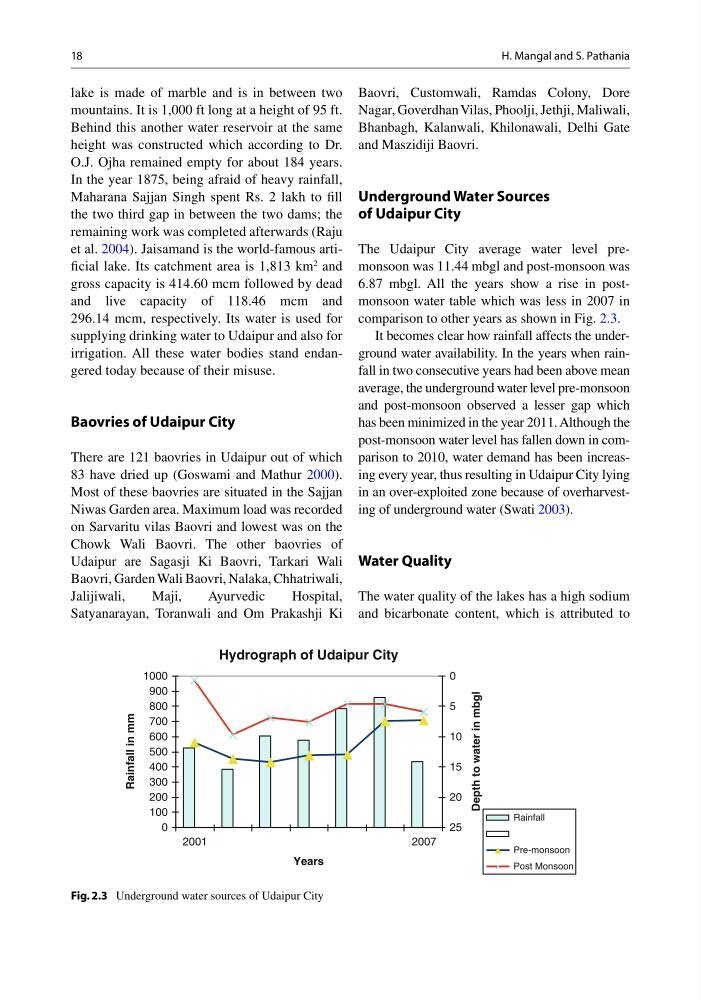
The Udaipur City average water level premonsoon was 11.44 mbgl and post-monsoon was
6.87 mbgl. All the years show a rise in postmonsoon water table which was less in 2007 in
comparison to other years as shown in Fig. 2.3 .
It becomes clear how rainfall affects the underground water availability. In the years when rainfall in two consecutive years had been above mean
average, the underground water level pre- monsoon
and post-monsoon observed a lesser gap which
has been minimized in the year 2011. Although the
post-monsoon water level has fallen down in comparison to 2010, water demand has been increasing every year, thus resulting in Udaipur City lying
in an over-exploited zone because of overharvesting of underground water (Swati 2003 ).
Water Quality
The water quality of the lakes has a high sodium
and bicarbonate content, which is attributed to
Hydrograph of Udaipur City
0
100
200
300
400
500
600
700
800
900
1000
2001
2007
Years
Rainfall in mm
0
5
10
15
20
25
Depth to water in mbgl
Rainfall
Pre-monsoon
Post Monsoon
Fig. 2.3 Underground water sources of Udaipur City
H. Mangal and S. Pathania
lake is made of marble and is in between two
mountains. It is 1,000 ft long at a height of 95 ft.
Behind this another water reservoir at the same
height was constructed which according to Dr.
O.J. Ojha remained empty for about 184 years.
In the year 1875, being afraid of heavy rainfall,
Maharana Sajjan Singh spent Rs. 2 lakh to fi ll
the two third gap in between the two dams; the
remaining work was completed afterwards (Raju
et al. 2004 ). Jaisamand is the world-famous artifi cial lake. Its catchment area is 1,813 km
2 and
gross capacity is 414.60 mcm followed by dead
and live capacity of 118.46 mcm and
296.14 mcm, respectively. Its water is used for
supplying drinking water to Udaipur and also for
irrigation. All these water bodies stand endangered today because of their misuse.
Baovries of Udaipur City
There are 121 baovries in Udaipur out of which
83 have dried up (Goswami and Mathur 2000 ).
Most of these baovries are situated in the Sajjan
Niwas Garden area. Maximum load was recorded
on Sarvaritu vilas Baovri and lowest was on the
Chowk Wali Baovri. The other baovries of
Udaipur are Sagasji Ki Baovri, Tarkari Wali
Baovri, Garden Wali Baovri, Nalaka, Chhatriwali,
Jalijiwali,
Maji,
Ayurvedic
Hospital,
Satyanarayan, Toranwali and Om Prakashji Ki
Baovri, Customwali, Ramdas Colony, Dore
Nagar , Goverdhan Vilas, Phoolji, Jethji, Maliwali,
Bhanbagh, Kalanwali, Khilonawali, Delhi Gate
and Maszidiji Baovri.
Underground Water Sources
of Udaipur City
The Udaipur City average water level premonsoon was 11.44 mbgl and post-monsoon was
6.87 mbgl. All the years show a rise in postmonsoon water table which was less in 2007 in
comparison to other years as shown in Fig. 2.3 .
It becomes clear how rainfall affects the underground water availability. In the years when rainfall in two consecutive years had been above mean
average, the underground water level pre- monsoon
and post-monsoon observed a lesser gap which
has been minimized in the year 2011. Although the
post-monsoon water level has fallen down in comparison to 2010, water demand has been increasing every year, thus resulting in Udaipur City lying
in an over-exploited zone because of overharvesting of underground water (Swati 2003 ).
Water Quality
The water quality of the lakes has a high sodium
and bicarbonate content, which is attributed to
Hydrograph of Udaipur City
0
100
200
300
400
500
600
700
800
900
1000
2001
2007
Years
Rainfall in mm
0
5
10
15
20
25
Depth to water in mbgl
Rainfall
Pre-monsoon
Post Monsoon
Fig. 2.3 Underground water sources of Udaipur City
H. Mangal and S. Pathania