

284
have the specific knowledge of the growth pattern
of a freshwater teleost fish, Channa punctatus
(Bloch), inhabiting the polluted waters of
Hussainsagar lake, which is situated in between
the twin cities of Hyderabad and Secunderabad
in Andhra Pradesh, India.
Methods
The present study was conducted on nearly 200
specimens of Channa punctatus (Bloch) ranging
from 15 to 30 cm in length. For convenience the
fishes were divided into eight groups according
to their length. The fishes were collected from
five different stations of Hussainsagar lake using
a cast net. The fishes were then brought to the
laboratory where they were weighed after
soaking water with the help of a blotting paper.
Then the statistical relationship between length
and weight of fishes was established using the
following formula:
W aL
b
=
(
)
Lecren1951
where W = weight of the fish, L = length of the
fish,
a = constant, and b = regression coefficient.
The length–weight relationship is usually
expressed in its logarithmic form as
Log
L ecren
W
a b
L
=
+
(
)
log
log
.
1951
The correlation coefficient (r) was calculated by
using the following formula:
r
XY
=
⋅
∑
∑ ∑
X
Y
2
2
where X = log length and Y = log weight.
The condition factor (K) was determined by
using the following formula:
K =
×
W
L
100
3
where L = length in cm and W = weight in gm.
Results and Discussion
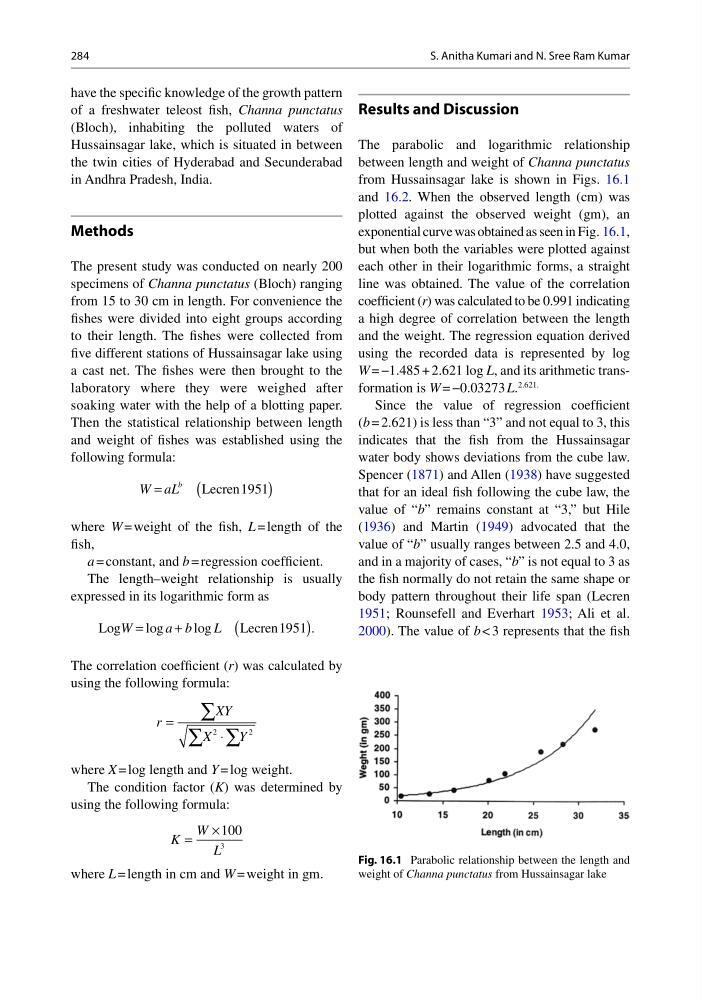
The parabolic and logarithmic relationship
between length and weight of Channa punctatus
from Hussainsagar lake is shown in Figs. 16.1
and 16.2. When the observed length (cm) was
plotted against the observed weight (gm), an
exponential curve was obtained as seen in Fig. 16.1,
but when both the variables were plotted against
each other in their logarithmic forms, a straight
line was obtained. The value of the correlation
coefficient (r) was calculated to be 0.991 indicating
a high degree of correlation between the length
and the weight. The regression equation derived
using the recorded data is represented by log
W = −1.485 + 2.621 log L, and its arithmetic transformation is W = −0.03273 L.
2.621.
Since the value of regression coefficient
(b = 2.621) is less than “3” and not equal to 3, this
indicates that the fish from the Hussainsagar
water body shows deviations from the cube law.
Spencer (1871) and Allen (1938) have suggested
that for an ideal fish following the cube law, the
value of “b” remains constant at “3,” but Hile
(1936) and Martin (1949) advocated that the
value of “b” usually ranges between 2.5 and 4.0,
and in a majority of cases, “b” is not equal to 3 as
the fish normally do not retain the same shape or
body pattern throughout their life span (Lecren
1951; Rounsefell and Everhart 1953; Ali et al.
2000). The value of b < 3 represents that the fish
Fig. 16.1 Parabolic relationship between the length and
weight of Channa punctatus from Hussainsagar lake
S. Anitha Kumari and N. Sree Ram Kumar
have the specific knowledge of the growth pattern
of a freshwater teleost fish, Channa punctatus
(Bloch), inhabiting the polluted waters of
Hussainsagar lake, which is situated in between
the twin cities of Hyderabad and Secunderabad
in Andhra Pradesh, India.
Methods
The present study was conducted on nearly 200
specimens of Channa punctatus (Bloch) ranging
from 15 to 30 cm in length. For convenience the
fishes were divided into eight groups according
to their length. The fishes were collected from
five different stations of Hussainsagar lake using
a cast net. The fishes were then brought to the
laboratory where they were weighed after
soaking water with the help of a blotting paper.
Then the statistical relationship between length
and weight of fishes was established using the
following formula:
W aL
b
=
(
)
Lecren1951
where W = weight of the fish, L = length of the
fish,
a = constant, and b = regression coefficient.
The length–weight relationship is usually
expressed in its logarithmic form as
Log
L ecren
W
a b
L
=
+
(
)
log
log
.
1951
The correlation coefficient (r) was calculated by
using the following formula:
r
XY
=
⋅
∑
∑ ∑
X
Y
2
2
where X = log length and Y = log weight.
The condition factor (K) was determined by
using the following formula:
K =
×
W
L
100
3
where L = length in cm and W = weight in gm.
Results and Discussion
The parabolic and logarithmic relationship
between length and weight of Channa punctatus
from Hussainsagar lake is shown in Figs. 16.1
and 16.2. When the observed length (cm) was
plotted against the observed weight (gm), an
exponential curve was obtained as seen in Fig. 16.1,
but when both the variables were plotted against
each other in their logarithmic forms, a straight
line was obtained. The value of the correlation
coefficient (r) was calculated to be 0.991 indicating
a high degree of correlation between the length
and the weight. The regression equation derived
using the recorded data is represented by log
W = −1.485 + 2.621 log L, and its arithmetic transformation is W = −0.03273 L.
2.621.
Since the value of regression coefficient
(b = 2.621) is less than “3” and not equal to 3, this
indicates that the fish from the Hussainsagar
water body shows deviations from the cube law.
Spencer (1871) and Allen (1938) have suggested
that for an ideal fish following the cube law, the
value of “b” remains constant at “3,” but Hile
(1936) and Martin (1949) advocated that the
value of “b” usually ranges between 2.5 and 4.0,
and in a majority of cases, “b” is not equal to 3 as
the fish normally do not retain the same shape or
body pattern throughout their life span (Lecren
1951; Rounsefell and Everhart 1953; Ali et al.
2000). The value of b < 3 represents that the fish
Fig. 16.1 Parabolic relationship between the length and
weight of Channa punctatus from Hussainsagar lake
S. Anitha Kumari and N. Sree Ram Kumar