

78
Inhibition
(short term)
Respiratory
control
(short term)
Growth and
related processes
Repression
(long term)
Induction
(long term)
Induction
(long term)
I.S. Amthor
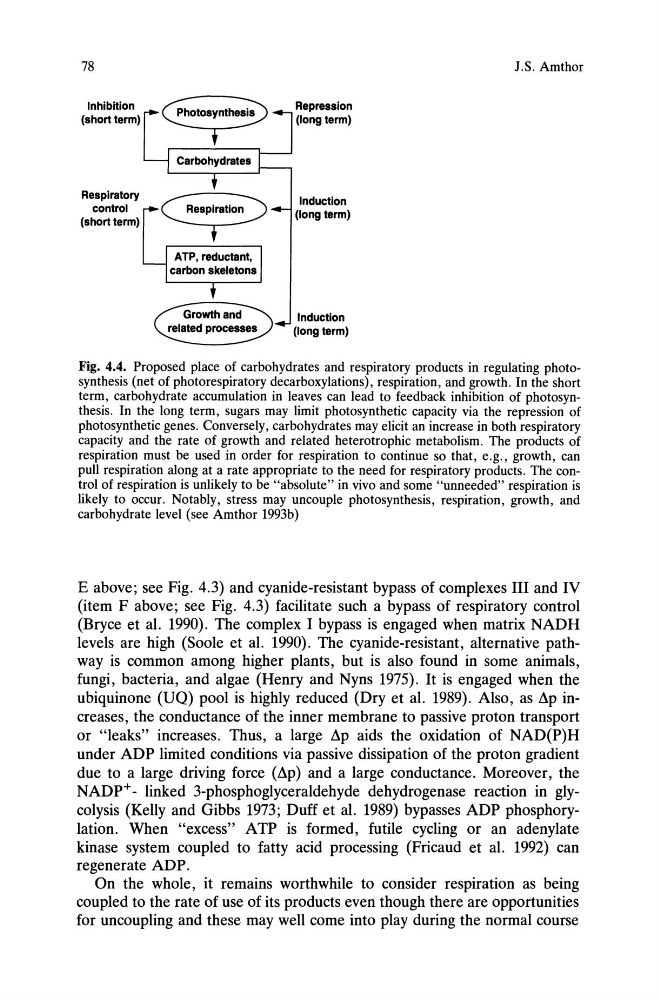
Fig. 4.4. Proposed place of carbohydrates and respiratory products in regulating photosynthesis (net of photorespiratory decarboxylations), respiration, and growth. In the short
term, carbohydrate accumulation in leaves can lead to feedback inhibition of photosynthesis. In the long term, sugars may limit photosynthetic capacity via the repression of
photosynthetic genes. Conversely, carbohydrates may elicit an increase in both respiratory
capacity and the rate of growth and related heterotrophic metabolism. The products of
respiration must be used in order for respiration to continue so that, e.g., growth, can
pull respiration along at a rate appropriate to the need for respiratory products. The control of respiration is unlikely to be "absolute" in vivo and some "unneeded" respiration is
likely to occur. Notably, stress may uncouple photosynthesis, respiration, growth, and
carbohydrate level (see Amthor 1993b)
E above; see Fig. 4.3) and cyanide-resistant bypass of complexes III and IV
(item F above; see Fig. 4.3) facilitate such a bypass of respiratory control
(Bryce et al. 1990). The complex I bypass is engaged when matrix NADH
levels are high (SooIe et al. 1990). The cyanide-resistant, alternative pathway is common among higher plants, but is also found in some animals,
fungi, bacteria, and algae (Henry and Nyns 1975). It is engaged when the
ubiquinone (UO) pool is highly reduced (Dry et al. 1989). Also, as Llp increases, the conductance of the inner membrane to passive proton transport
or "leaks" increases. Thus, a large Llp aids the oxidation of NAD(P)H
under ADP limited conditions via passive dissipation of the proton gradient
due to a large driving force (Llp) and a large conductance. Moreover, the
NADP+ - linked 3-phosphoglyceraldehyde dehydrogenase reaction in glycolysis (Kelly and Gibbs 1973; Duff et al. 1989) bypasses ADP phosphorylation. When "excess" ATP is formed, futile cycling or an adenylate
kinase system coupled to fatty acid processing (Fricaud et al. 1992) can
regenerate ADP.
On the whole, it remains worthwhile to consider respiration as being
coupled to the rate of use of its products even though there are opportunities
for uncoupling and these may well come into play during the normal course
Inhibition
(short term)
Respiratory
control
(short term)
Growth and
related processes
Repression
(long term)
Induction
(long term)
Induction
(long term)
I.S. Amthor
Fig. 4.4. Proposed place of carbohydrates and respiratory products in regulating photosynthesis (net of photorespiratory decarboxylations), respiration, and growth. In the short
term, carbohydrate accumulation in leaves can lead to feedback inhibition of photosynthesis. In the long term, sugars may limit photosynthetic capacity via the repression of
photosynthetic genes. Conversely, carbohydrates may elicit an increase in both respiratory
capacity and the rate of growth and related heterotrophic metabolism. The products of
respiration must be used in order for respiration to continue so that, e.g., growth, can
pull respiration along at a rate appropriate to the need for respiratory products. The control of respiration is unlikely to be "absolute" in vivo and some "unneeded" respiration is
likely to occur. Notably, stress may uncouple photosynthesis, respiration, growth, and
carbohydrate level (see Amthor 1993b)
E above; see Fig. 4.3) and cyanide-resistant bypass of complexes III and IV
(item F above; see Fig. 4.3) facilitate such a bypass of respiratory control
(Bryce et al. 1990). The complex I bypass is engaged when matrix NADH
levels are high (SooIe et al. 1990). The cyanide-resistant, alternative pathway is common among higher plants, but is also found in some animals,
fungi, bacteria, and algae (Henry and Nyns 1975). It is engaged when the
ubiquinone (UO) pool is highly reduced (Dry et al. 1989). Also, as Llp increases, the conductance of the inner membrane to passive proton transport
or "leaks" increases. Thus, a large Llp aids the oxidation of NAD(P)H
under ADP limited conditions via passive dissipation of the proton gradient
due to a large driving force (Llp) and a large conductance. Moreover, the
NADP+ - linked 3-phosphoglyceraldehyde dehydrogenase reaction in glycolysis (Kelly and Gibbs 1973; Duff et al. 1989) bypasses ADP phosphorylation. When "excess" ATP is formed, futile cycling or an adenylate
kinase system coupled to fatty acid processing (Fricaud et al. 1992) can
regenerate ADP.
On the whole, it remains worthwhile to consider respiration as being
coupled to the rate of use of its products even though there are opportunities
for uncoupling and these may well come into play during the normal course