

74
l.S. Amthor
prevalent features of respiration during evolution (Chapman and Ragan
1980). The reactions and structures of respiration evolved under a wide
range of environmental and biological conditions, often building upon
metabolism and structures already in place. Glycolysis is "the most universal
of metabolic pathways" (Prosser 1986) and developed early in the evolution
of life. Parts of the TCA cycle (anaerobic, reductive, perhaps lacking aketoglutarate dehydrogenase) and the oxidative pentose phosphate network
arose later. The photosynthetic carbon reduction cycle probably followed
this, but due to the extensive oxidation of iron and other metals, it was some
time before O2 released by photosynthetic light reactions accumulated in the
atmosphere (Cloud 1976). Under the aerobic conditions that eventually
existed, a-ketoglutarate dehydrogenase may have appeared, perhaps from
pyruvate dehydrogenase, and the TCA cycle was complete and functioning
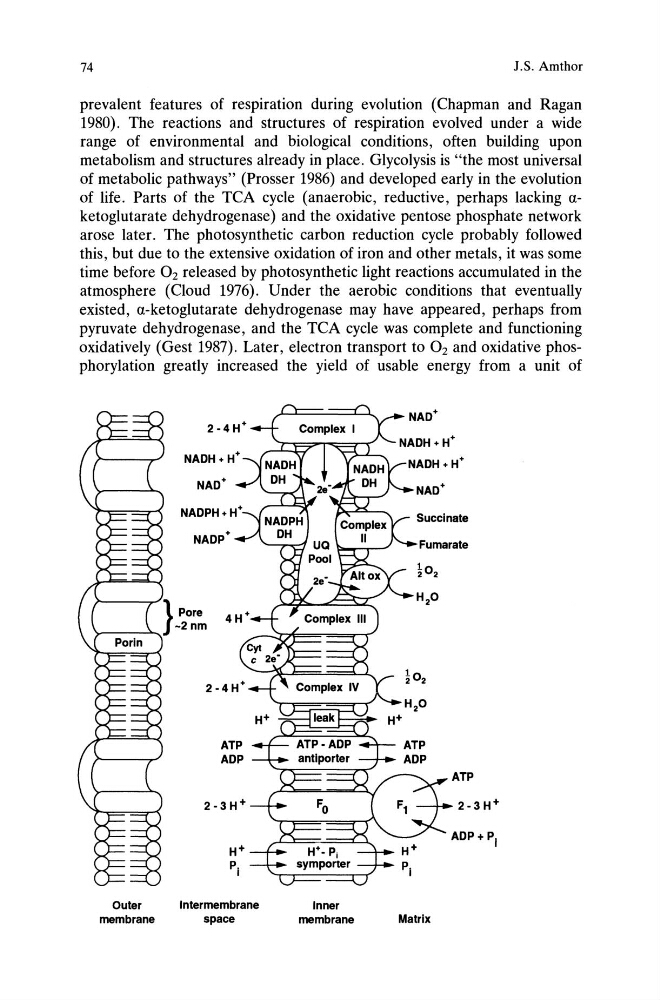
oxidatively (Gest 1987). Later, electron transport to O2 and oxidative phosphorylation greatly increased the yield of usable energy from a unit of
Outer
Intermembrane
membrane
space
Inner
membrane
Matrix
l.S. Amthor
prevalent features of respiration during evolution (Chapman and Ragan
1980). The reactions and structures of respiration evolved under a wide
range of environmental and biological conditions, often building upon
metabolism and structures already in place. Glycolysis is "the most universal
of metabolic pathways" (Prosser 1986) and developed early in the evolution
of life. Parts of the TCA cycle (anaerobic, reductive, perhaps lacking aketoglutarate dehydrogenase) and the oxidative pentose phosphate network
arose later. The photosynthetic carbon reduction cycle probably followed
this, but due to the extensive oxidation of iron and other metals, it was some
time before O2 released by photosynthetic light reactions accumulated in the
atmosphere (Cloud 1976). Under the aerobic conditions that eventually
existed, a-ketoglutarate dehydrogenase may have appeared, perhaps from
pyruvate dehydrogenase, and the TCA cycle was complete and functioning
oxidatively (Gest 1987). Later, electron transport to O2 and oxidative phosphorylation greatly increased the yield of usable energy from a unit of
Outer
Intermembrane
membrane
space
Inner
membrane
Matrix