

42
O. Bjorkman and B. Demmig-Adams
Q)
0>
C
9
Prunus ilicifolia
1900 Dark
0
.c
0
8
1600
t t
10
0
1200~
c 7
0
:;::;
8
0
E 6
V
L0
0
'+5
:f
6
c
a..
0
z
0
4
NPQ
'0
c
4
0
3
280 r
c
0
2
:;::;
0
1
2
E
.....
L0
'+N
0
0
0
10
20
30
40
50
60
Time, min
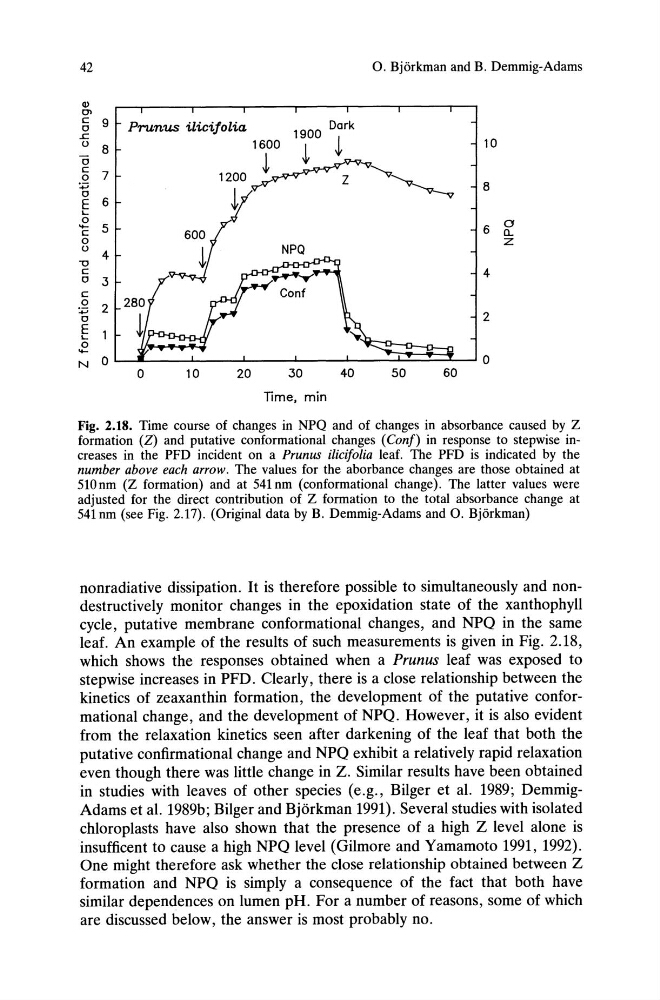
Fig. 2.18. Time course of changes in NPQ and of changes in absorbance caused by Z
formation (Z) and putative conformational changes (Can!) in response to stepwise increases in the PFD incident on a Prunus ilici/olia leaf. The PFD is indicated by the
number above each arrow. The values for the aborbance changes are those obtained at
510nm (Z formation) and at 541nm (conformational change). The latter values were
adjusted for the direct contribution of Z formation to the total absorbance change at
541 nm (see Fig. 2.17). (Original data by B. Demmig-Adams and O. Bjorkman)
nonradiative dissipation. It is therefore possible to simultaneously and nondestructively monitor changes in the epoxidation state of the xanthophyll
cycle, putative membrane conformational changes, and NPQ in the same
leaf. An example of the results of such measurements is given in Fig. 2.18,
which shows the responses obtained when a Prunus leaf was exposed to
stepwise increases in PFD. Clearly, there is a close relationship between the
kinetics of zeaxanthin formation, the development of the putative conformational change, and the development of NPQ. However, it is also evident
from the relaxation kinetics seen after darkening of the leaf that both the
putative confirmational change and NPQ exhibit a relatively rapid relaxation
even though there was little change in Z. Similar results have been obtained
in studies with leaves of other species (e.g., Bilger et al. 1989; DemmigAdams et al. 1989b; Bilger and Bjorkman 1991). Several studies with isolated
chloroplasts have also shown that the presence of a high Z level alone is
insufficent to cause a high NPQ level (Gilmore and Yamamoto 1991, 1992).
One might therefore ask whether the close relationship obtained between Z
formation and NPQ is simply a consequence of the fact that both have
similar dependences on lumen pH. For a number of reasons, some of which
are discussed below, the answer is most probably no.
O. Bjorkman and B. Demmig-Adams
Q)
0>
C
9
Prunus ilicifolia
1900 Dark
0
.c
0
8
1600
t t
10
0
1200~
c 7
0
:;::;
8
0
E 6
V
L0
0
'+5
:f
6
c
a..
0
z
0
4
NPQ
'0
c
4
0
3
280 r
c
0
2
:;::;
0
1
2
E
.....
L0
'+N
0
0
0
10
20
30
40
50
60
Time, min
Fig. 2.18. Time course of changes in NPQ and of changes in absorbance caused by Z
formation (Z) and putative conformational changes (Can!) in response to stepwise increases in the PFD incident on a Prunus ilici/olia leaf. The PFD is indicated by the
number above each arrow. The values for the aborbance changes are those obtained at
510nm (Z formation) and at 541nm (conformational change). The latter values were
adjusted for the direct contribution of Z formation to the total absorbance change at
541 nm (see Fig. 2.17). (Original data by B. Demmig-Adams and O. Bjorkman)
nonradiative dissipation. It is therefore possible to simultaneously and nondestructively monitor changes in the epoxidation state of the xanthophyll
cycle, putative membrane conformational changes, and NPQ in the same
leaf. An example of the results of such measurements is given in Fig. 2.18,
which shows the responses obtained when a Prunus leaf was exposed to
stepwise increases in PFD. Clearly, there is a close relationship between the
kinetics of zeaxanthin formation, the development of the putative conformational change, and the development of NPQ. However, it is also evident
from the relaxation kinetics seen after darkening of the leaf that both the
putative confirmational change and NPQ exhibit a relatively rapid relaxation
even though there was little change in Z. Similar results have been obtained
in studies with leaves of other species (e.g., Bilger et al. 1989; DemmigAdams et al. 1989b; Bilger and Bjorkman 1991). Several studies with isolated
chloroplasts have also shown that the presence of a high Z level alone is
insufficent to cause a high NPQ level (Gilmore and Yamamoto 1991, 1992).
One might therefore ask whether the close relationship obtained between Z
formation and NPQ is simply a consequence of the fact that both have
similar dependences on lumen pH. For a number of reasons, some of which
are discussed below, the answer is most probably no.