

38
2000
cOO
'0 E
c:
0''0 1000
u. E
a.. :::t..
0.8
N + 0.6
«
+
2:. 0.4
-N 0.2
I
I
I
I
I
I
I
O. Bjorkman and B. Demmig-Adams
I
I
I
I
I
8
10 12 14 16 18 20 22
Time of day
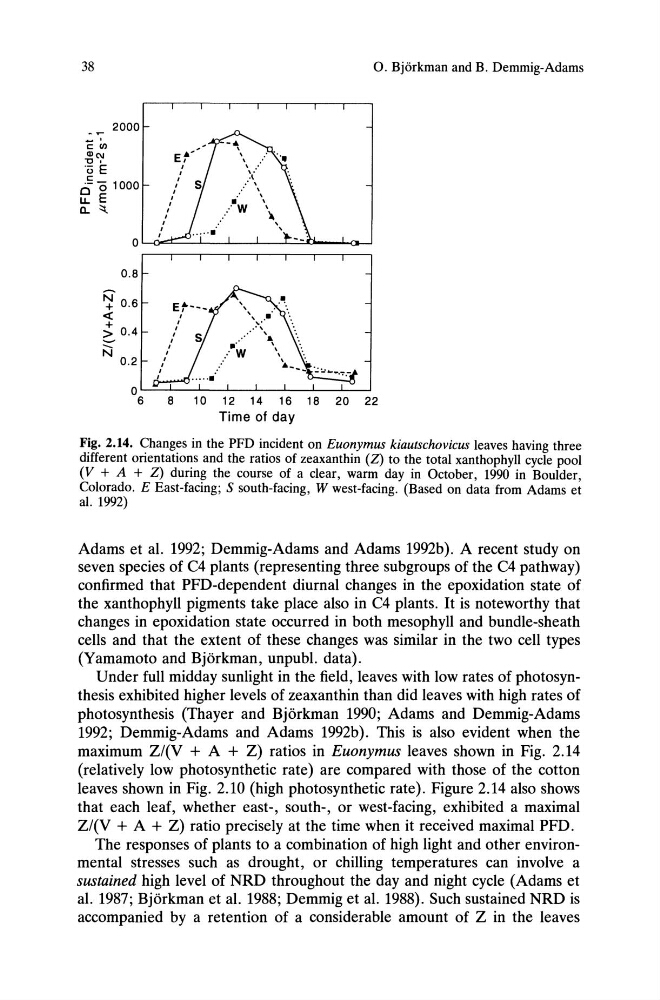
Fig. 2.14. Changes in the PFD incident on Euonymus kiautschovicus leaves having three
different orientations and the ratios of zeaxanthin (Z) to the total xanthophyll cycle pool
(V + A + Z) during the course of a clear, warm day in October, 1990 in Boulder,
Colorado. E East-facing; S south-facing, W west-facing. (Based on data from Adams et
al. 1992)
Adams et al. 1992; Demmig-Adams and Adams 1992b). A recent study on
seven species of C4 plants (representing three subgroups of the C4 pathway)
confirmed that PFD-dependent diurnal changes in the epoxidation state of
the xanthophyll pigments take place also in C4 plants. It is noteworthy that
changes in epoxidation state occurred in both mesophyll and bundle-sheath
cells and that the extent of these changes was similar in the two cell types
(Yamamoto and Bjorkman, unpubl. data).
Under full midday sunlight in the field, leaves with low rates of photosynthesis exhibited higher levels of zeaxanthin than did leaves with high rates of
photosynthesis (Thayer and Bjorkman 1990; Adams and Demmig-Adams
1992; Demmig-Adams and Adams 1992b). This is also evident when the
maximum Z/(V + A + Z) ratios in Euonymus leaves shown in Fig. 2.14
(relatively low photosynthetic rate) are compared with those of the cotton
leaves shown in Fig. 2.10 (high photosynthetic rate). Figure 2.14 also shows
that each leaf, whether east-, south-, or west-facing, exhibited a maximal
Z/(V + A + Z) ratio precisely at the time when it received maximal PFD.
The responses of plants to a combination of high light and other environmental stresses such as drought, or chilling temperatures can involve a
sustained high level of NRD throughout the day and night cycle (Adams et
al. 1987; Bjorkman et al. 1988; Demmig et al. 1988). Such sustained NRD is
accompanied by a retention of a considerable amount of Z in the leaves
2000
cOO
'0 E
c:
0''0 1000
u. E
a.. :::t..
0.8
N + 0.6
«
+
2:. 0.4
-N 0.2
I
I
I
I
I
I
I
O. Bjorkman and B. Demmig-Adams
I
I
I
I
I
8
10 12 14 16 18 20 22
Time of day
Fig. 2.14. Changes in the PFD incident on Euonymus kiautschovicus leaves having three
different orientations and the ratios of zeaxanthin (Z) to the total xanthophyll cycle pool
(V + A + Z) during the course of a clear, warm day in October, 1990 in Boulder,
Colorado. E East-facing; S south-facing, W west-facing. (Based on data from Adams et
al. 1992)
Adams et al. 1992; Demmig-Adams and Adams 1992b). A recent study on
seven species of C4 plants (representing three subgroups of the C4 pathway)
confirmed that PFD-dependent diurnal changes in the epoxidation state of
the xanthophyll pigments take place also in C4 plants. It is noteworthy that
changes in epoxidation state occurred in both mesophyll and bundle-sheath
cells and that the extent of these changes was similar in the two cell types
(Yamamoto and Bjorkman, unpubl. data).
Under full midday sunlight in the field, leaves with low rates of photosynthesis exhibited higher levels of zeaxanthin than did leaves with high rates of
photosynthesis (Thayer and Bjorkman 1990; Adams and Demmig-Adams
1992; Demmig-Adams and Adams 1992b). This is also evident when the
maximum Z/(V + A + Z) ratios in Euonymus leaves shown in Fig. 2.14
(relatively low photosynthetic rate) are compared with those of the cotton
leaves shown in Fig. 2.10 (high photosynthetic rate). Figure 2.14 also shows
that each leaf, whether east-, south-, or west-facing, exhibited a maximal
Z/(V + A + Z) ratio precisely at the time when it received maximal PFD.
The responses of plants to a combination of high light and other environmental stresses such as drought, or chilling temperatures can involve a
sustained high level of NRD throughout the day and night cycle (Adams et
al. 1987; Bjorkman et al. 1988; Demmig et al. 1988). Such sustained NRD is
accompanied by a retention of a considerable amount of Z in the leaves