

Overview: Perspectives in Ecophysiological Research of Photosynthesis
555
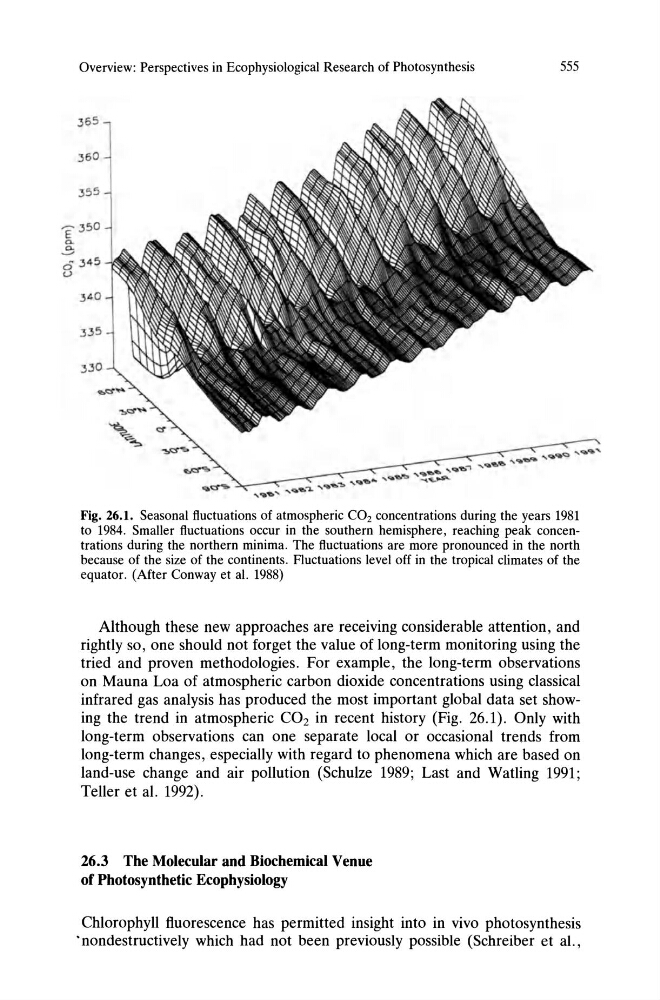
Fig. 26.1. Seasonal fluctuations of atmospheric CO2 concentrations during the years 1981
to 1984. Smaller fluctuations occur in the southern hemisphere, reaching peak concentrations during the northern minima. The fluctuations are more pronounced in the north
because of the size of the continents. Fluctuations level off in the tropical climates of the
equator. (After Conway et al. 1988)
Although these new approaches are receiving considerable attention, and
rightly so, one should not forget the value of long-term monitoring using the
tried and proven methodologies. For example, the long-term observations
on Mauna Loa of atmospheric carbon dioxide concentrations using classical
infrared gas analysis has produced the most important global data set showing the trend in atmospheric CO2 in recent history (Fig. 26.1). Only with
long-term observations can one separate local or occasional trends from
long-term changes, especially with regard to phenomena which are based on
land-use change and air pollution (Schulze 1989; Last and Watling 1991;
Teller et al. 1992).
26.3 The Molecular and Biochemical Venue
of Photosynthetic Ecophysiology
Chlorophyll fluorescence has permitted insight into in vivo photosynthesis
'nondestructively which had not been previously possible (Schreiber et aI.,
555
Fig. 26.1. Seasonal fluctuations of atmospheric CO2 concentrations during the years 1981
to 1984. Smaller fluctuations occur in the southern hemisphere, reaching peak concentrations during the northern minima. The fluctuations are more pronounced in the north
because of the size of the continents. Fluctuations level off in the tropical climates of the
equator. (After Conway et al. 1988)
Although these new approaches are receiving considerable attention, and
rightly so, one should not forget the value of long-term monitoring using the
tried and proven methodologies. For example, the long-term observations
on Mauna Loa of atmospheric carbon dioxide concentrations using classical
infrared gas analysis has produced the most important global data set showing the trend in atmospheric CO2 in recent history (Fig. 26.1). Only with
long-term observations can one separate local or occasional trends from
long-term changes, especially with regard to phenomena which are based on
land-use change and air pollution (Schulze 1989; Last and Watling 1991;
Teller et al. 1992).
26.3 The Molecular and Biochemical Venue
of Photosynthetic Ecophysiology
Chlorophyll fluorescence has permitted insight into in vivo photosynthesis
'nondestructively which had not been previously possible (Schreiber et aI.,