

Regulation of Photosynthetic Light Energy Capture
35
'm 1500
')I
E
o E 1000
"'l.
C
Ql
U
500
0
c
0
LL
a..
0
4
1.0 ,--,--,----,----r--.,..--,---,
~ ..... L-l----.J..--'---'---'---'O
r-r-~-__r---,---r--...,...-----, 1.0
0.8
>g 0.6
())
'0
[i 0.4
0.2
d
I
D.
o~
"U.,
o calculated
'- for -NPQ
\
'a ,
0.8
0.6 §
0.40,
0.2
0--0-0
~~L--L~~~~~O
6
8
10
12
14
16
18
6
8
10
12
14
16
18
Time of day
Time of day
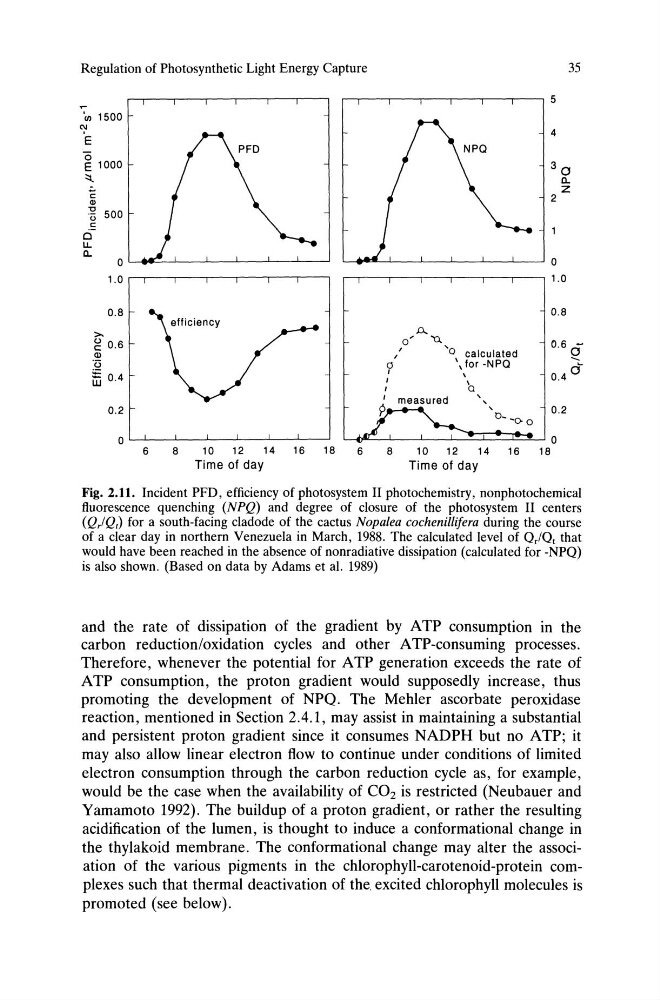
Fig. 2.11. Incident PFD, efficiency of photosystem II photochemistry, nonphotochemical
fluorescence quenching (NPQ) and degree of closure of the photosystem II centers
(Q/Q,) for a south-facing cladode of the cactus Nopalea cochenillifera during the course
of a clear day in northern Venezuela in March, 1988. The calculated level of Or/Ot that
would have been reached in the absence of nonradiative dissipation (calculated for -NPO)
is also shown. (Based on data by Adams et al. 1989)
and the rate of dissipation of the gradient by ATP consumption in the
carbon reduction/oxidation cycles and other ATP-consuming processes.
Therefore, whenever the potential for ATP generation exceeds the rate of
ATP consumption, the proton gradient would supposedly increase, thus
promoting the development of NPQ. The Mehler ascorbate peroxidase
reaction, mentioned in Section 2.4.1, may assist in maintaining a substantial
and persistent proton gradient since it consumes NADPH but no ATP; it
may also allow linear electron flow to continue under conditions of limited
electron consumption through the carbon reduction cycle as, for example,
would be the case when the availability of CO2 is restricted (Neubauer and
Yamamoto 1992). The buildup of a proton gradient, or rather the resulting
acidification of the lumen, is thought to induce a conformational change in
the thylakoid membrane. The conformational change may alter the association of the various pigments in the chlorophyll-carotenoid-protein complexes such that thermal deactivation of the. excited chlorophyll molecules is
promoted (see below).
35
'm 1500
')I
E
o E 1000
"'l.
C
Ql
U
500
0
c
0
LL
a..
0
4
1.0 ,--,--,----,----r--.,..--,---,
~ ..... L-l----.J..--'---'---'---'O
r-r-~-__r---,---r--...,...-----, 1.0
0.8
>g 0.6
())
'0
[i 0.4
0.2
d
I
D.
o~
"U.,
o calculated
'- for -NPQ
\
'a ,
0.8
0.6 §
0.40,
0.2
0--0-0
~~L--L~~~~~O
6
8
10
12
14
16
18
6
8
10
12
14
16
18
Time of day
Time of day
Fig. 2.11. Incident PFD, efficiency of photosystem II photochemistry, nonphotochemical
fluorescence quenching (NPQ) and degree of closure of the photosystem II centers
(Q/Q,) for a south-facing cladode of the cactus Nopalea cochenillifera during the course
of a clear day in northern Venezuela in March, 1988. The calculated level of Or/Ot that
would have been reached in the absence of nonradiative dissipation (calculated for -NPO)
is also shown. (Based on data by Adams et al. 1989)
and the rate of dissipation of the gradient by ATP consumption in the
carbon reduction/oxidation cycles and other ATP-consuming processes.
Therefore, whenever the potential for ATP generation exceeds the rate of
ATP consumption, the proton gradient would supposedly increase, thus
promoting the development of NPQ. The Mehler ascorbate peroxidase
reaction, mentioned in Section 2.4.1, may assist in maintaining a substantial
and persistent proton gradient since it consumes NADPH but no ATP; it
may also allow linear electron flow to continue under conditions of limited
electron consumption through the carbon reduction cycle as, for example,
would be the case when the availability of CO2 is restricted (Neubauer and
Yamamoto 1992). The buildup of a proton gradient, or rather the resulting
acidification of the lumen, is thought to induce a conformational change in
the thylakoid membrane. The conformational change may alter the association of the various pigments in the chlorophyll-carotenoid-protein complexes such that thermal deactivation of the. excited chlorophyll molecules is
promoted (see below).