

538
S. Henderson et al.
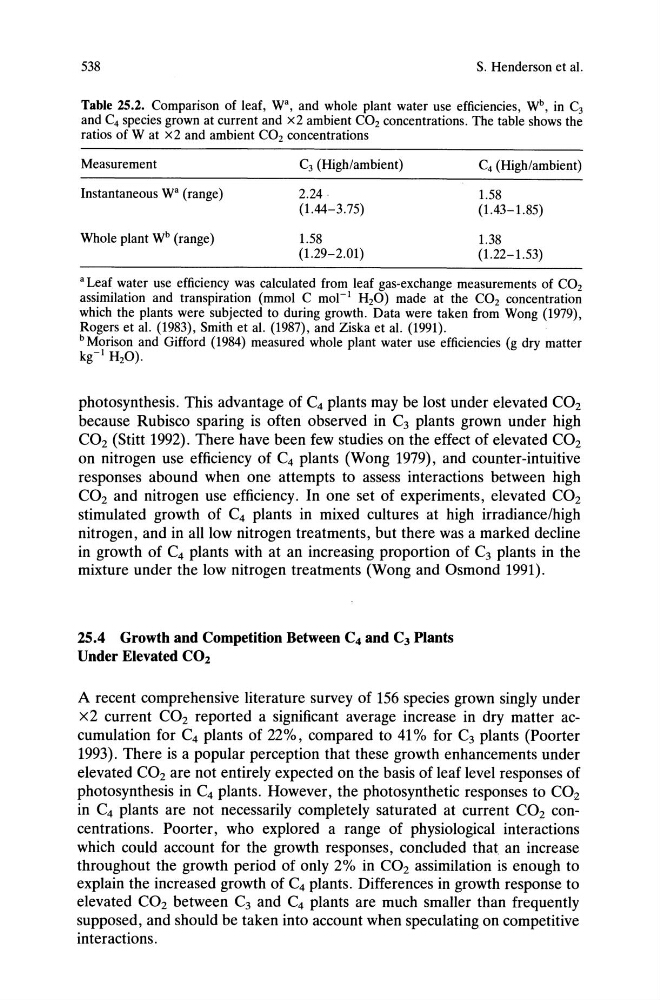
Table 25.2. Comparison of leaf, W', and whole plant water use efficiencies, W b , in C 3
and C4 species grown at current and x2 ambient CO2 concentrations. The table shows the
ratios of W at x2 and ambient CO2 concentrations
Measurement
Instantaneous W' (range)
Whole plant W b (range)
C3 (High/ambient)
2.24·
(1.44-3.75)
1.58
(1.29-2.01)
C4 (High/ambient)
1.58
(1.43-1.85)
1.38
(1.22-1.53)
• Leaf water use efficiency was calculated from leaf gas-exchange measurements of CO 2
assimilation and transpiration (mmol C mol- 1 H20) made at the CO2 concentration
which the plants were subjected to during growth. Data were taken from Wong (1979),
Rogers et al. (1983), Smith et al. (1987), and Ziska et al. (1991).
bMorison and Gifford (1984) measured whole plant water use efficiencies (g dry matter
kg- 1 H 2 0).
photosynthesis. This advantage of C4 plants may be lost under elevated CO2
because Rubisco sparing is often observed in C3 plants grown under high
CO2 (Stitt 1992). There have been few studies on the effect of elevated CO2
on nitrogen use efficiency of C4 plants (Wong 1979), and counter-intuitive
responses abound when one attempts to assess interactions between high
CO 2 and nitrogen use efficiency. In one set of experiments, elevated CO2
stimulated growth of C4 plants in mixed cultures at high irradiance/high
nitrogen, and in all low nitrogen treatments, but there was a marked decline
in growth of C 4 plants with at an increasing proportion of C3 plants in the
mixture under the low nitrogen treatments (Wong and Osmond 1991).
25.4 Growth and Competition Between C4 and C3 Plants
Under Elevated CO2
A recent comprehensive literature survey of 156 species grown singly under
x 2 current CO2 reported a significant average increase in dry matter accumulation for C4 plants of 22%, compared to 41 % for C3 plants (Poorter
1993). There is a popular perception that these growth enhancements under
elevated CO 2 are not entirely expected on the basis of leaf level responses of
photosynthesis in C4 plants. However, the photosynthetic responses to CO 2
in C4 plants are not necessarily completely saturated at current CO2 concentrations. Poorter, who explored a range of physiological interactions
which could account for the growth responses, concluded that an increase
throughout the growth period of only 2% in CO2 assimilation is enough to
explain the increased growth of C4 plants. Differences in growth response to
elevated CO2 between C3 and C4 plants are much smaller than frequently
supposed, and should be taken into account when speculating on competitive
interactions.
S. Henderson et al.
Table 25.2. Comparison of leaf, W', and whole plant water use efficiencies, W b , in C 3
and C4 species grown at current and x2 ambient CO2 concentrations. The table shows the
ratios of W at x2 and ambient CO2 concentrations
Measurement
Instantaneous W' (range)
Whole plant W b (range)
C3 (High/ambient)
2.24·
(1.44-3.75)
1.58
(1.29-2.01)
C4 (High/ambient)
1.58
(1.43-1.85)
1.38
(1.22-1.53)
• Leaf water use efficiency was calculated from leaf gas-exchange measurements of CO 2
assimilation and transpiration (mmol C mol- 1 H20) made at the CO2 concentration
which the plants were subjected to during growth. Data were taken from Wong (1979),
Rogers et al. (1983), Smith et al. (1987), and Ziska et al. (1991).
bMorison and Gifford (1984) measured whole plant water use efficiencies (g dry matter
kg- 1 H 2 0).
photosynthesis. This advantage of C4 plants may be lost under elevated CO2
because Rubisco sparing is often observed in C3 plants grown under high
CO2 (Stitt 1992). There have been few studies on the effect of elevated CO2
on nitrogen use efficiency of C4 plants (Wong 1979), and counter-intuitive
responses abound when one attempts to assess interactions between high
CO 2 and nitrogen use efficiency. In one set of experiments, elevated CO2
stimulated growth of C4 plants in mixed cultures at high irradiance/high
nitrogen, and in all low nitrogen treatments, but there was a marked decline
in growth of C 4 plants with at an increasing proportion of C3 plants in the
mixture under the low nitrogen treatments (Wong and Osmond 1991).
25.4 Growth and Competition Between C4 and C3 Plants
Under Elevated CO2
A recent comprehensive literature survey of 156 species grown singly under
x 2 current CO2 reported a significant average increase in dry matter accumulation for C4 plants of 22%, compared to 41 % for C3 plants (Poorter
1993). There is a popular perception that these growth enhancements under
elevated CO 2 are not entirely expected on the basis of leaf level responses of
photosynthesis in C4 plants. However, the photosynthetic responses to CO 2
in C4 plants are not necessarily completely saturated at current CO2 concentrations. Poorter, who explored a range of physiological interactions
which could account for the growth responses, concluded that an increase
throughout the growth period of only 2% in CO2 assimilation is enough to
explain the increased growth of C4 plants. Differences in growth response to
elevated CO2 between C3 and C4 plants are much smaller than frequently
supposed, and should be taken into account when speculating on competitive
interactions.