

536
c:::
-13.0
0
a
+:
'iii
-12.5
0
e.
E
-12.0
0 -
oJ
(1)e.O
0(")
-11.5
-~ OtO -11.0
!!J.
c:::
-10.5
0
.0 ....
«S
-10.0
0
20 40 60 80 100 120 140
Leaf Nitrogen Content
(mmol m- 2 )
S. Henderson et al.
b
•
•
•
0.2
0.3
0.4
0.5
Root Nitrogen Content
(mmol m- 2 )
-13.0
-12.5
-12.0
-11.5
-11.0
-10.5
-10.0
0
I» .... cO
::J
Ui
0'l0
~wO
0'0
_CD
fO
- 0
3
'0
0
C/l
;:;:
o·
::J
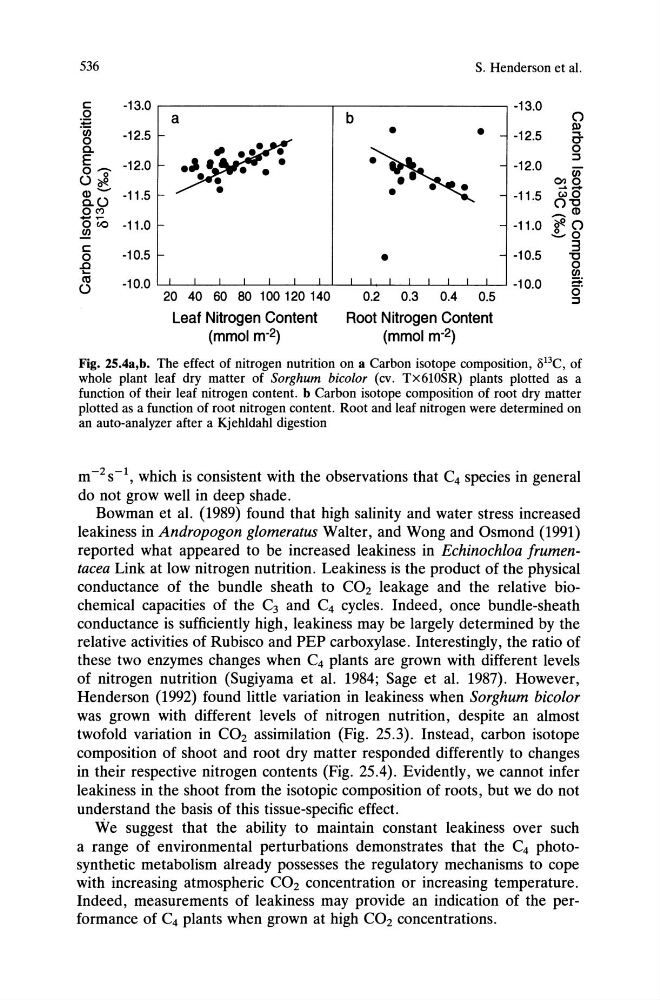
Fig. 25.4a,b. The effect of nitrogen nutrition on a Carbon isotope composition, 013C, of
whole plant leaf dry matter of Sorghum bicolor (cv. Tx61OSR) plants plotted as a
function of their leaf nitrogen content. b Carbon isotope composition of root dry matter
plotted as a function of root nitrogen content. Root and leaf nitrogen were determined on
an auto-analyzer after a Kjehldahl digestion
m- 2 s-1, which is consistent with the observations that C 4 species in general
do not grow well in deep shade.
Bowman et al. (1989) found that high salinity and water stress increased
leakiness in Andropogon glomeratus Walter, and Wong and Osmond (1991)
reported what appeared to be increased leakiness in Eehinoehloa frumentaeea Link at low nitrogen nutrition. Leakiness is the product of the physical
conductance of the bundle sheath to CO2 leakage and the relative biochemical capacities of the C3 and C4 cycles. Indeed, once bundle-sheath
conductance is sufficiently high, leakiness may be largely determined by the
relative activities of Rubisco and PEP carboxylase. Interestingly, the ratio of
these two enzymes changes when C4 plants are grown with different levels
of nitrogen nutrition (Sugiyama et al. 1984; Sage et al. 1987). However,
Henderson (1992) found little variation in leakiness when Sorghum bieolor
was grown with different levels of nitrogen nutrition, despite an almost
twofold variation in CO2 assimilation (Fig. 25.3). Instead, carbon isotope
composition of shoot and root dry matter responded differently to changes
in their respective nitrogen contents (Fig. 25.4). Evidently, we cannot infer
leakiness in the shoot from the isotopic composition of roots, but we do not
understand the basis of this tissue-specific effect.
We suggest that the ability to maintain constant leakiness over such
a range of environmental perturbations demonstrates that the C4 photosynthetic metabolism already possesses the regulatory mechanisms to cope
with increasing atmospheric CO2 concentration or increasing temperature.
Indeed, measurements of leakiness may provide an indication of the performance of C4 plants when grown at high CO2 concentrations.
c:::
-13.0
0
a
+:
'iii
-12.5
0
e.
E
-12.0
0 -
oJ
(1)e.O
0(")
-11.5
-~ OtO -11.0
!!J.
c:::
-10.5
0
.0 ....
«S
-10.0
0
20 40 60 80 100 120 140
Leaf Nitrogen Content
(mmol m- 2 )
S. Henderson et al.
b
•
•
•
0.2
0.3
0.4
0.5
Root Nitrogen Content
(mmol m- 2 )
-13.0
-12.5
-12.0
-11.5
-11.0
-10.5
-10.0
0
I» .... cO
::J
Ui
0'l0
~wO
0'0
_CD
fO
- 0
3
'0
0
C/l
;:;:
o·
::J
Fig. 25.4a,b. The effect of nitrogen nutrition on a Carbon isotope composition, 013C, of
whole plant leaf dry matter of Sorghum bicolor (cv. Tx61OSR) plants plotted as a
function of their leaf nitrogen content. b Carbon isotope composition of root dry matter
plotted as a function of root nitrogen content. Root and leaf nitrogen were determined on
an auto-analyzer after a Kjehldahl digestion
m- 2 s-1, which is consistent with the observations that C 4 species in general
do not grow well in deep shade.
Bowman et al. (1989) found that high salinity and water stress increased
leakiness in Andropogon glomeratus Walter, and Wong and Osmond (1991)
reported what appeared to be increased leakiness in Eehinoehloa frumentaeea Link at low nitrogen nutrition. Leakiness is the product of the physical
conductance of the bundle sheath to CO2 leakage and the relative biochemical capacities of the C3 and C4 cycles. Indeed, once bundle-sheath
conductance is sufficiently high, leakiness may be largely determined by the
relative activities of Rubisco and PEP carboxylase. Interestingly, the ratio of
these two enzymes changes when C4 plants are grown with different levels
of nitrogen nutrition (Sugiyama et al. 1984; Sage et al. 1987). However,
Henderson (1992) found little variation in leakiness when Sorghum bieolor
was grown with different levels of nitrogen nutrition, despite an almost
twofold variation in CO2 assimilation (Fig. 25.3). Instead, carbon isotope
composition of shoot and root dry matter responded differently to changes
in their respective nitrogen contents (Fig. 25.4). Evidently, we cannot infer
leakiness in the shoot from the isotopic composition of roots, but we do not
understand the basis of this tissue-specific effect.
We suggest that the ability to maintain constant leakiness over such
a range of environmental perturbations demonstrates that the C4 photosynthetic metabolism already possesses the regulatory mechanisms to cope
with increasing atmospheric CO2 concentration or increasing temperature.
Indeed, measurements of leakiness may provide an indication of the performance of C4 plants when grown at high CO2 concentrations.