

534
S. Henderson et al.
in controlling the rate of CO2 assimilation (Leegood and Osmond 1991).
Although one can argue that such short-term perturbations (Fig. 25.2) have
a mo~e severe effect on photosynthetic metabolism than when plants are
allowed to acclimate to changes in growth conditions, the fact that large
changes in metabolite pool sizes did not occur when leaves were exposed
to CO2 concentrations above ambient suggests that extensive metabolic
regulation occurs during C4 photosynthesis which may provide mechanisms
that allow it to adjust readily to elevated CO2 concentrations. As yet no
studies have addressed metabolite regulation during C4 photosynthesis in
plants grown in elevated CO2 concentrations.
25.3.2 Leakage of CO2 from the Bundle Sheath
The efficiency of the CO2 pump in the C4 cycle is influenced by the extent
of passive leakage of CO2 from the bundle sheath. This leakage of CO2
represents an energy cost to the leaf because A TP is required for the
regeneration of PEP. The rate of leakage of CO2 from the bundle sheath
cannot be measured directly but estimates have been made in various ways.
Hatch and Osmond (1976) estimated that, on diffusional grounds, the back
flux of CO 2 could be about 10% of the C4 acid flux, a value confirmed in
recent biochemical studies (Furbank and Hatch 1987; Jenkins et al. 1989).
Theoretical treatments of carbon isotope discrimination that occurs during
C 4 photosynthesis have shown that the extent of discrimination is linked to
the rate of leakage of CO2 from the bundle sheath (O'Leary 1981; Peisker
1982; Farquhar 1983; Deleens et al. 1983; Peisker and Henderson 1992).
Henderson et al. (1992) used direct measurements of carbon isotope discrimination made in conjunction with gas-exchange to examine leakiness
(the ratio of leakage of CO 2 from the bundle sheath to the rate of PEP
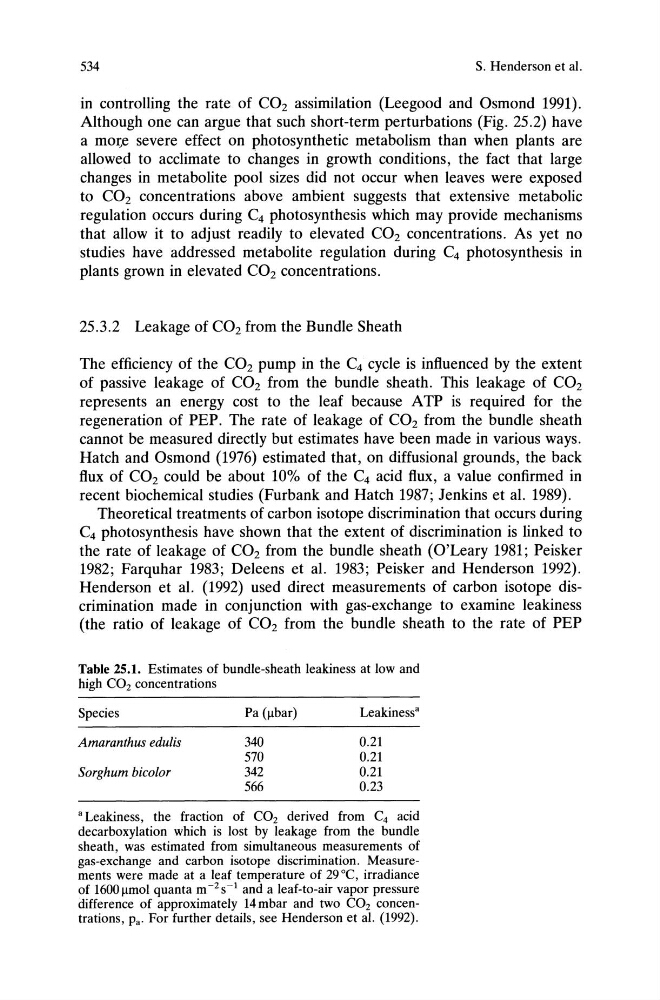
Table 25.1. Estimates of bundle-sheath leakiness at low and
high CO2 concentrations
Species
Pa (Ilbar)
Leakiness"
Amaranthus edulis
340
0.21
570
0.21
Sorghum hicotor
342
0.21
566
0.23
a Leakiness, the fraction of CO2 derived from C4 acid
decarboxylation which is lost by leakage from the bundle
sheath, was estimated from simultaneous measurements of
gas-exchange and carbon isotope discrimination. Measurements were made at a leaf temperature of 29 cC, irradiance
of 1600 Ilmol quanta m- 2 S-l and a leaf-to-air vapor pressure
difference of approximately 14mbar and two CO2 concentrations, Pa' For further details, see Henderson et al. (1992).
S. Henderson et al.
in controlling the rate of CO2 assimilation (Leegood and Osmond 1991).
Although one can argue that such short-term perturbations (Fig. 25.2) have
a mo~e severe effect on photosynthetic metabolism than when plants are
allowed to acclimate to changes in growth conditions, the fact that large
changes in metabolite pool sizes did not occur when leaves were exposed
to CO2 concentrations above ambient suggests that extensive metabolic
regulation occurs during C4 photosynthesis which may provide mechanisms
that allow it to adjust readily to elevated CO2 concentrations. As yet no
studies have addressed metabolite regulation during C4 photosynthesis in
plants grown in elevated CO2 concentrations.
25.3.2 Leakage of CO2 from the Bundle Sheath
The efficiency of the CO2 pump in the C4 cycle is influenced by the extent
of passive leakage of CO2 from the bundle sheath. This leakage of CO2
represents an energy cost to the leaf because A TP is required for the
regeneration of PEP. The rate of leakage of CO2 from the bundle sheath
cannot be measured directly but estimates have been made in various ways.
Hatch and Osmond (1976) estimated that, on diffusional grounds, the back
flux of CO 2 could be about 10% of the C4 acid flux, a value confirmed in
recent biochemical studies (Furbank and Hatch 1987; Jenkins et al. 1989).
Theoretical treatments of carbon isotope discrimination that occurs during
C 4 photosynthesis have shown that the extent of discrimination is linked to
the rate of leakage of CO2 from the bundle sheath (O'Leary 1981; Peisker
1982; Farquhar 1983; Deleens et al. 1983; Peisker and Henderson 1992).
Henderson et al. (1992) used direct measurements of carbon isotope discrimination made in conjunction with gas-exchange to examine leakiness
(the ratio of leakage of CO 2 from the bundle sheath to the rate of PEP
Table 25.1. Estimates of bundle-sheath leakiness at low and
high CO2 concentrations
Species
Pa (Ilbar)
Leakiness"
Amaranthus edulis
340
0.21
570
0.21
Sorghum hicotor
342
0.21
566
0.23
a Leakiness, the fraction of CO2 derived from C4 acid
decarboxylation which is lost by leakage from the bundle
sheath, was estimated from simultaneous measurements of
gas-exchange and carbon isotope discrimination. Measurements were made at a leaf temperature of 29 cC, irradiance
of 1600 Ilmol quanta m- 2 S-l and a leaf-to-air vapor pressure
difference of approximately 14mbar and two CO2 concentrations, Pa' For further details, see Henderson et al. (1992).