

Are C 4 Pathway Plants Threatened by Global Climatic Change?
E
a.
a.
C
0
:;::::;
ctS
....
- c::
Q)
(,)
c::
0
(,)
C\I
0
()
400.----------------------------------------.
350
I
300
250
200
Vostock ice core -I
j
•
."
:t; .
• I ·
, .-=-.. • ••
/000
/0
I
·1
Mauna Loa
II(
-I
Siple
ice core
I
102
Years before present
531
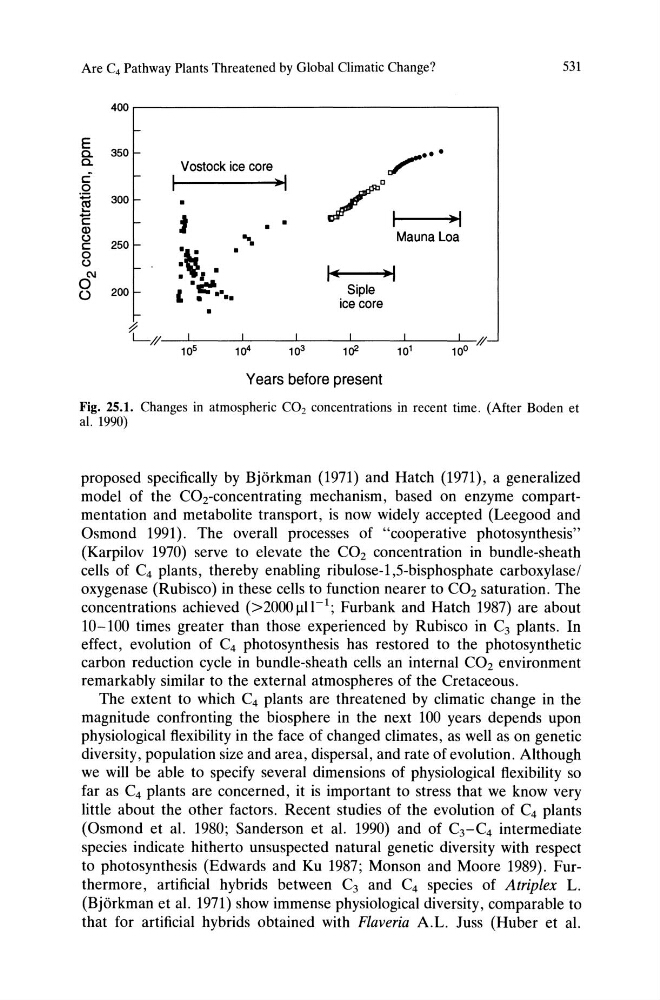
Fig. 25.1. Changes in atmospheric CO2 concentrations in recent time. (After Boden et
al. 1990)
proposed specifically by Bjorkman (1971) and Hatch (1971), a generalized
model of the COrconcentrating mechanism, based on enzyme compartmentation and metabolite transport, is now widely accepted (Leegood and
Osmond 1991). The overall processes of "cooperative photosynthesis"
(Karpilov 1970) serve to elevate the CO2 concentration in bundle-sheath
cells of C4 plants, thereby enabling ribulose-1,S-bisphosphate carboxylase/
oxygenase (Rubisco) in these cells to function nearer to CO2 saturation. The
concentrations achieved (>20001-111-\ Furbank and Hatch 1987) are about
10-100 times greater than those experienced by Rubisco in C 3 plants. In
effect, evolution of C4 photosynthesis has restored to the photosynthetic
carbon reduction cycle in bundle-sheath cells an internal CO2 environment
remarkably similar to the external atmospheres of the Cretaceous.
The extent to which C4 plants are threatened by climatic change in the
magnitude confronting the biosphere in the next 100 years depends upon
physiological flexibility in the face of changed climates, as well as on genetic
diversity, population size and area, dispersal, and rate of evolution. Although
we will be able to specify several dimensions of physiological flexibility so
far as C4 plants are concerned, it is important to stress that we know very
little about the other factors. Recent studies of the evolution of C 4 plants
(Osmond et al. 1980; Sanderson et al. 1990) and of Cr C4 intermediate
species indicate hitherto unsuspected natural genetic diversity with respect
to photosynthesis (Edwards and Ku 1987; Monson and Moore 1989). Furthermore, artificial hybrids between C3 and C4 species of Atriplex L.
(Bjorkman et al. 1971) show immense physiological diversity, comparable to
that for artificial hybrids obtained with Flaveria A.L. Juss (Huber et al.
E
a.
a.
C
0
:;::::;
ctS
....
- c::
Q)
(,)
c::
0
(,)
C\I
0
()
400.----------------------------------------.
350
I
300
250
200
Vostock ice core -I
j
•
."
:t; .
• I ·
, .-=-.. • ••
/000
/0
I
·1
Mauna Loa
II(
-I
Siple
ice core
I
102
Years before present
531
Fig. 25.1. Changes in atmospheric CO2 concentrations in recent time. (After Boden et
al. 1990)
proposed specifically by Bjorkman (1971) and Hatch (1971), a generalized
model of the COrconcentrating mechanism, based on enzyme compartmentation and metabolite transport, is now widely accepted (Leegood and
Osmond 1991). The overall processes of "cooperative photosynthesis"
(Karpilov 1970) serve to elevate the CO2 concentration in bundle-sheath
cells of C4 plants, thereby enabling ribulose-1,S-bisphosphate carboxylase/
oxygenase (Rubisco) in these cells to function nearer to CO2 saturation. The
concentrations achieved (>20001-111-\ Furbank and Hatch 1987) are about
10-100 times greater than those experienced by Rubisco in C 3 plants. In
effect, evolution of C4 photosynthesis has restored to the photosynthetic
carbon reduction cycle in bundle-sheath cells an internal CO2 environment
remarkably similar to the external atmospheres of the Cretaceous.
The extent to which C4 plants are threatened by climatic change in the
magnitude confronting the biosphere in the next 100 years depends upon
physiological flexibility in the face of changed climates, as well as on genetic
diversity, population size and area, dispersal, and rate of evolution. Although
we will be able to specify several dimensions of physiological flexibility so
far as C4 plants are concerned, it is important to stress that we know very
little about the other factors. Recent studies of the evolution of C 4 plants
(Osmond et al. 1980; Sanderson et al. 1990) and of Cr C4 intermediate
species indicate hitherto unsuspected natural genetic diversity with respect
to photosynthesis (Edwards and Ku 1987; Monson and Moore 1989). Furthermore, artificial hybrids between C3 and C4 species of Atriplex L.
(Bjorkman et al. 1971) show immense physiological diversity, comparable to
that for artificial hybrids obtained with Flaveria A.L. Juss (Huber et al.