

518
C.B. Field et al.
1000
°
Sufficient N and H 2 O
D H 2 0 Stress
-
t,. N Stress
N
E 800
0
0>
0
0
- C/) 600
C/)
CO
E
0
0
:0 400
CO
- 0
I200
0 0
500
1000
1500
2000
2500
Integrated FPAR
-2
(mol m )
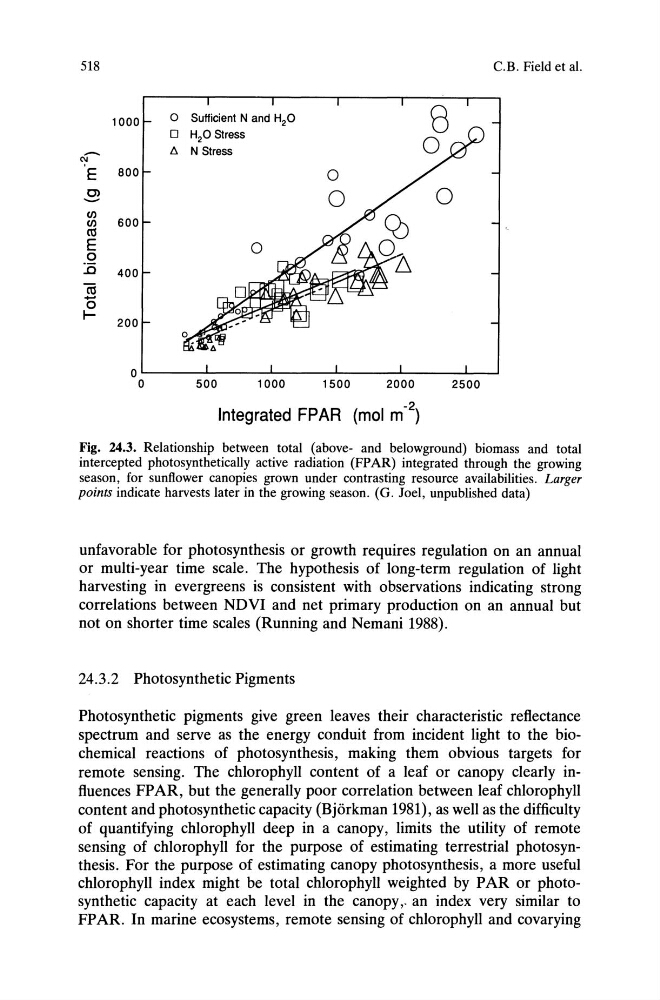
Fig. 24.3. Relationship between total (above- and belowground) biomass and total
intercepted photosynthetically active radiation (FPAR) integrated through the growing
season, for sunflower canopies grown under contrasting resource availabilities. Larger
points indicate harvests later in the growing season. (G. Joel, unpublished data)
unfavorable for photosynthesis or growth requires regulation on an annual
or multi-year time scale. The hypothesis of long-term regulation of light
harvesting in evergreens is consistent with observations indicating strong
correlations between NDVI and net primary production on an annual but
not on shorter time scales (Running and Nemani 1988).
24.3.2 Photosynthetic Pigments
Photosynthetic pigments give green leaves their characteristic reflectance
spectrum and serve as the energy conduit from incident light to the biochemical reactions of photosynthesis, making them obvious targets for
remote sensing. The chlorophyll content of a leaf or canopy clearly influences FP AR, but the generally poor correlation between leaf chlorophyll
content and photosynthetic capacity (Bjorkman 1981), as well as the difficulty
of quantifying chlorophyll deep in a canopy, limits the utility of remote
sensing of chlorophyll for the purpose of estimating terrestrial photosynthesis. For the purpose of estimating canopy photosynthesis, a more useful
chlorophyll index might be total chlorophyll weighted by PAR or photosynthetic capacity at each level in the canopy,. an index very similar to
FP AR. In marine ecosystems, remote sensing of chlorophyll and covarying
C.B. Field et al.
1000
°
Sufficient N and H 2 O
D H 2 0 Stress
-
t,. N Stress
N
E 800
0
0>
0
0
- C/) 600
C/)
CO
E
0
0
:0 400
CO
- 0
I200
0 0
500
1000
1500
2000
2500
Integrated FPAR
-2
(mol m )
Fig. 24.3. Relationship between total (above- and belowground) biomass and total
intercepted photosynthetically active radiation (FPAR) integrated through the growing
season, for sunflower canopies grown under contrasting resource availabilities. Larger
points indicate harvests later in the growing season. (G. Joel, unpublished data)
unfavorable for photosynthesis or growth requires regulation on an annual
or multi-year time scale. The hypothesis of long-term regulation of light
harvesting in evergreens is consistent with observations indicating strong
correlations between NDVI and net primary production on an annual but
not on shorter time scales (Running and Nemani 1988).
24.3.2 Photosynthetic Pigments
Photosynthetic pigments give green leaves their characteristic reflectance
spectrum and serve as the energy conduit from incident light to the biochemical reactions of photosynthesis, making them obvious targets for
remote sensing. The chlorophyll content of a leaf or canopy clearly influences FP AR, but the generally poor correlation between leaf chlorophyll
content and photosynthetic capacity (Bjorkman 1981), as well as the difficulty
of quantifying chlorophyll deep in a canopy, limits the utility of remote
sensing of chlorophyll for the purpose of estimating terrestrial photosynthesis. For the purpose of estimating canopy photosynthesis, a more useful
chlorophyll index might be total chlorophyll weighted by PAR or photosynthetic capacity at each level in the canopy,. an index very similar to
FP AR. In marine ecosystems, remote sensing of chlorophyll and covarying