

Predictions and Measurements of the Maximum Photosynthetic Rate
493
40
35
30
.-.
III
'l'
25
E
(5 20
E
S
~ 15
E
< 10
5
........
o ~~~~~~~~~~~~~
o 50 100 150 200 250 300 350 400
Leaf N (mmol N m- 2 )
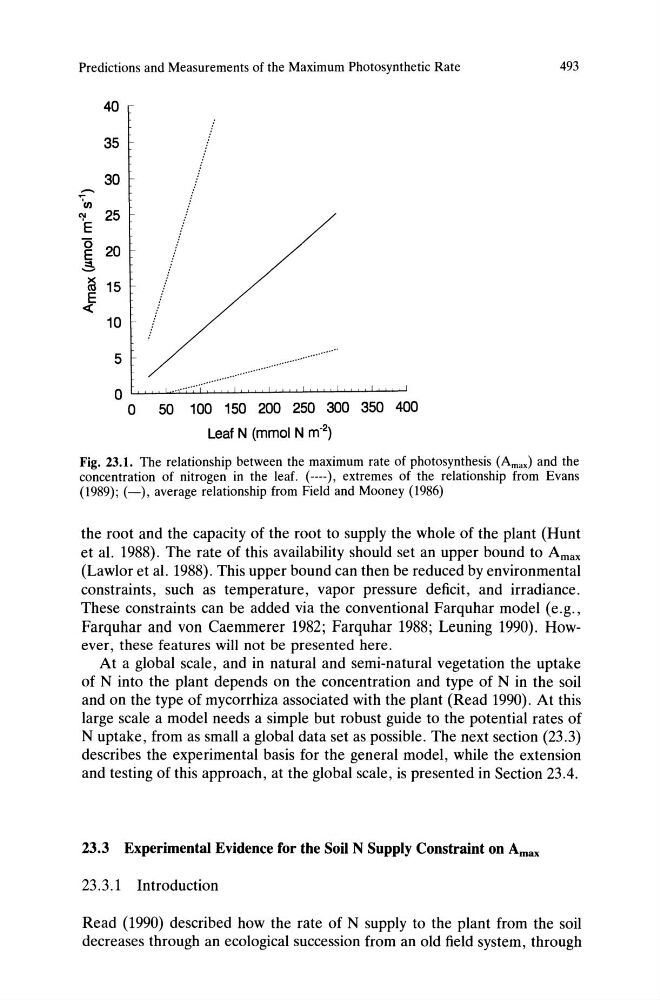
Fig. 23.1. The relationship between the maximum rate of photosynthesis (Amax) and the
concentration of nitrogen in the leaf. (----), extremes of the relationship from Evans
(1989); (-), average relationship from Field and Mooney (1986)
the root and the capacity of the root to supply the whole of the plant (Hunt
et al. 1988). The rate of this availability should set an upper bound to Amax
(Lawlor et al. 1988). This upper bound can then be reduced by environmental
constraints, such as temperature, vapor pressure deficit, and irradiance_
These constraints can be added via the conventional Farquhar model (e.g.,
Farquhar and von Caemmerer 1982; Farquhar 1988; Leuning 1990). However, these features will not be presented here.
At a global scale, and in natural and semi-natural vegetation the uptake
of N into the plant depends on the concentration and type of N in the soil
and on the type of mycorrhiza associated with the plant (Read 1990)_ At this
large scale a model needs a simple but robust guide to the potential rates of
N uptake, from as small a global data set as possible. The next section (23.3)
describes the experimental basis for the general model, while the extension
and testing of this approach, at the global scale, is presented in Section 23.4.
23.3 Experimental Evidence for the Soil N Supply Constraint on Amax
23.3.1 Introduction
Read (1990) described how the rate of N supply to the plant from the soil
decreases through an ecological succession from an old field system, through
493
40
35
30
.-.
III
'l'
25
E
(5 20
E
S
~ 15
E
< 10
5
........
o ~~~~~~~~~~~~~
o 50 100 150 200 250 300 350 400
Leaf N (mmol N m- 2 )
Fig. 23.1. The relationship between the maximum rate of photosynthesis (Amax) and the
concentration of nitrogen in the leaf. (----), extremes of the relationship from Evans
(1989); (-), average relationship from Field and Mooney (1986)
the root and the capacity of the root to supply the whole of the plant (Hunt
et al. 1988). The rate of this availability should set an upper bound to Amax
(Lawlor et al. 1988). This upper bound can then be reduced by environmental
constraints, such as temperature, vapor pressure deficit, and irradiance_
These constraints can be added via the conventional Farquhar model (e.g.,
Farquhar and von Caemmerer 1982; Farquhar 1988; Leuning 1990). However, these features will not be presented here.
At a global scale, and in natural and semi-natural vegetation the uptake
of N into the plant depends on the concentration and type of N in the soil
and on the type of mycorrhiza associated with the plant (Read 1990)_ At this
large scale a model needs a simple but robust guide to the potential rates of
N uptake, from as small a global data set as possible. The next section (23.3)
describes the experimental basis for the general model, while the extension
and testing of this approach, at the global scale, is presented in Section 23.4.
23.3 Experimental Evidence for the Soil N Supply Constraint on Amax
23.3.1 Introduction
Read (1990) described how the rate of N supply to the plant from the soil
decreases through an ecological succession from an old field system, through