

Leaf Diffusive Conductances in the Major Vegetation Types of the Globe
483
100
..:§
0
- Q)
0
C
CIS
- 0 ::J
'0
C 50
0
0
Q)
>
'iii
::J
:t:
:c
- CIS
~
0
r------------------------~gmax
-phase 1
..
6
- - - - phase 2 - - - phase 3 - -
9
gaet = f (vpd)
..
.!:
E
.....
-
- II o a.
C)
gpot 1,2
gpot3
glow
' - - - - - I
------:------:------~____i gmin
12
day time
15
18
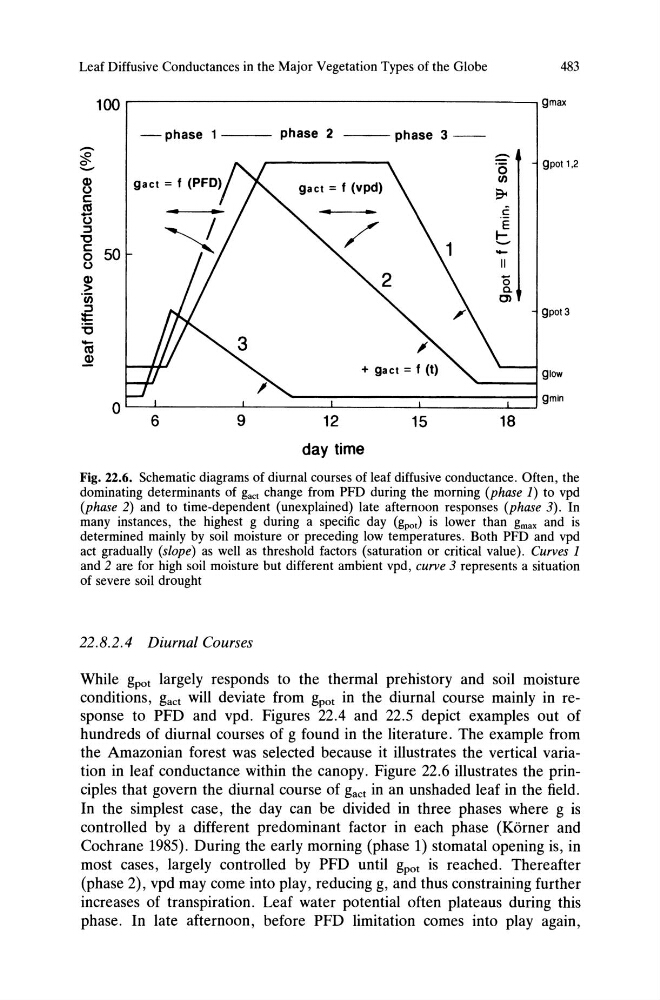
Fig. 22.6. Schematic diagrams of diurnal courses of leaf diffusive conductance. Often, the
dominating determinants of gaet change from PFD during the morning (phase 1) to vpd
(phase 2) and to time-dependent (unexplained) late afternoon responses (phase 3). In
many instances, the highest g during a specific day (gpot) is lower than gmax and is
determined mainly by soil moisture or preceding low temperatures. Both PFD and vpd
act gradually (slope) as well as threshold factors (saturation or critical value). Curves 1
and 2 are for high soil moisture but different ambient vpd, curve 3 represents a situation
of severe soil drought
22.8.2.4 Diurnal Courses
While gpot largely responds to the thermal prehistory and soil moisture
conditions, gaet will deviate from gpot in the diurnal course mainly in response to PFD and vpd. Figures 22.4 and 22.5 depict examples out of
hundreds of diurnal courses of g found in the literature. The example from
the Amazonian forest was selected because it illustrates the vertical variation in leaf conductance within the canopy. Figure 22.6 illustrates the principles that govern the diurnal course of gaet in an unshaded leaf in the field.
In the simplest case, the day can be divided in three phases where g is
controlled by a different predominant factor in each phase (Korner and
Cochrane 1985). During the early morning (phase 1) stomatal opening is, in
most cases, largely controlled by PFD until gpot is reached. Thereafter
(phase 2), vpd may come into play, reducing g, and thus constraining further
increases of transpiration. Leaf water potential often plateaus during this
phase. In late afternoon, before PFD limitation comes into play again,
483
100
..:§
0
- Q)
0
C
CIS
- 0 ::J
'0
C 50
0
0
Q)
>
'iii
::J
:t:
:c
- CIS
~
0
r------------------------~gmax
-phase 1
..
6
- - - - phase 2 - - - phase 3 - -
9
gaet = f (vpd)
..
.!:
E
.....
-
- II o a.
C)
gpot 1,2
gpot3
glow
' - - - - - I
------:------:------~____i gmin
12
day time
15
18
Fig. 22.6. Schematic diagrams of diurnal courses of leaf diffusive conductance. Often, the
dominating determinants of gaet change from PFD during the morning (phase 1) to vpd
(phase 2) and to time-dependent (unexplained) late afternoon responses (phase 3). In
many instances, the highest g during a specific day (gpot) is lower than gmax and is
determined mainly by soil moisture or preceding low temperatures. Both PFD and vpd
act gradually (slope) as well as threshold factors (saturation or critical value). Curves 1
and 2 are for high soil moisture but different ambient vpd, curve 3 represents a situation
of severe soil drought
22.8.2.4 Diurnal Courses
While gpot largely responds to the thermal prehistory and soil moisture
conditions, gaet will deviate from gpot in the diurnal course mainly in response to PFD and vpd. Figures 22.4 and 22.5 depict examples out of
hundreds of diurnal courses of g found in the literature. The example from
the Amazonian forest was selected because it illustrates the vertical variation in leaf conductance within the canopy. Figure 22.6 illustrates the principles that govern the diurnal course of gaet in an unshaded leaf in the field.
In the simplest case, the day can be divided in three phases where g is
controlled by a different predominant factor in each phase (Korner and
Cochrane 1985). During the early morning (phase 1) stomatal opening is, in
most cases, largely controlled by PFD until gpot is reached. Thereafter
(phase 2), vpd may come into play, reducing g, and thus constraining further
increases of transpiration. Leaf water potential often plateaus during this
phase. In late afternoon, before PFD limitation comes into play again,