

28
O. Bjorkman and B. Demmig-Adams
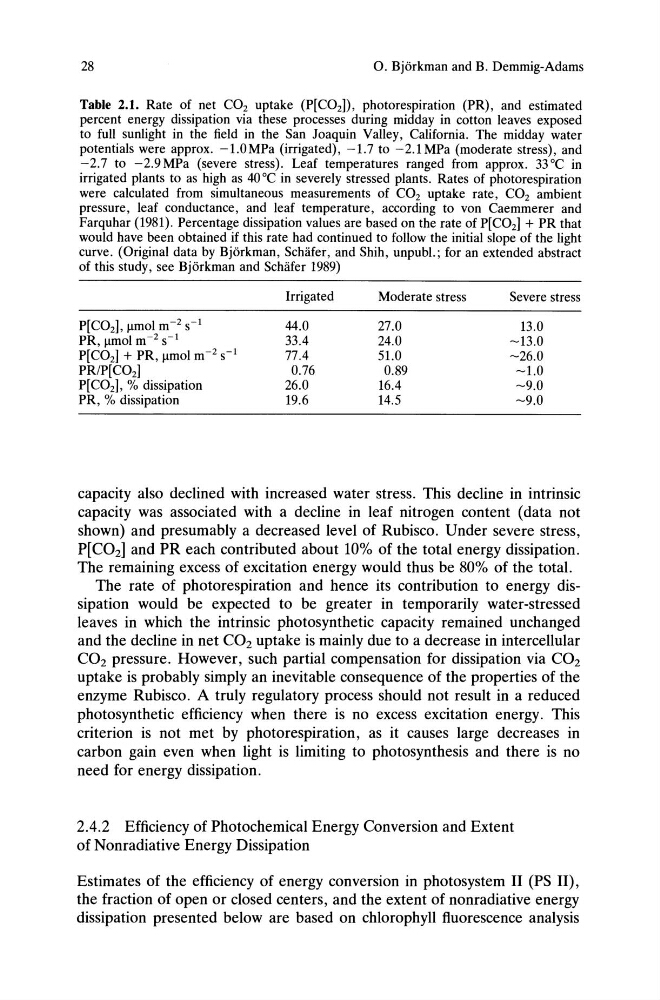
Table 2.1. Rate of net CO2 uptake (P[C02]), photorespiration (PR), and estimated
percent energy dissipation via these processes during midday in cotton leaves exposed
to full sunlight in the field in the San Joaquin Valley, California. The midday water
potentials were approx. -1.0MPa (irrigated), -1.7 to -2.1MPa (moderate stress), and
-2.7 to -2.9MPa (severe stress). Leaf temperatures ranged from approx. 33°C in
irrigated plants to as high as 40°C in severely stressed plants. Rates of photorespiration
were calculated from simultaneous measurements of CO2 uptake rate, CO 2 ambient
pressure, leaf conductance, and leaf temperature, according to von Caemmerer and
Farquhar (1981). Percentage dissipation values are based on the rate of P[C0 2 ] + PR that
would have been obtained if this rate had continued to follow the initial slope of the light
curve. (Original data by Bjorkman, Schafer, and Shih, un pub!. ; for an extended abstract
of this study, see Bjorkman and Schafer 1989)
Irrigated
Moderate stress
Severe stress
P[C0 2 ], Ilmol m- 2 S-1
44.0
27.0
13.0
PR, Ilmol m- 2 S-1
33.4
24.0
~13.0
P[C0 2 ] + PR, Ilmol m- 2 S-1
77.4
51.0
~26.0
PR/P[C02]
0.76
0.89
~1.0
P[C02], % dissipation
26.0
16.4
~9.0
PR, % dissipation
19.6
14.5
~9.0
capacity also declined with increased water stress. This decline in intrinsic
capacity was associated with a decline in leaf nitrogen content (data not
shown) and presumably a decreased level of Rubisco. Under severe stress,
P[C021 and PR each contributed about 10% of the total energy dissipation.
The remaining excess of excitation energy would thus be 80% of the total.
The rate of photo respiration and hence its contribution to energy dissipation would be expected to be greater in temporarily water-stressed
leaves in which the intrinsic photosynthetic capacity remained unchanged
and the decline in net CO2 uptake is mainly due to a decrease in intercellular
CO2 pressure. However, such partial compensation for dissipation via CO2
uptake is probably simply an inevitable consequence of the properties of the
enzyme Rubisco. A truly regulatory process should not result in a reduced
photosynthetic efficiency when there is no excess excitation energy. This
criterion is not met by photorespiration, as it causes large decreases in
carbon gain even when light is limiting to photosynthesis and there is no
need for energy dissipation.
2.4.2 Efficiency of Photochemical Energy Conversion and Extent
of Nonradiative Energy Dissipation
Estimates of the efficiency of energy conversion in photo system II (PS II),
the fraction of open or closed centers, and the extent of nonradiative energy
dissipation presented below are based on chlorophyll fluorescence analysis
O. Bjorkman and B. Demmig-Adams
Table 2.1. Rate of net CO2 uptake (P[C02]), photorespiration (PR), and estimated
percent energy dissipation via these processes during midday in cotton leaves exposed
to full sunlight in the field in the San Joaquin Valley, California. The midday water
potentials were approx. -1.0MPa (irrigated), -1.7 to -2.1MPa (moderate stress), and
-2.7 to -2.9MPa (severe stress). Leaf temperatures ranged from approx. 33°C in
irrigated plants to as high as 40°C in severely stressed plants. Rates of photorespiration
were calculated from simultaneous measurements of CO2 uptake rate, CO 2 ambient
pressure, leaf conductance, and leaf temperature, according to von Caemmerer and
Farquhar (1981). Percentage dissipation values are based on the rate of P[C0 2 ] + PR that
would have been obtained if this rate had continued to follow the initial slope of the light
curve. (Original data by Bjorkman, Schafer, and Shih, un pub!. ; for an extended abstract
of this study, see Bjorkman and Schafer 1989)
Irrigated
Moderate stress
Severe stress
P[C0 2 ], Ilmol m- 2 S-1
44.0
27.0
13.0
PR, Ilmol m- 2 S-1
33.4
24.0
~13.0
P[C0 2 ] + PR, Ilmol m- 2 S-1
77.4
51.0
~26.0
PR/P[C02]
0.76
0.89
~1.0
P[C02], % dissipation
26.0
16.4
~9.0
PR, % dissipation
19.6
14.5
~9.0
capacity also declined with increased water stress. This decline in intrinsic
capacity was associated with a decline in leaf nitrogen content (data not
shown) and presumably a decreased level of Rubisco. Under severe stress,
P[C021 and PR each contributed about 10% of the total energy dissipation.
The remaining excess of excitation energy would thus be 80% of the total.
The rate of photo respiration and hence its contribution to energy dissipation would be expected to be greater in temporarily water-stressed
leaves in which the intrinsic photosynthetic capacity remained unchanged
and the decline in net CO2 uptake is mainly due to a decrease in intercellular
CO2 pressure. However, such partial compensation for dissipation via CO2
uptake is probably simply an inevitable consequence of the properties of the
enzyme Rubisco. A truly regulatory process should not result in a reduced
photosynthetic efficiency when there is no excess excitation energy. This
criterion is not met by photorespiration, as it causes large decreases in
carbon gain even when light is limiting to photosynthesis and there is no
need for energy dissipation.
2.4.2 Efficiency of Photochemical Energy Conversion and Extent
of Nonradiative Energy Dissipation
Estimates of the efficiency of energy conversion in photo system II (PS II),
the fraction of open or closed centers, and the extent of nonradiative energy
dissipation presented below are based on chlorophyll fluorescence analysis