

Regulation of Photosynthetic Light Energy Capture
25
1.0 r - r - - - - , r - - - , - - - , - - - - - - , - - ,
:§:
0.8
Q)
(j
c 0.6
0
+'
0.
L
0
Ul
0.4
..c
0
......
0
Q)
....J
0.2
Oxalis oregana
0.0
400
500
600
700
800
Wavelength, nm
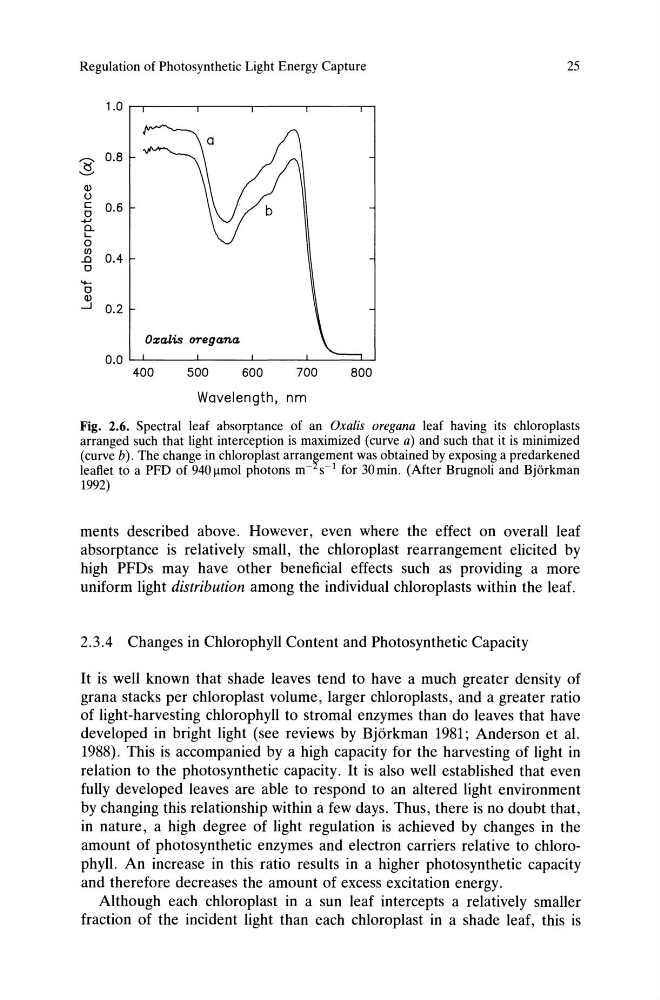
Fig. 2.6. Spectral leaf absorptance of an Oxalis oregana leaf having its chloroplasts
arranged such that light interception is maximized (curve a) and such that it is minimized
(curve b). The change in chloroplast arran~ement was obtained by exposing a predarkened
leaflet to a PFD of 940llmol photons m- S-1 for 30min. (After Brugnoli and Bjorkman
1992)
ments described above. However, even where the effect on overall leaf
absorptance is relatively small, the chloroplast rearrangement elicited by
high PFDs may have other beneficial effects such as providing a more
uniform light distribution among the individual chloroplasts within the leaf.
2.3.4 Changes in Chlorophyll Content and Photosynthetic Capacity
It is well known that shade leaves tend to have a much greater density of
grana stacks per chloroplast volume, larger chloroplasts, and a greater ratio
of light-harvesting chlorophyll to stromal enzymes than do leaves that have
developed in bright light (see reviews by Bjorkman 1981; Anderson et al.
1988). This is accompanied by a high capacity for the harvesting of light in
relation to the photosynthetic capacity. It is also well established that even
fully developed leaves are able to respond to an altered light environment
by changing this relationship within a few days. Thus, there is no doubt that,
in nature, a high degree of light regulation is achieved by changes in the
amount of photosynthetic enzymes and electron carriers relative to chlorophyll. An increase in this ratio results in a higher photosynthetic capacity
and therefore decreases the amount of excess excitation energy.
Although each chloroplast in a sun leaf intercepts a relatively smaller
fraction of the incident light than each chloroplast in a shade leaf, this is
25
1.0 r - r - - - - , r - - - , - - - , - - - - - - , - - ,
:§:
0.8
Q)
(j
c 0.6
0
+'
0.
L
0
Ul
0.4
..c
0
......
0
Q)
....J
0.2
Oxalis oregana
0.0
400
500
600
700
800
Wavelength, nm
Fig. 2.6. Spectral leaf absorptance of an Oxalis oregana leaf having its chloroplasts
arranged such that light interception is maximized (curve a) and such that it is minimized
(curve b). The change in chloroplast arran~ement was obtained by exposing a predarkened
leaflet to a PFD of 940llmol photons m- S-1 for 30min. (After Brugnoli and Bjorkman
1992)
ments described above. However, even where the effect on overall leaf
absorptance is relatively small, the chloroplast rearrangement elicited by
high PFDs may have other beneficial effects such as providing a more
uniform light distribution among the individual chloroplasts within the leaf.
2.3.4 Changes in Chlorophyll Content and Photosynthetic Capacity
It is well known that shade leaves tend to have a much greater density of
grana stacks per chloroplast volume, larger chloroplasts, and a greater ratio
of light-harvesting chlorophyll to stromal enzymes than do leaves that have
developed in bright light (see reviews by Bjorkman 1981; Anderson et al.
1988). This is accompanied by a high capacity for the harvesting of light in
relation to the photosynthetic capacity. It is also well established that even
fully developed leaves are able to respond to an altered light environment
by changing this relationship within a few days. Thus, there is no doubt that,
in nature, a high degree of light regulation is achieved by changes in the
amount of photosynthetic enzymes and electron carriers relative to chlorophyll. An increase in this ratio results in a higher photosynthetic capacity
and therefore decreases the amount of excess excitation energy.
Although each chloroplast in a sun leaf intercepts a relatively smaller
fraction of the incident light than each chloroplast in a shade leaf, this is