

Effects of Phenology, Physiology, and Gradients in Community Composition
449
-
(1)"~ 'Cf)
- Q,N
::),
E
d"o
(J E
:::l
-
8.----------------------------.
6
4
+ Tussocks
o Intertussock areas
A GAS-FLUX Model
+
+
0\ +
:t ~
A
+ +
o
o
o
1000
.f
:~
+ +
- A A
: :
fAA
o
- 2 - 1
PFD (Ilmol m
s )
2000
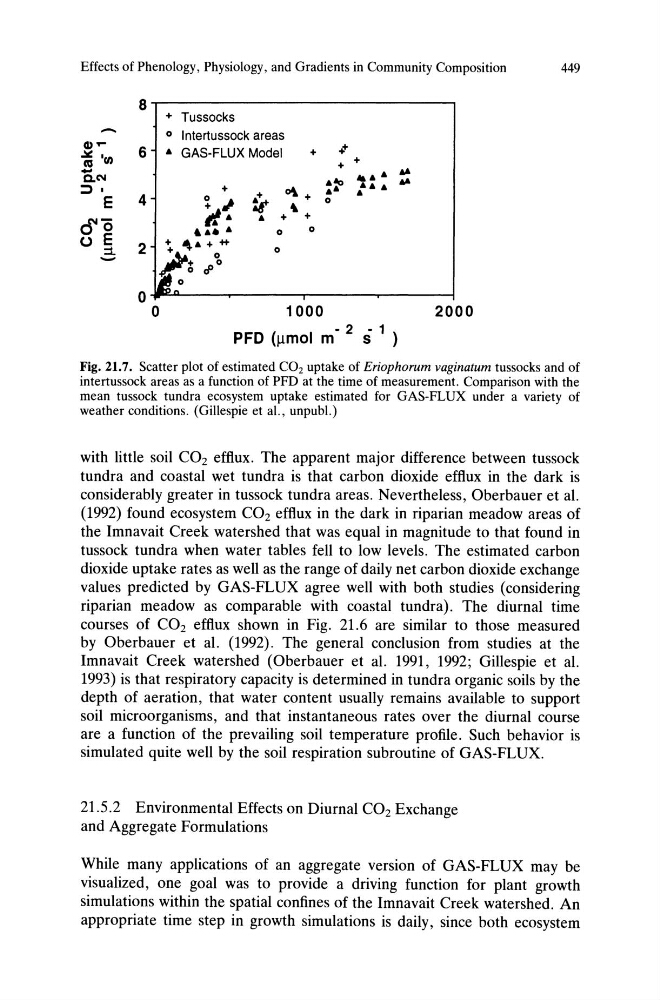
Fig. 21.7. Scatter plot of estimated CO2 uptake of Eriophorum vaginatum tussocks and of
intertussock areas as a function of PFD at the time of measurement. Comparison with the
mean tussock tundra ecosystem uptake estimated for GAS-FLUX under a variety of
weather conditions. (Gillespie et aI., unpuhl.)
with little soil CO2 efflux. The apparent major difference between tussock
tundra and coastal wet tundra is that carbon dioxide efflux in the dark is
considerably greater in tussock tundra areas. Nevertheless, Oberbauer et al.
(1992) found ecosystem CO2 efflux in the dark in riparian meadow areas of
the Imnavait Creek watershed that was equal in magnitude to that found in
tussock tundra when water tables fell to low levels. The estimated carbon
dioxide uptake rates as well as the range of daily net carbon dioxide exchange
values predicted by GAS-FLUX agree well with both studies (considering
riparian meadow as comparable with coastal tundra). The diurnal time
courses of CO2 efflux shown in Fig. 21.6 are similar to those measured
by Oberbauer et al. (1992). The general conclusion from studies at the
Imnavait Creek watershed (Oberbauer et al. 1991, 1992; Gillespie et al.
1993) is that respiratory capacity is determined in tundra organic soils by the
depth of aeration, that water content usually remains available to support
soil microorganisms, and that instantaneous rates over the diurnal course
are a function of the prevailing soil temperature profile. Such behavior is
simulated quite well by the soil respiration subroutine of GAS-FLUX.
21.5.2 Environmental Effects on Diurnal CO 2 Exchange
and Aggregate Formulations
While many applications of an aggregate version of GAS-FLUX may be
visualized, one goal was to provide a driving function for plant growth
simulations within the spatial confines of the Imnavait Creek watershed. An
appropriate time step in growth simulations is daily, since both ecosystem
449
-
(1)"~ 'Cf)
- Q,N
::),
E
d"o
(J E
:::l
-
8.----------------------------.
6
4
+ Tussocks
o Intertussock areas
A GAS-FLUX Model
+
+
0\ +
:t ~
A
+ +
o
o
o
1000
.f
:~
+ +
- A A
: :
fAA
o
- 2 - 1
PFD (Ilmol m
s )
2000
Fig. 21.7. Scatter plot of estimated CO2 uptake of Eriophorum vaginatum tussocks and of
intertussock areas as a function of PFD at the time of measurement. Comparison with the
mean tussock tundra ecosystem uptake estimated for GAS-FLUX under a variety of
weather conditions. (Gillespie et aI., unpuhl.)
with little soil CO2 efflux. The apparent major difference between tussock
tundra and coastal wet tundra is that carbon dioxide efflux in the dark is
considerably greater in tussock tundra areas. Nevertheless, Oberbauer et al.
(1992) found ecosystem CO2 efflux in the dark in riparian meadow areas of
the Imnavait Creek watershed that was equal in magnitude to that found in
tussock tundra when water tables fell to low levels. The estimated carbon
dioxide uptake rates as well as the range of daily net carbon dioxide exchange
values predicted by GAS-FLUX agree well with both studies (considering
riparian meadow as comparable with coastal tundra). The diurnal time
courses of CO2 efflux shown in Fig. 21.6 are similar to those measured
by Oberbauer et al. (1992). The general conclusion from studies at the
Imnavait Creek watershed (Oberbauer et al. 1991, 1992; Gillespie et al.
1993) is that respiratory capacity is determined in tundra organic soils by the
depth of aeration, that water content usually remains available to support
soil microorganisms, and that instantaneous rates over the diurnal course
are a function of the prevailing soil temperature profile. Such behavior is
simulated quite well by the soil respiration subroutine of GAS-FLUX.
21.5.2 Environmental Effects on Diurnal CO 2 Exchange
and Aggregate Formulations
While many applications of an aggregate version of GAS-FLUX may be
visualized, one goal was to provide a driving function for plant growth
simulations within the spatial confines of the Imnavait Creek watershed. An
appropriate time step in growth simulations is daily, since both ecosystem