

Effects of Phenology, Physiology, and Gradients in Community Composition
447
influencing tundra carbon balance. High water tables that result in decreased
soil respiration were observed only in conjunction with the wettest conditions in tussock tundra and riparian meadow. In the results shown below,
high water table situations decreased soil respiration by approximately 50%
when moss and soil water content was equal to 1100% of dry weight.
21.5 Simulations of Ecosystem CO2 Exchange
21.5.1 Diurnal Course of Gas Exchange of Major Tundra Structural
Components
Examples of the diurnal course for carbon dioxide exchange of vascular
plant leaves, Sphagnum moss, vascular plant twigs and stems, and of the soil
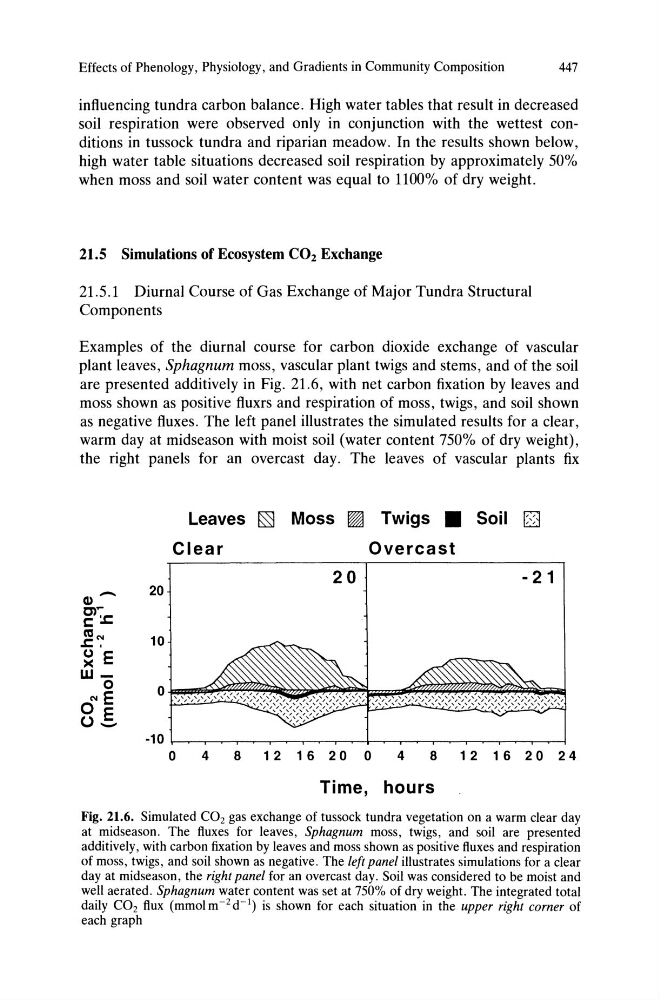
are presented additively in Fig. 21.6, with net carbon fixation by leaves and
moss shown as positive fluxrs and respiration of moss, twigs, and soil shown
as negative fluxes. The left panel illustrates the simulated results for a clear,
warm day at midseason with moist soil (water content 750% of dry weight),
the right panels for an overcast day. The leaves of vascular plants fix
Fig. 21.6. Simulated COl gas exchange of tussock tundra vegetation on a warm clear day
at midseason. The fluxes for leaves, Sphagnum moss, twigs, and soil are presented
additively, with carbon fixation by leaves and moss shown as positive fluxes and respiration
of moss, twigs, and soil shown as negative. The left panel illustrates simulations for a clear
day at midseason, the right panel for an overcast day. Soil was considered to be moist and
well aerated. Sphagnum water content was set at 750% of dry weight. The integrated total
daily COl flux (mmolm-ld- I ) is shown for each situation in the upper right corner of
each graph
447
influencing tundra carbon balance. High water tables that result in decreased
soil respiration were observed only in conjunction with the wettest conditions in tussock tundra and riparian meadow. In the results shown below,
high water table situations decreased soil respiration by approximately 50%
when moss and soil water content was equal to 1100% of dry weight.
21.5 Simulations of Ecosystem CO2 Exchange
21.5.1 Diurnal Course of Gas Exchange of Major Tundra Structural
Components
Examples of the diurnal course for carbon dioxide exchange of vascular
plant leaves, Sphagnum moss, vascular plant twigs and stems, and of the soil
are presented additively in Fig. 21.6, with net carbon fixation by leaves and
moss shown as positive fluxrs and respiration of moss, twigs, and soil shown
as negative fluxes. The left panel illustrates the simulated results for a clear,
warm day at midseason with moist soil (water content 750% of dry weight),
the right panels for an overcast day. The leaves of vascular plants fix
Fig. 21.6. Simulated COl gas exchange of tussock tundra vegetation on a warm clear day
at midseason. The fluxes for leaves, Sphagnum moss, twigs, and soil are presented
additively, with carbon fixation by leaves and moss shown as positive fluxes and respiration
of moss, twigs, and soil shown as negative. The left panel illustrates simulations for a clear
day at midseason, the right panel for an overcast day. Soil was considered to be moist and
well aerated. Sphagnum water content was set at 750% of dry weight. The integrated total
daily COl flux (mmolm-ld- I ) is shown for each situation in the upper right corner of
each graph