

440
J.D. Tenhunen et al.
July 23, 1988
Eriophorum vagina tum Salix pulchra
Ledum palustre
1600
,
..
N
1200
20
,
E
()
"0 800
.;,
E
::1.
10
"
...,
Q 400
oJ
...
fQ.
0
0
' . .
~
co
... 20
. .
. .
co
co
...
...
E
-10
i
10
6~
~
-20
300 .UI
' .
6
N
,
'E
E
4
200 "0
"0
E
E
E
E
2
E
100
oi
ui
0
18
' .
~
N
14
E
E
6
A~
0
::1.
ci 2
A
-2
0
4
8 12 16 20 0
4
8
12 16 20 0
4
8 12 16 20
Time,
hours
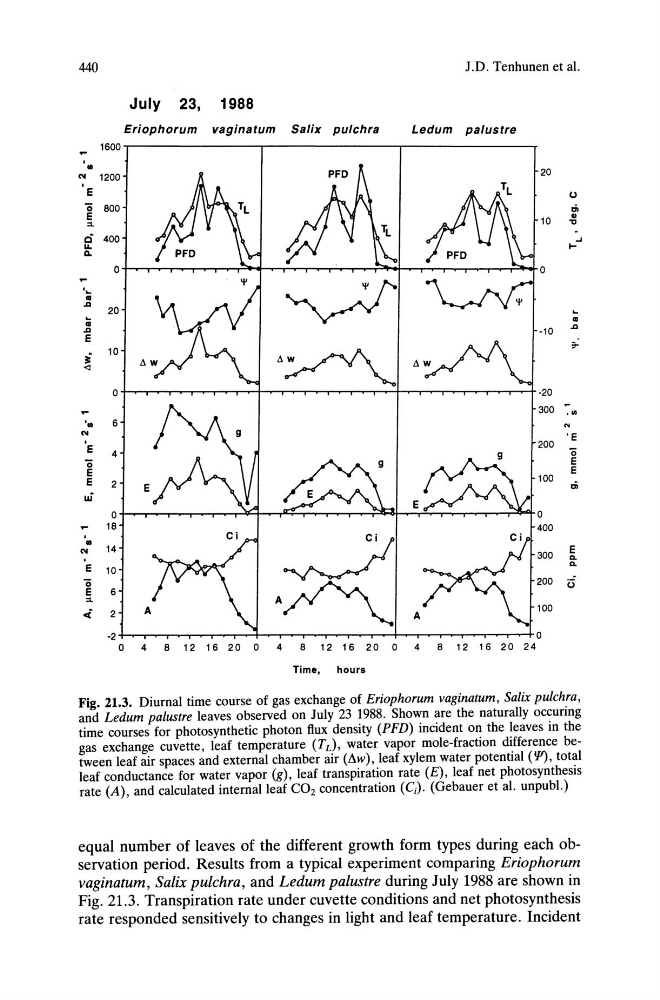
Fig. 21.3. Diurnal time course of gas exchange of Eriophorum vaginatum, Salix pulchra,
and Ledum palustre leaves observed on July 23 1988. Shown are the naturally occuring
time courses for photosynthetic photon flux density (PFD) incident on the leaves in the
gas exchange cuvette, leaf temperature (Td, water vapor mole-fraction difference between leaf air spaces and external chamber air (~w), leaf xylem water potential ('P), total
leaf conductance for water vapor (g), leaf transpiration rate (E), leaf net photosynthesis
rate (A), and calculated internal leaf CO2 concentration (C;). (Gebauer et al. unpubl.)
equal number of leaves of the different growth form types during each observation period. Results from a typical experiment comparing Eriophorum
vaginatum, Salix pulchra, and Ledum palustre during July 1988 are shown in
Fig. 21.3. Transpiration rate under cuvette conditions and net photosynthesis
rate responded sensitively to changes in light and leaf temperature. Incident
J.D. Tenhunen et al.
July 23, 1988
Eriophorum vagina tum Salix pulchra
Ledum palustre
1600
,
..
N
1200
20
,
E
()
"0 800
.;,
E
::1.
10
"
...,
Q 400
oJ
...
fQ.
0
0
' . .
~
co
... 20
. .
. .
co
co
...
...
E
-10
i
10
6~
~
-20
300 .UI
' .
6
N
,
'E
E
4
200 "0
"0
E
E
E
E
2
E
100
oi
ui
0
18
' .
~
N
14
E
E
6
A~
0
::1.
ci 2
A
-2
0
4
8 12 16 20 0
4
8
12 16 20 0
4
8 12 16 20
Time,
hours
Fig. 21.3. Diurnal time course of gas exchange of Eriophorum vaginatum, Salix pulchra,
and Ledum palustre leaves observed on July 23 1988. Shown are the naturally occuring
time courses for photosynthetic photon flux density (PFD) incident on the leaves in the
gas exchange cuvette, leaf temperature (Td, water vapor mole-fraction difference between leaf air spaces and external chamber air (~w), leaf xylem water potential ('P), total
leaf conductance for water vapor (g), leaf transpiration rate (E), leaf net photosynthesis
rate (A), and calculated internal leaf CO2 concentration (C;). (Gebauer et al. unpubl.)
equal number of leaves of the different growth form types during each observation period. Results from a typical experiment comparing Eriophorum
vaginatum, Salix pulchra, and Ledum palustre during July 1988 are shown in
Fig. 21.3. Transpiration rate under cuvette conditions and net photosynthesis
rate responded sensitively to changes in light and leaf temperature. Incident