

416
100
...--.
C!' 1
'--'
c: 75
o
Ql
I
ON 50
U
<1l
>
"0 25
<1l
....
o
_
.haded taliage
o uppo' loct loyer
_
l
a"o, holt at canapy
J F M A M J J A SON D
W. Beyschlag et al.
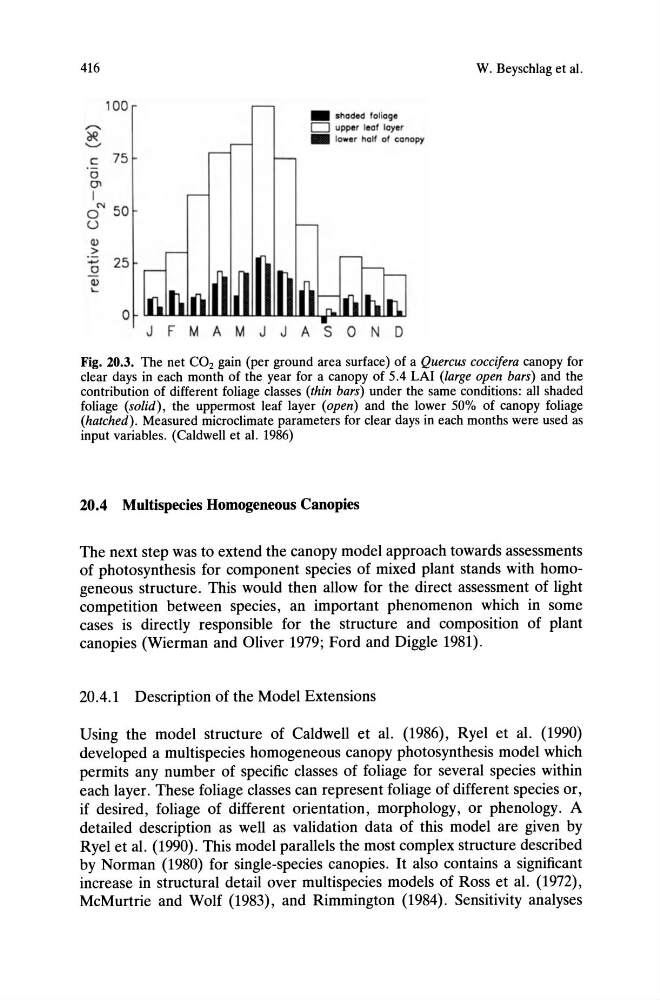
Fig. 20.3. The net CO2 gain (per ground area surface) of a Quercus coccifera canopy for
clear days in each month of the year for a canopy of 5.4 LAI (large open bars) and the
contribution of different foliage classes (thin bars) under the same conditions: all shaded
foliage (solid), the uppermost leaf layer (open) and the lower 50% of canopy foliage
(hatched). Measured microclimate parameters for clear days in each months were used as
input variables. (Caldwell et al. 1986)
20.4 Multispecies Homogeneous Canopies
The next step was to extend the canopy model approach towards assessments
of photosynthesis for component species of mixed plant stands with homogeneous structure. This would then allow for the direct assessment of light
competition between species, an important phenomenon which in some
cases is directly responsible for the structure and composition of plant
canopies (Wierman and Oliver 1979; Ford and Diggle 1981).
20.4.1 Description of the Model Extensions
Using the model structure of Caldwell et al. (1986), Ryel et al. (1990)
developed a multispecies homogeneous canopy photosynthesis model which
permits any number of specific classes of foliage for several species within
each layer. These foliage classes can represent foliage of different species or,
if desired, foliage of different orientation, morphology, or phenology. A
detailed description as well as validation data of this model are given by
Ryel et al. (1990). This model parallels the most complex structure described
by Norman (1980) for single-species canopies. It also contains a significant
increase in structural detail over multispecies models of Ross et al. (1972),
McMurtrie and Wolf (1983), and Rimmington (1984). Sensitivity analyses
100
...--.
C!' 1
'--'
c: 75
o
Ql
I
ON 50
U
<1l
>
"0 25
<1l
....
o
_
.haded taliage
o uppo' loct loyer
_
l
a"o, holt at canapy
J F M A M J J A SON D
W. Beyschlag et al.
Fig. 20.3. The net CO2 gain (per ground area surface) of a Quercus coccifera canopy for
clear days in each month of the year for a canopy of 5.4 LAI (large open bars) and the
contribution of different foliage classes (thin bars) under the same conditions: all shaded
foliage (solid), the uppermost leaf layer (open) and the lower 50% of canopy foliage
(hatched). Measured microclimate parameters for clear days in each months were used as
input variables. (Caldwell et al. 1986)
20.4 Multispecies Homogeneous Canopies
The next step was to extend the canopy model approach towards assessments
of photosynthesis for component species of mixed plant stands with homogeneous structure. This would then allow for the direct assessment of light
competition between species, an important phenomenon which in some
cases is directly responsible for the structure and composition of plant
canopies (Wierman and Oliver 1979; Ford and Diggle 1981).
20.4.1 Description of the Model Extensions
Using the model structure of Caldwell et al. (1986), Ryel et al. (1990)
developed a multispecies homogeneous canopy photosynthesis model which
permits any number of specific classes of foliage for several species within
each layer. These foliage classes can represent foliage of different species or,
if desired, foliage of different orientation, morphology, or phenology. A
detailed description as well as validation data of this model are given by
Ryel et al. (1990). This model parallels the most complex structure described
by Norman (1980) for single-species canopies. It also contains a significant
increase in structural detail over multispecies models of Ross et al. (1972),
McMurtrie and Wolf (1983), and Rimmington (1984). Sensitivity analyses