

410
W. Beyschlag et al.
20.3 The Simple Case: Single-Species Homogeneous Canopies
The simple case is a canopy consisting of only one species which is relatively
uniform in height. Foliage density may vary to a large extent vertically
within the canopy but its horizontal distribution is relatively homogeneous.
The canopy can be subdivided into several horizontal layers, each of which
is assumed to be structurally similar and to have the same foliage orientation.
This canopy is one-dimensional in design as differences in structure are only
a function of height within the canopy. Several such models exist, but we
will briefly describe one of Caldwell et al. (1986) used to determine the
contribution of different foliage classes, such as shaded foliage or foliage at
the top of the canopy, of a Quercus coccifera canopy in a Mediterranean
macchia. Since all the models in this chapter use the same basic approach,
this section begins with a short description of this model.
20.3.1 General Model Description
The canopy model of Caldwell et al. (1986) contains most of the important
parts of a more complete canopy model (Norman 1978). The photosynthesis
submodel calculates gross photosynthesis, dark respiration, and transpiration
using as inputs incident light, leaf and air temperatures, relative humidity,
ambient CO2 concentration, and predawn soil moisture potential. It contains
routines within the microclimatic sub model to calculate incident light on various classes of leaves, air temperature within the canopy, longwave radiation
penetration into the canopy, and leaf temperature using as inputs solar
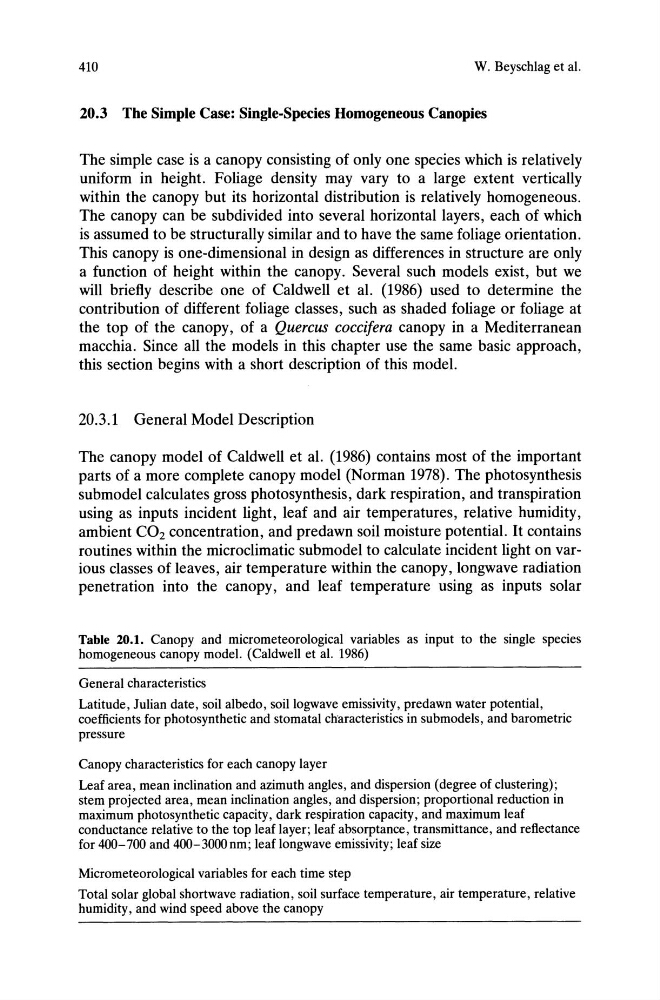
Table 20.1. Canopy and micrometeorological variables as input to the single species
homogeneous canopy model. (Caldwell et al. 1986)
General characteristics
Latitude, Julian date, soil albedo, soillogwave emissivity, predawn water potential,
coefficients for photosynthetic and stomatal characteristics in submodels, and barometric
pressure
Canopy characteristics for each canopy layer
Leaf area, mean inclination and azimuth angles, and dispersion (degree of clustering);
stem projected area, mean inclination angles, and dispersion; proportional reduction in
maximum photosynthetic capacity, dark respiration capacity, and maximum leaf
conductance relative to the top leaf layer; leaf absorptance, transmittance, and reflectance
for 400-700 and 400-3000nm; leaf longwave emissivity; leaf size
Micrometeorological variables for each time step
Total solar global shortwave radiation, soil surface temperature, air temperature, relative
humidity, and wind speed above the canopy
W. Beyschlag et al.
20.3 The Simple Case: Single-Species Homogeneous Canopies
The simple case is a canopy consisting of only one species which is relatively
uniform in height. Foliage density may vary to a large extent vertically
within the canopy but its horizontal distribution is relatively homogeneous.
The canopy can be subdivided into several horizontal layers, each of which
is assumed to be structurally similar and to have the same foliage orientation.
This canopy is one-dimensional in design as differences in structure are only
a function of height within the canopy. Several such models exist, but we
will briefly describe one of Caldwell et al. (1986) used to determine the
contribution of different foliage classes, such as shaded foliage or foliage at
the top of the canopy, of a Quercus coccifera canopy in a Mediterranean
macchia. Since all the models in this chapter use the same basic approach,
this section begins with a short description of this model.
20.3.1 General Model Description
The canopy model of Caldwell et al. (1986) contains most of the important
parts of a more complete canopy model (Norman 1978). The photosynthesis
submodel calculates gross photosynthesis, dark respiration, and transpiration
using as inputs incident light, leaf and air temperatures, relative humidity,
ambient CO2 concentration, and predawn soil moisture potential. It contains
routines within the microclimatic sub model to calculate incident light on various classes of leaves, air temperature within the canopy, longwave radiation
penetration into the canopy, and leaf temperature using as inputs solar
Table 20.1. Canopy and micrometeorological variables as input to the single species
homogeneous canopy model. (Caldwell et al. 1986)
General characteristics
Latitude, Julian date, soil albedo, soillogwave emissivity, predawn water potential,
coefficients for photosynthetic and stomatal characteristics in submodels, and barometric
pressure
Canopy characteristics for each canopy layer
Leaf area, mean inclination and azimuth angles, and dispersion (degree of clustering);
stem projected area, mean inclination angles, and dispersion; proportional reduction in
maximum photosynthetic capacity, dark respiration capacity, and maximum leaf
conductance relative to the top leaf layer; leaf absorptance, transmittance, and reflectance
for 400-700 and 400-3000nm; leaf longwave emissivity; leaf size
Micrometeorological variables for each time step
Total solar global shortwave radiation, soil surface temperature, air temperature, relative
humidity, and wind speed above the canopy