

Regulation of Photosynthetic Light Energy Capture
21
20r---,---,----.---.----,---,----.---.-.
Sunfleck
Q)
0
Q)
L
Ol
Q)
-20
-0
,...."
c;.. -40
~
Ol
C
0
-60
'+0
Q)
-1
-80
OzaLis oregano.
-100 ~--~--~----~~~----~--~----~--~~
-20 -10
o
10
20
30
40
50
60
Time, min
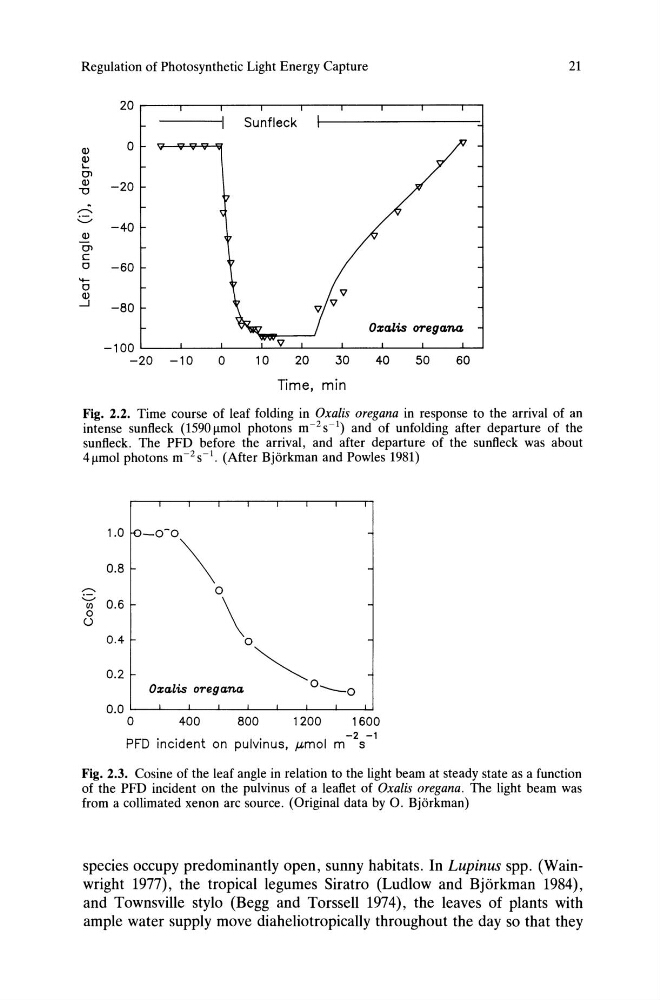
Fig. 2.2. Time course of leaf folding in Oxalis oregana in response to the arrival of an
intense sunfleck (1590flmol photons m- 2 s- 1 ) and of unfolding after departure of the
sunfleck. The PFD before the arrival, and after departure of the sunfleck was about
4flmol photons m- 2 s- 1 . (After Bjorkman and Powles 1981)
1.0 [0-0-0
0.8
\
.---.
o
.:::;,
Vl
0.6
o
\
o~
u
0.4
0.2
Ozalis oregano,
0 ____ 0
O. 0 ~~ __ ___' _ __ ~ __ "'______' __ ---l-_ _ __'__ _ _ ..L.J
o
400
800
1200
1600
-2 -1
PFD incident on pulvinus, jtmol m s
Fig. 2.3. Cosine of the leaf angle in relation to the light beam at steady state as a function
of the PFD incident on the pulvinus of a leaflet of Oxalis oregana. The light beam was
from a collimated xenon arc source. (Original data by O. Bjorkman)
species occupy predominantly open, sunny habitats. In Lupinus spp. (Wainwright 1977), the tropical legumes Siratro (Ludlow and Bjorkman 1984),
and Townsville stylo (Begg and Torssell 1974), the leaves of plants with
ample water supply move diaheliotropically throughout the day so that they
21
20r---,---,----.---.----,---,----.---.-.
Sunfleck
Q)
0
Q)
L
Ol
Q)
-20
-0
,...."
c;.. -40
~
Ol
C
0
-60
'+0
Q)
-1
-80
OzaLis oregano.
-100 ~--~--~----~~~----~--~----~--~~
-20 -10
o
10
20
30
40
50
60
Time, min
Fig. 2.2. Time course of leaf folding in Oxalis oregana in response to the arrival of an
intense sunfleck (1590flmol photons m- 2 s- 1 ) and of unfolding after departure of the
sunfleck. The PFD before the arrival, and after departure of the sunfleck was about
4flmol photons m- 2 s- 1 . (After Bjorkman and Powles 1981)
1.0 [0-0-0
0.8
\
.---.
o
.:::;,
Vl
0.6
o
\
o~
u
0.4
0.2
Ozalis oregano,
0 ____ 0
O. 0 ~~ __ ___' _ __ ~ __ "'______' __ ---l-_ _ __'__ _ _ ..L.J
o
400
800
1200
1600
-2 -1
PFD incident on pulvinus, jtmol m s
Fig. 2.3. Cosine of the leaf angle in relation to the light beam at steady state as a function
of the PFD incident on the pulvinus of a leaflet of Oxalis oregana. The light beam was
from a collimated xenon arc source. (Original data by O. Bjorkman)
species occupy predominantly open, sunny habitats. In Lupinus spp. (Wainwright 1977), the tropical legumes Siratro (Ludlow and Bjorkman 1984),
and Townsville stylo (Begg and Torssell 1974), the leaves of plants with
ample water supply move diaheliotropically throughout the day so that they