

404
H. Ziegler
Table 19.3. Continued
Australia
Ol3C
OD
Tapinanthus oleifolius
-17.60
-58.9
Aloe dichotoma Masson (CAM)
-13.79
-42.8
Neuhof, Namibia (3/87)
Viscum biflorum
-28.70
-62.9
Acacia heterophylla Willd.
-28.65
-61.5
Maido, Reunion (4/89)
Viscum capense L.f.
-26.53
-59.5
Boscia foetida Schinz
-23.52
-59.2
Kamelhof, Namibia (4/87)
Viscum capense
-23.96
-46.5
Zygophyllum divaricatum
-24.74
-97.7
Bloomvelt (4/87)
Viscum capense
-27.77
-40.3
Antizoma miersiana
-23.48
-73.3
Bloomvelt (4/87)
Vis cum capense
-25.90
-58.9
Euphorbia mauretanica L. (CAM)
-18.44
-63.4
Karroo Bot. Garden (3/86)
Viscum crassulae Echl. & Zeyh.
-26.20
-6.2
Portulacaria afra Jacg. (CAM)
-22.54
-6.1
Karroo Bot. Garden (3/86)
Viscum rotundifolium L.f.
-27.58
-52.9
Ehretia rigida (Thunb.) Druce
-23.94
-58.8
Khomas Hochland, Namibia (3/87)
Vis cum rotundifolium
-25.69
-28.6
Boscia foetida Schinz
-23.24
-59.2
Neuhof, Namibia (3/87)
Viscum rotundifolium
-28.83
-38.5
Maerua schinzii Pax
-25.46
-56.5
Seeriem, Namibia (3/87)
Viscum sp.
-30.79
-47.5
Macarisia sp.
-31.52
-69.1
Madagascar (Kluge leg., 88)
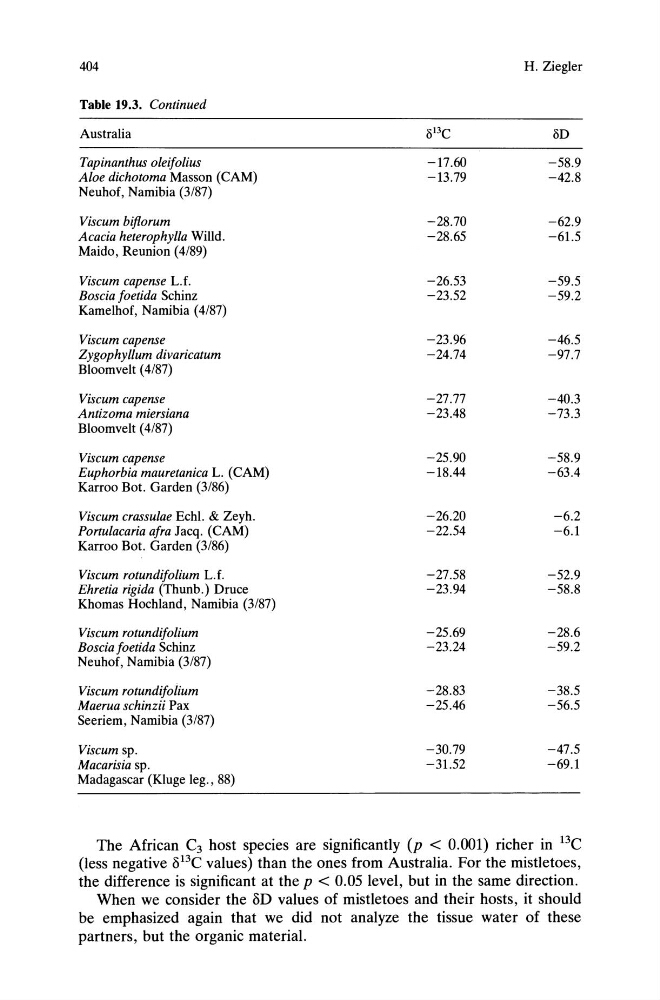
The African C 3 host species are significantly (p < 0.001) richer in 13C
(less negative (i13C values) than the ones from Australia. For the mistletoes,
the difference is significant at the p < 0.05 level, but in the same direction.
When we consider the (iD values of mistletoes and their hosts, it should
be emphasized again that we did not analyze the tissue water of these
partners, but the organic material.
H. Ziegler
Table 19.3. Continued
Australia
Ol3C
OD
Tapinanthus oleifolius
-17.60
-58.9
Aloe dichotoma Masson (CAM)
-13.79
-42.8
Neuhof, Namibia (3/87)
Viscum biflorum
-28.70
-62.9
Acacia heterophylla Willd.
-28.65
-61.5
Maido, Reunion (4/89)
Viscum capense L.f.
-26.53
-59.5
Boscia foetida Schinz
-23.52
-59.2
Kamelhof, Namibia (4/87)
Viscum capense
-23.96
-46.5
Zygophyllum divaricatum
-24.74
-97.7
Bloomvelt (4/87)
Viscum capense
-27.77
-40.3
Antizoma miersiana
-23.48
-73.3
Bloomvelt (4/87)
Vis cum capense
-25.90
-58.9
Euphorbia mauretanica L. (CAM)
-18.44
-63.4
Karroo Bot. Garden (3/86)
Viscum crassulae Echl. & Zeyh.
-26.20
-6.2
Portulacaria afra Jacg. (CAM)
-22.54
-6.1
Karroo Bot. Garden (3/86)
Viscum rotundifolium L.f.
-27.58
-52.9
Ehretia rigida (Thunb.) Druce
-23.94
-58.8
Khomas Hochland, Namibia (3/87)
Vis cum rotundifolium
-25.69
-28.6
Boscia foetida Schinz
-23.24
-59.2
Neuhof, Namibia (3/87)
Viscum rotundifolium
-28.83
-38.5
Maerua schinzii Pax
-25.46
-56.5
Seeriem, Namibia (3/87)
Viscum sp.
-30.79
-47.5
Macarisia sp.
-31.52
-69.1
Madagascar (Kluge leg., 88)
The African C 3 host species are significantly (p < 0.001) richer in 13C
(less negative (i13C values) than the ones from Australia. For the mistletoes,
the difference is significant at the p < 0.05 level, but in the same direction.
When we consider the (iD values of mistletoes and their hosts, it should
be emphasized again that we did not analyze the tissue water of these
partners, but the organic material.