

386
~
..:
Q)
- nl
~
E Q)
>- x
'0
~
0
-20
-40
-60
-80
-100
•
•
--------------------J .R. Ehleringer
summer
rains
winter
rains
well water
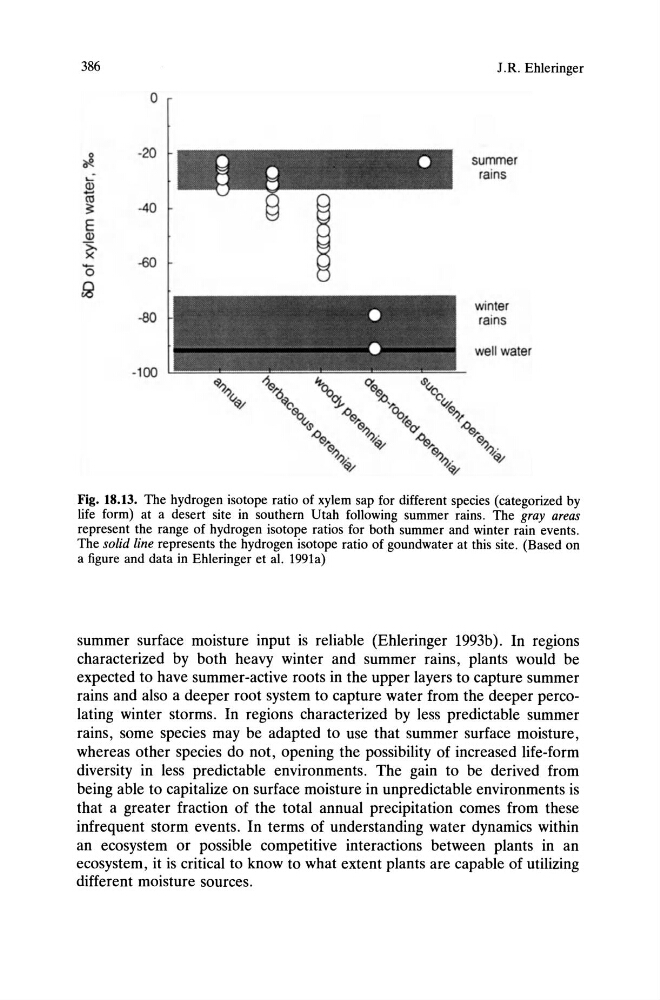
Fig. 18.13. The hydrogen isotope ratio of xylem sap for different species (categorized by
life form) at a desert site in southern Utah following summer rains. The gray areas
represent the range of hydrogen isotope ratios for both summer and winter rain events.
The solid line represents the hydrogen isotope ratio of goundwater at this site. (Based on
a figure and data in Ehleringer et al. 1991a)
summer surface moisture input is reliable (Ehleringer 1993b). In regions
characterized by both heavy winter and summer rains, plants would be
expected to have summer-active roots in the upper layers to capture summer
rains and also a deeper root system to capture water from the deeper percolating winter storms. In regions characterized by less predictable summer
rains, some species may be adapted to use that summer surface moisture,
whereas other species do not, opening the possibility of increased life-form
diversity in less predictable environments. The gain to be derived from
being able to capitalize on surface moisture in unpredictable environments is
that a greater fraction of the total annual precipitation comes from these
infrequent storm events. In terms of understanding water dynamics within
an ecosystem or possible competitive interactions between plants in an
ecosystem, it is critical to know to what extent plants are capable of utilizing
different moisture sources.
~
..:
Q)
- nl
~
E Q)
>- x
'0
~
0
-20
-40
-60
-80
-100
•
•
--------------------J .R. Ehleringer
summer
rains
winter
rains
well water
Fig. 18.13. The hydrogen isotope ratio of xylem sap for different species (categorized by
life form) at a desert site in southern Utah following summer rains. The gray areas
represent the range of hydrogen isotope ratios for both summer and winter rain events.
The solid line represents the hydrogen isotope ratio of goundwater at this site. (Based on
a figure and data in Ehleringer et al. 1991a)
summer surface moisture input is reliable (Ehleringer 1993b). In regions
characterized by both heavy winter and summer rains, plants would be
expected to have summer-active roots in the upper layers to capture summer
rains and also a deeper root system to capture water from the deeper percolating winter storms. In regions characterized by less predictable summer
rains, some species may be adapted to use that summer surface moisture,
whereas other species do not, opening the possibility of increased life-form
diversity in less predictable environments. The gain to be derived from
being able to capitalize on surface moisture in unpredictable environments is
that a greater fraction of the total annual precipitation comes from these
infrequent storm events. In terms of understanding water dynamics within
an ecosystem or possible competitive interactions between plants in an
ecosystem, it is critical to know to what extent plants are capable of utilizing
different moisture sources.