

The Consequences of Sunftecks for Photosynthesis
357
0.0
I
I
I
I
-0.5
-1.0
-1.5
;\ ji 7 _ min sunfleCiO
\.__ - ________ __ (j"/(J _________ _
o
0---, /
o 30-min sunfleck
-
-2.0 L -_ _ _ L-I ___ ~I ___ ~I __ ~I ____ ~I ____ ~I ____ ~
o
10
20
30
40
50
60
Time (minutes)
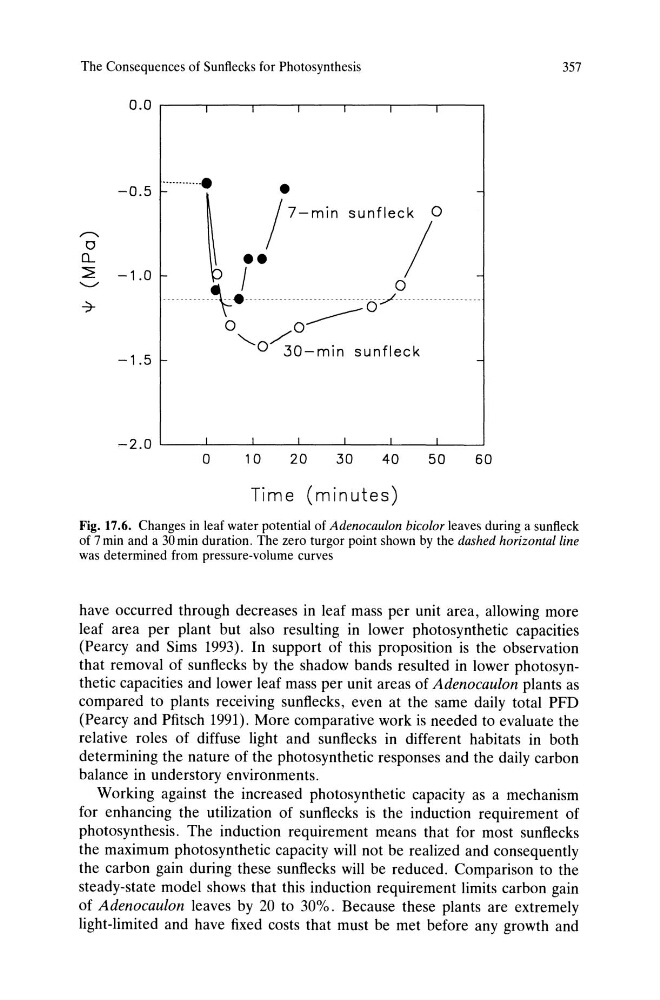
Fig. 17.6. Changes in leaf water potential of Adenoeaulon bieolor leaves during a sunfteck
of 7 min and a 30 min duration. The zero turgor point shown by the dashed horizontal line
was determined from pressure-volume curves
have occurred through decreases in leaf mass per unit area, allowing more
leaf area per plant but also resulting in lower photosynthetic capacities
(Pearcy and Sims 1993). In support of this proposition is the observation
that removal of sunftecks by the shadow bands resulted in lower photosynthetic capacities and lower leaf mass per unit areas of Adenocaulon plants as
compared to plants receiving sunftecks, even at the same daily total PPD
(Pearcy and Pfitsch 1991). More comparative work is needed to evaluate the
relative roles of diffuse light and sunftecks in different habitats in both
determining the nature of the photosynthetic responses and the daily carbon
balance in understory environments.
Working against the increased photosynthetic capacity as a mechanism
for enhancing the utilization of sunftecks is the induction requirement of
photosynthesis. The induction requirement means that for most sunftecks
the maximum photosynthetic capacity will not be realized and consequently
the carbon gain during these sunftecks will be reduced. Comparison to the
steady-state model shows that this induction requirement limits carbon gain
of Adenocaulon leaves by 20 to 30%. Because these plants are extremely
light-limited and have fixed costs that must be met before any growth and
357
0.0
I
I
I
I
-0.5
-1.0
-1.5
;\ ji 7 _ min sunfleCiO
\.__ - ________ __ (j"/(J _________ _
o
0---, /
o 30-min sunfleck
-
-2.0 L -_ _ _ L-I ___ ~I ___ ~I __ ~I ____ ~I ____ ~I ____ ~
o
10
20
30
40
50
60
Time (minutes)
Fig. 17.6. Changes in leaf water potential of Adenoeaulon bieolor leaves during a sunfteck
of 7 min and a 30 min duration. The zero turgor point shown by the dashed horizontal line
was determined from pressure-volume curves
have occurred through decreases in leaf mass per unit area, allowing more
leaf area per plant but also resulting in lower photosynthetic capacities
(Pearcy and Sims 1993). In support of this proposition is the observation
that removal of sunftecks by the shadow bands resulted in lower photosynthetic capacities and lower leaf mass per unit areas of Adenocaulon plants as
compared to plants receiving sunftecks, even at the same daily total PPD
(Pearcy and Pfitsch 1991). More comparative work is needed to evaluate the
relative roles of diffuse light and sunftecks in different habitats in both
determining the nature of the photosynthetic responses and the daily carbon
balance in understory environments.
Working against the increased photosynthetic capacity as a mechanism
for enhancing the utilization of sunftecks is the induction requirement of
photosynthesis. The induction requirement means that for most sunftecks
the maximum photosynthetic capacity will not be realized and consequently
the carbon gain during these sunftecks will be reduced. Comparison to the
steady-state model shows that this induction requirement limits carbon gain
of Adenocaulon leaves by 20 to 30%. Because these plants are extremely
light-limited and have fixed costs that must be met before any growth and