

326
T.G.A. Green and O.L. Lange
of the xanthophyll cycle (Demmig-Adams et al. 1990) and others may
use some form of filter. Increased parietin production may act as a filter
in Xanthoria parietina (Hawksworth and Hill 1984) and a dark pigment
has been shown to lower light levels at the photobiont within the thallus
of Peltula species to less than 5% of ambient (Biidel 1987). The black
upper cortex of the Antarctic lichen, Buellia frigida, strongly reduced fluorescence signals, which could be much increased by scraping away the cortex
(Schroeter et al. 1992). Also, the Antarctic moss Bryum argenteum shows a
lower quantum efficiency for CO2 uptake in sun forms, but still has fully
active photo systems , strongly suggesting that excess light is lost through
refraction by the hyaline leaf tips (Green, unpubl. results).
16.2.5 Thallus Water Content and Photosynthesis
Lichens and bryophytes show a similar relationship between A and thallus
water content (Kershaw 1985; Dilks and Proctor 1979). Initially, A increases
rapidly with thallus water content until a maximum value is reached. Over
this range of hydration it is accepted that A is biochemically limited through
low water potential effects. At higher thallus water content, A may remain
relatively constant or decline; the decline can be explained by increased
diffusion resistances as water constricts or blocks gas diffusion pathways
(Lange and Tenhunen 1981). The situation has been thoroughly analyzed
in the lichen Ramalina maciformis and the increased diffusion resistances
quantified (Cowan et al. 1992). No similar analysis has been done for mosses
or hepatica but the blocking effect of excess water can be shown for those
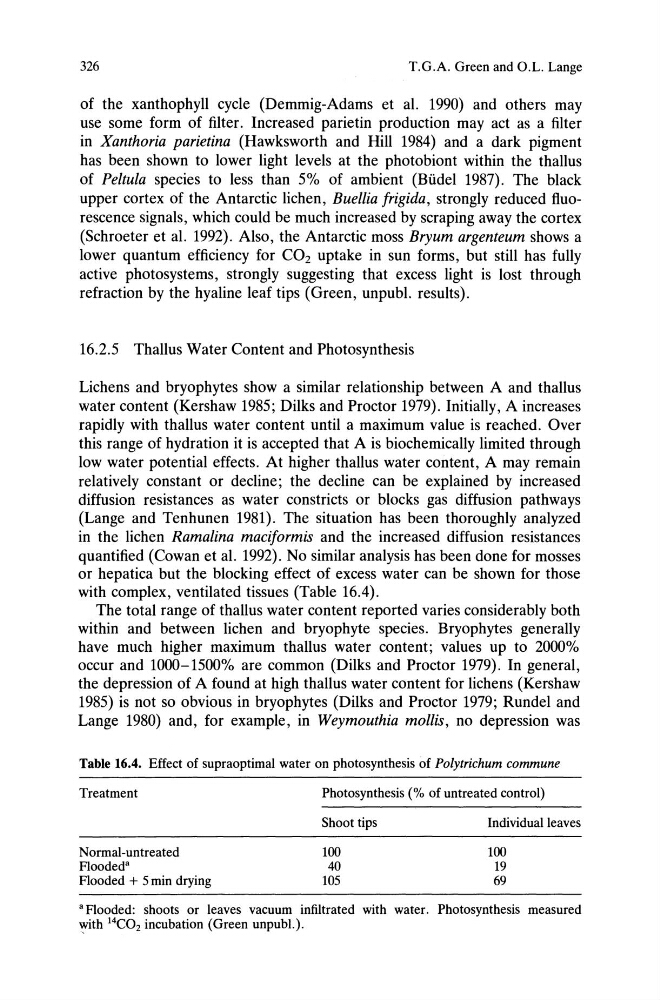
with complex, ventilated tissues (Table 16.4).
The total range of thallus water content reported varies considerably both
within and between lichen and bryophyte species. Bryophytes generally
have much higher maximum thallus water content; values up to 2000%
occur and 1000-1500% are common (Dilks and Proctor 1979). In general,
the depression of A found at high thallus water content for lichens (Kershaw
1985) is not so obvious in bryophytes (Dilks and Proctor 1979; Rundel and
Lange 1980) and, for example, in Weymouthia mol/is, no depression was
Table 16.4. Effect of supraoptimal water on photosynthesis of Polytrichum commune
Treatment
Normal-untreated
Flooded"
Flooded + 5 min drying
Photosynthesis (% of untreated control)
Shoot tips
1oo
40
105
Individual leaves
100
19
69
"Flooded: shoots or leaves vacuum infiltrated with water. Photosynthesis measured
\Vith 14C02 incubation (Green unpubl.).
T.G.A. Green and O.L. Lange
of the xanthophyll cycle (Demmig-Adams et al. 1990) and others may
use some form of filter. Increased parietin production may act as a filter
in Xanthoria parietina (Hawksworth and Hill 1984) and a dark pigment
has been shown to lower light levels at the photobiont within the thallus
of Peltula species to less than 5% of ambient (Biidel 1987). The black
upper cortex of the Antarctic lichen, Buellia frigida, strongly reduced fluorescence signals, which could be much increased by scraping away the cortex
(Schroeter et al. 1992). Also, the Antarctic moss Bryum argenteum shows a
lower quantum efficiency for CO2 uptake in sun forms, but still has fully
active photo systems , strongly suggesting that excess light is lost through
refraction by the hyaline leaf tips (Green, unpubl. results).
16.2.5 Thallus Water Content and Photosynthesis
Lichens and bryophytes show a similar relationship between A and thallus
water content (Kershaw 1985; Dilks and Proctor 1979). Initially, A increases
rapidly with thallus water content until a maximum value is reached. Over
this range of hydration it is accepted that A is biochemically limited through
low water potential effects. At higher thallus water content, A may remain
relatively constant or decline; the decline can be explained by increased
diffusion resistances as water constricts or blocks gas diffusion pathways
(Lange and Tenhunen 1981). The situation has been thoroughly analyzed
in the lichen Ramalina maciformis and the increased diffusion resistances
quantified (Cowan et al. 1992). No similar analysis has been done for mosses
or hepatica but the blocking effect of excess water can be shown for those
with complex, ventilated tissues (Table 16.4).
The total range of thallus water content reported varies considerably both
within and between lichen and bryophyte species. Bryophytes generally
have much higher maximum thallus water content; values up to 2000%
occur and 1000-1500% are common (Dilks and Proctor 1979). In general,
the depression of A found at high thallus water content for lichens (Kershaw
1985) is not so obvious in bryophytes (Dilks and Proctor 1979; Rundel and
Lange 1980) and, for example, in Weymouthia mol/is, no depression was
Table 16.4. Effect of supraoptimal water on photosynthesis of Polytrichum commune
Treatment
Normal-untreated
Flooded"
Flooded + 5 min drying
Photosynthesis (% of untreated control)
Shoot tips
1oo
40
105
Individual leaves
100
19
69
"Flooded: shoots or leaves vacuum infiltrated with water. Photosynthesis measured
\Vith 14C02 incubation (Green unpubl.).