

Photosynthesis in Aquatic Plants
303
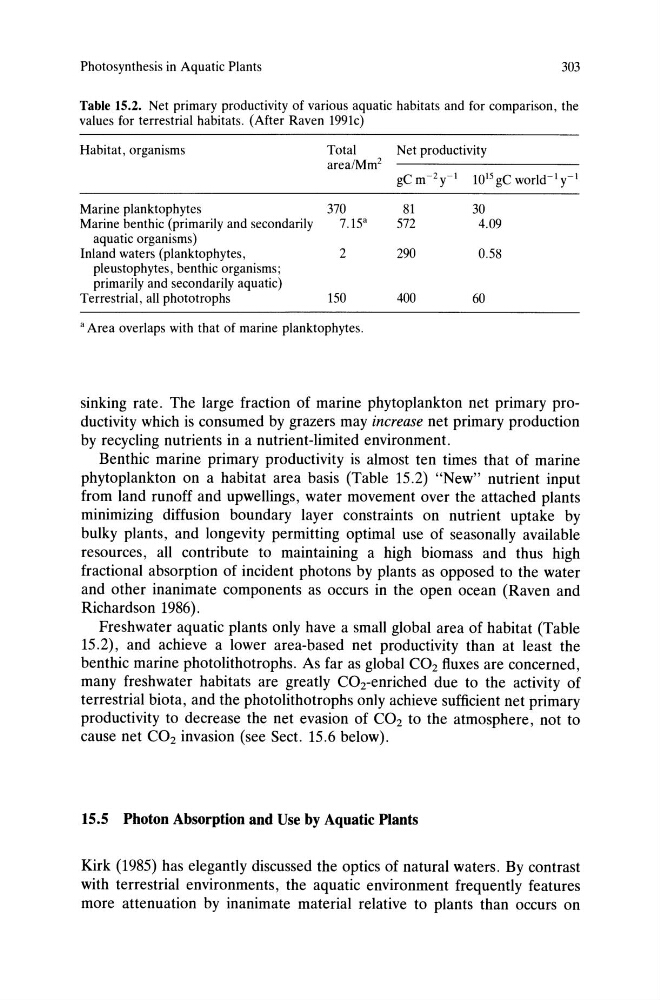
Table 15.2. Net primary productivity of various aquatic habitats and for comparison, the
values for terrestrial habitats. (After Raven 1991c)
Habitat, organisms
Total
area/Mm 2
Net productivity
gC m-2 y-l 10 15 gC world- 1 y-l
Marine planktophytes
370
81
30
Marine benthic (primarily and secondarily
7.15"
572
4.09
aquatic organisms)
Inland waters (planktophytes,
2
290
0.58
pleustophytes, benthic organisms;
primarily and secondarily aquatic)
Terrestrial, all phototrophs
150
400
60
a Area overlaps with that of marine planktophytes.
sinking rate. The large fraction of marine phytoplankton net primary productivity which is consumed by grazers may increase net primary production
by recycling nutrients in a nutrient-limited environment.
Benthic marine primary productivity is almost ten times that of marine
phytoplankton on a habitat area basis (Table 15.2) "New" nutrient input
from land runoff and upwellings, water movement over the attached plants
minimizing diffusion boundary layer constraints on nutrient uptake by
bulky plants, and longevity permitting optimal use of seasonally available
resources, all contribute to maintaining a high biomass and thus high
fractional absorption of incident photons by plants as opposed to the water
and other inanimate components as occurs in the open ocean (Raven and
Richardson 1986).
Freshwater aquatic plants only have a small global area of habitat (Table
15.2), and achieve a lower area-based net productivity than at least the
benthic marine photolithotrophs. As far as global CO 2 fluxes are concerned,
many freshwater habitats are greatly COz-enriched due to the activity of
terrestrial biota, and the photolithotrophs only achieve sufficient net primary
productivity to decrease the net evasion of CO 2 to the atmosphere, not to
cause net CO2 invasion (see Sect. 15.6 below).
15.5 Photon Absorption and Use by Aqnatic Plants
Kirk (1985) has elegantly discussed the optics of natural waters. By contrast
with terrestrial environments, the aquatic environment frequently features
more attenuation by inanimate material relative to plants than occurs on
303
Table 15.2. Net primary productivity of various aquatic habitats and for comparison, the
values for terrestrial habitats. (After Raven 1991c)
Habitat, organisms
Total
area/Mm 2
Net productivity
gC m-2 y-l 10 15 gC world- 1 y-l
Marine planktophytes
370
81
30
Marine benthic (primarily and secondarily
7.15"
572
4.09
aquatic organisms)
Inland waters (planktophytes,
2
290
0.58
pleustophytes, benthic organisms;
primarily and secondarily aquatic)
Terrestrial, all phototrophs
150
400
60
a Area overlaps with that of marine planktophytes.
sinking rate. The large fraction of marine phytoplankton net primary productivity which is consumed by grazers may increase net primary production
by recycling nutrients in a nutrient-limited environment.
Benthic marine primary productivity is almost ten times that of marine
phytoplankton on a habitat area basis (Table 15.2) "New" nutrient input
from land runoff and upwellings, water movement over the attached plants
minimizing diffusion boundary layer constraints on nutrient uptake by
bulky plants, and longevity permitting optimal use of seasonally available
resources, all contribute to maintaining a high biomass and thus high
fractional absorption of incident photons by plants as opposed to the water
and other inanimate components as occurs in the open ocean (Raven and
Richardson 1986).
Freshwater aquatic plants only have a small global area of habitat (Table
15.2), and achieve a lower area-based net productivity than at least the
benthic marine photolithotrophs. As far as global CO 2 fluxes are concerned,
many freshwater habitats are greatly COz-enriched due to the activity of
terrestrial biota, and the photolithotrophs only achieve sufficient net primary
productivity to decrease the net evasion of CO 2 to the atmosphere, not to
cause net CO2 invasion (see Sect. 15.6 below).
15.5 Photon Absorption and Use by Aqnatic Plants
Kirk (1985) has elegantly discussed the optics of natural waters. By contrast
with terrestrial environments, the aquatic environment frequently features
more attenuation by inanimate material relative to plants than occurs on