

Air Pollution, Photosynthesis and Forest Decline: Interactions and Consequences
281
14.3 The Magnitude of Fluxes into Leaves
Henry's distribution law. not only determines to what extent the au IS
cleaned by precipitation, it also determines the rate of uptake of air pollutants by leaves. High solubility of a reactive gas in aqueous or lipophilic
cellular phases, where it undergoes hydration or other reactions, leads to
fast diffusional flux from the atmosphere to the site of solubilization. For
S02 and ozone, the stomata are the main diffusion barrier (Pfanz et al.
1987; Laisk et al. 1989). This makes an approximate calculation of fluxes
into leaves easy, because concentrations in the intercellular gas phase are
lowered by fast solubilization to a negligible level. This assumption is valid
only for S02, and for ozone because of its high reactivity, but not for N02.
In this situation, a simplified version of Fick's law can be used to calculate
fluxes of S02 or ozone into leaves. It is sufficient to know the pollutant
concentrations in the atmosphere outside the leaves and to determine the
sum of the boundary layer and stomatal flux resistances. They can be
calculated from transpiration measurements (Nobel 1983). Measured resistances to the flux of H20 must then be divided by 0.53 for S02 and by
0.61 for ozone. The flux F is directly proportional to the concentration c and
inversely proportional to the sum of the flux resistances RSum:
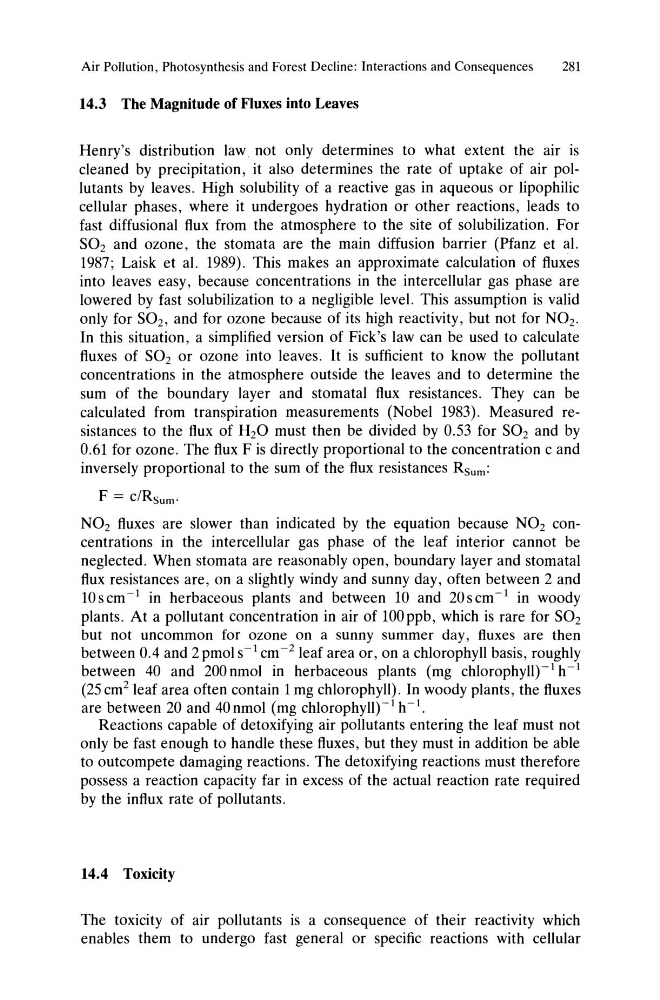
F = c/Rsum .
N0 2 fluxes are slower than indicated by the equation because N02 concentrations in the intercellular gas phase of the leaf interior cannot be
neglected. When stomata are reasonably open, boundary layer and stomatal
flux resistances are, on a slightly windy and sunny day, often between 2 and
10 s cm -1 in herbaceous plants and between 10 and 20 s cm -1 in woody
plants. At a pollutant concentration in air of 100ppb, which is rare for S02
but not uncommon for ozone on a sunny summer day, fluxes are then
between 0.4 and 2 pmol S-1 cm- 2 leaf area or, on a chlorophyll basis, roughly
between 40 and 200 nmol in herbaceous plants (mg chlorophyll) -1 h- 1
(25 cm 2 leaf area often contain 1 mg chlorophyll). In woody plants, the fluxes
are between 20 and 40nmol (mg chlorophyll)-lh- 1 .
Reactions capable of detoxifying air pollutants entering the leaf must not
only be fast enough to handle these fluxes, but they must in addition be able
to outcompete damaging reactions. The detoxifying reactions must therefore
possess a reaction capacity far in excess of the actual reaction rate required
by the influx rate of pollutants.
14.4 Toxicity
The toxicity of air pollutants is a consequence of their reactivity which
enables them to undergo fast general or specific reactions with cellular
281
14.3 The Magnitude of Fluxes into Leaves
Henry's distribution law. not only determines to what extent the au IS
cleaned by precipitation, it also determines the rate of uptake of air pollutants by leaves. High solubility of a reactive gas in aqueous or lipophilic
cellular phases, where it undergoes hydration or other reactions, leads to
fast diffusional flux from the atmosphere to the site of solubilization. For
S02 and ozone, the stomata are the main diffusion barrier (Pfanz et al.
1987; Laisk et al. 1989). This makes an approximate calculation of fluxes
into leaves easy, because concentrations in the intercellular gas phase are
lowered by fast solubilization to a negligible level. This assumption is valid
only for S02, and for ozone because of its high reactivity, but not for N02.
In this situation, a simplified version of Fick's law can be used to calculate
fluxes of S02 or ozone into leaves. It is sufficient to know the pollutant
concentrations in the atmosphere outside the leaves and to determine the
sum of the boundary layer and stomatal flux resistances. They can be
calculated from transpiration measurements (Nobel 1983). Measured resistances to the flux of H20 must then be divided by 0.53 for S02 and by
0.61 for ozone. The flux F is directly proportional to the concentration c and
inversely proportional to the sum of the flux resistances RSum:
F = c/Rsum .
N0 2 fluxes are slower than indicated by the equation because N02 concentrations in the intercellular gas phase of the leaf interior cannot be
neglected. When stomata are reasonably open, boundary layer and stomatal
flux resistances are, on a slightly windy and sunny day, often between 2 and
10 s cm -1 in herbaceous plants and between 10 and 20 s cm -1 in woody
plants. At a pollutant concentration in air of 100ppb, which is rare for S02
but not uncommon for ozone on a sunny summer day, fluxes are then
between 0.4 and 2 pmol S-1 cm- 2 leaf area or, on a chlorophyll basis, roughly
between 40 and 200 nmol in herbaceous plants (mg chlorophyll) -1 h- 1
(25 cm 2 leaf area often contain 1 mg chlorophyll). In woody plants, the fluxes
are between 20 and 40nmol (mg chlorophyll)-lh- 1 .
Reactions capable of detoxifying air pollutants entering the leaf must not
only be fast enough to handle these fluxes, but they must in addition be able
to outcompete damaging reactions. The detoxifying reactions must therefore
possess a reaction capacity far in excess of the actual reaction rate required
by the influx rate of pollutants.
14.4 Toxicity
The toxicity of air pollutants is a consequence of their reactivity which
enables them to undergo fast general or specific reactions with cellular