

268
W. Larcher
-0
4
.....
a:
Q.l
en
ro
Q.l
....
o
Q.l
-0
3~========~~=-------~----------~
~ 2
c
Q.l
o
en
Q.l
....
o
::l
u::
20
15
10
5
o
Leaf temperature [OC]
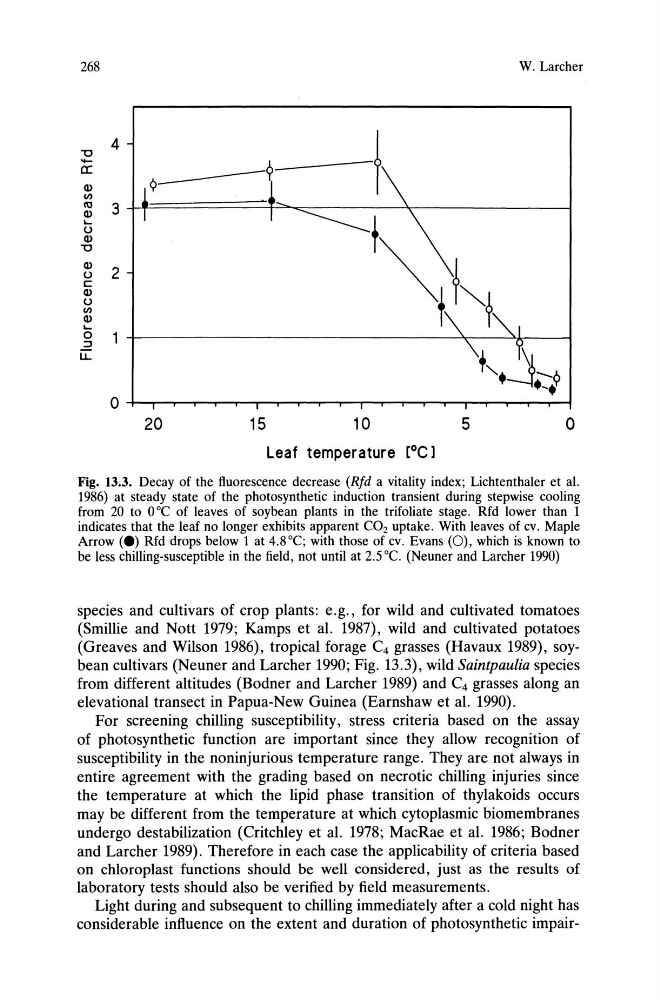
Fig. 13.3. Decay of the fluorescence decrease (Rfd a vitality index; Lichtenthaler et al.
1986) at steady state of the photosynthetic induction transient during stepwise cooling
from 20 to O°C of leaves of soybean plants in the trifoliate stage. Rfd lower than 1
indicates that the leaf no longer exhibits apparent CO2 uptake. With leaves of cv. Maple
Arrow (e) Rfd drops below 1 at 4.8°C; with those of cv. Evans (0), which is known to
be less chilling-susceptible in the field, not until at 2.5 0c. (Neuner and Larcher 1990)
species and cultivars of crop plants: e.g., for wild and cultivated tomatoes
(Smillie and Nott 1979; Kamps et al. 1987), wild and cultivated potatoes
(Greaves and Wilson 1986), tropical forage C4 grasses (Havaux 1989), soybean cultivars (Neuner and Larcher 1990; Fig. 13.3), wild Saintpaulia species
from different altitudes (Bodner and Larcher 1989) and C4 grasses along an
elevational transect in Papua-New Guinea (Earnshaw et al. 1990).
For screening chilling susceptibility, stress criteria based on the assay
of photosynthetic function are important since they allow recognition of
susceptibility in the noninjurious temperature range. They are not always in
entire agreement with the grading based on necrotic chilling injuries since
the temperature at which the lipid phase transition of thylakoids occurs
may be different from the temperature at which cytoplasmic biomembranes
undergo destabilization (Critchley et al. 1978; MacRae et al. 1986; Bodner
and Larcher 1989). Therefore in each case the applicability of criteria based
on chloroplast functions should be well considered, just as the results of
laboratory tests should also be verified by field measurements.
Light during and subsequent to chilling immediately after a cold night has
considerable influence on the extent and duration of photosynthetic impair-
W. Larcher
-0
4
.....
a:
Q.l
en
ro
Q.l
....
o
Q.l
-0
3~========~~=-------~----------~
~ 2
c
Q.l
o
en
Q.l
....
o
::l
u::
20
15
10
5
o
Leaf temperature [OC]
Fig. 13.3. Decay of the fluorescence decrease (Rfd a vitality index; Lichtenthaler et al.
1986) at steady state of the photosynthetic induction transient during stepwise cooling
from 20 to O°C of leaves of soybean plants in the trifoliate stage. Rfd lower than 1
indicates that the leaf no longer exhibits apparent CO2 uptake. With leaves of cv. Maple
Arrow (e) Rfd drops below 1 at 4.8°C; with those of cv. Evans (0), which is known to
be less chilling-susceptible in the field, not until at 2.5 0c. (Neuner and Larcher 1990)
species and cultivars of crop plants: e.g., for wild and cultivated tomatoes
(Smillie and Nott 1979; Kamps et al. 1987), wild and cultivated potatoes
(Greaves and Wilson 1986), tropical forage C4 grasses (Havaux 1989), soybean cultivars (Neuner and Larcher 1990; Fig. 13.3), wild Saintpaulia species
from different altitudes (Bodner and Larcher 1989) and C4 grasses along an
elevational transect in Papua-New Guinea (Earnshaw et al. 1990).
For screening chilling susceptibility, stress criteria based on the assay
of photosynthetic function are important since they allow recognition of
susceptibility in the noninjurious temperature range. They are not always in
entire agreement with the grading based on necrotic chilling injuries since
the temperature at which the lipid phase transition of thylakoids occurs
may be different from the temperature at which cytoplasmic biomembranes
undergo destabilization (Critchley et al. 1978; MacRae et al. 1986; Bodner
and Larcher 1989). Therefore in each case the applicability of criteria based
on chloroplast functions should be well considered, just as the results of
laboratory tests should also be verified by field measurements.
Light during and subsequent to chilling immediately after a cold night has
considerable influence on the extent and duration of photosynthetic impair-