

Dynamics in Photosystem II Structure and Function
7
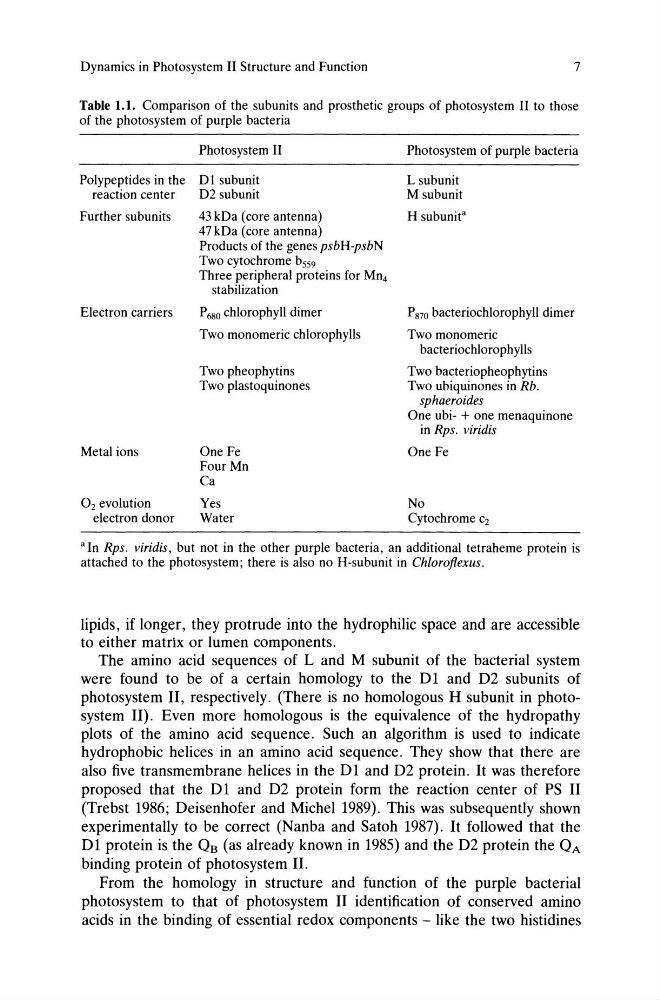
Table 1.1. Comparison of the subunits and prosthetic groups of photosystem II to those
of the photosystem of purple bacteria
Photo system II
Polypeptides in the D1 subunit
reaction center
D2 subunit
Photosystem of purple bacteria
L subunit
M subunit
Further subunits
43 kDa (core antenna)
H subunit a
Electron carriers
Metal ions
O2 evolution
electron donor
47kDa (core antenna)
Products of the genes psbH-psbN
Two cytochrome bss9
Three peripheral proteins for Mn4
stabilization
P680 chlorophyll dimer
PS70 bacteriochlorophyll dimer
Two monomeric chlorophylls
Two pheophytins
Two plastoquinones
One Fe
FourMn
Ca
Yes
Water
Two monomeric
bacteriochlorophylls
Two bacteriopheophytins
Two ubiquinones in Rb.
sphaeroides
One ubi- + one menaquinone
in Rps. viridis
One Fe
No
Cytochrome C2
a In Rps. viridis, but not in the other purple bacteria, an additional tetraheme protein is
attached to the photosystem; there is also no H-subunit in Chlorofiexus.
lipids, if longer, they protrude into the hydrophilic space and are accessible
to either matrix or lumen components.
The amino acid sequences of Land M subunit of the bacterial system
were found to be of a certain homology to the 01 and 02 subunits of
photosystem II, respectively. (There is no homologous H subunit in photosystem II). Even more homologous is the equivalence of the hydropathy
plots of the amino acid sequence. Such an algorithm is used to indicate
hydrophobic helices in an amino acid sequence. They show that there are
also five transmembrane helices in the 01 and 02 protein. It was therefore
proposed that the 01 and 02 protein form the reaction center of PS II
(Trebst 1986; Oeisenhofer and Michel 1989). This was subsequently shown
experimentally to be correct (Nanba and Satoh 1987). It followed that the
01 protein is the QB (as already known in 1985) and the 02 protein the Q A
binding protein of photo system II.
From the homology in structure and function of the purple bacterial
photosystem to that of photo system II identification of conserved amino
acids in the binding of essential redox components - like the two histidines
7
Table 1.1. Comparison of the subunits and prosthetic groups of photosystem II to those
of the photosystem of purple bacteria
Photo system II
Polypeptides in the D1 subunit
reaction center
D2 subunit
Photosystem of purple bacteria
L subunit
M subunit
Further subunits
43 kDa (core antenna)
H subunit a
Electron carriers
Metal ions
O2 evolution
electron donor
47kDa (core antenna)
Products of the genes psbH-psbN
Two cytochrome bss9
Three peripheral proteins for Mn4
stabilization
P680 chlorophyll dimer
PS70 bacteriochlorophyll dimer
Two monomeric chlorophylls
Two pheophytins
Two plastoquinones
One Fe
FourMn
Ca
Yes
Water
Two monomeric
bacteriochlorophylls
Two bacteriopheophytins
Two ubiquinones in Rb.
sphaeroides
One ubi- + one menaquinone
in Rps. viridis
One Fe
No
Cytochrome C2
a In Rps. viridis, but not in the other purple bacteria, an additional tetraheme protein is
attached to the photosystem; there is also no H-subunit in Chlorofiexus.
lipids, if longer, they protrude into the hydrophilic space and are accessible
to either matrix or lumen components.
The amino acid sequences of Land M subunit of the bacterial system
were found to be of a certain homology to the 01 and 02 subunits of
photosystem II, respectively. (There is no homologous H subunit in photosystem II). Even more homologous is the equivalence of the hydropathy
plots of the amino acid sequence. Such an algorithm is used to indicate
hydrophobic helices in an amino acid sequence. They show that there are
also five transmembrane helices in the 01 and 02 protein. It was therefore
proposed that the 01 and 02 protein form the reaction center of PS II
(Trebst 1986; Oeisenhofer and Michel 1989). This was subsequently shown
experimentally to be correct (Nanba and Satoh 1987). It followed that the
01 protein is the QB (as already known in 1985) and the 02 protein the Q A
binding protein of photo system II.
From the homology in structure and function of the purple bacterial
photosystem to that of photo system II identification of conserved amino
acids in the binding of essential redox components - like the two histidines