

242
L. Kappen et al.
Vicia faba
7
c
'7
6
~v~~1\.oo
0
rJ)
5
'';;
co ';I
4
r f
... E
'0.
rJ)
'0
3
~~~
c
co
E
2
... E
~
~
1
e
0
- 300
,
rJ)
- ';I
co
Q)
E 200
....J
C)
0
\/e'.-AwA. rJJ'
E
E 100
~
\
co '7
600
...
rJ)
co ';I
E
E 500
/"
0
... '0
en
E 400
C)
5
300
28 30 32 34 36 38
T emperature 1eaf [0 C)
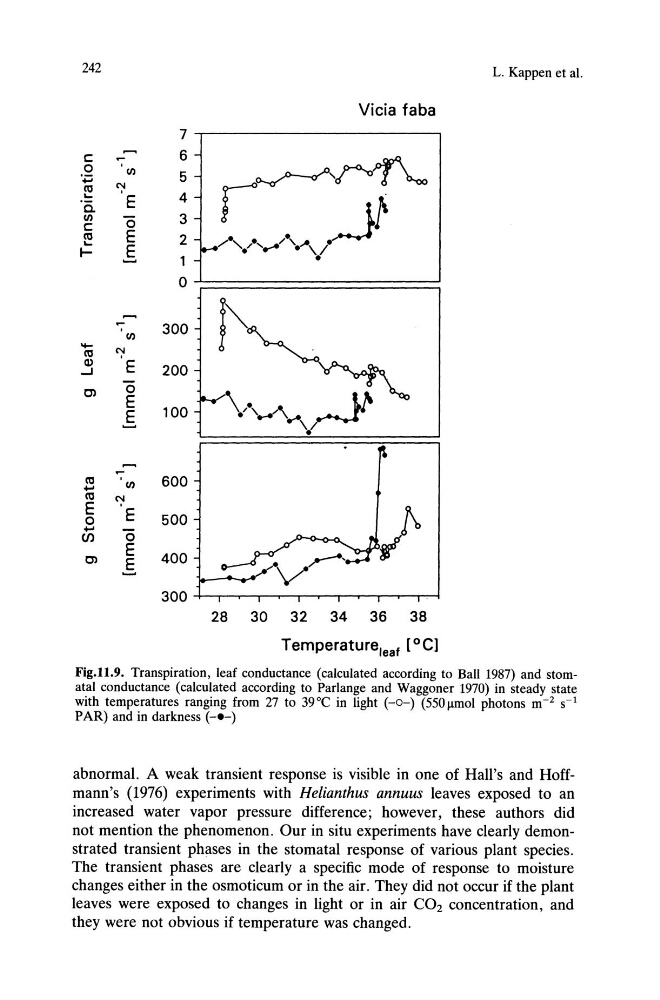
Fig.H.9. Transpiration, leaf conductance (calculated according to Ball 1987) and stomatal conductance (calculated according to Parlange and Waggoner 1970) in steady state
with temperatures ranging from 27 to 39°C in light (-0-) (550 Ilmol photons m - 2 S-1
PAR) and in darkness (-e-)
abnormal. A weak transient response is visible in one of Hall's and Hoffmann's (1976) experiments with Helianthus annuus leaves exposed to an
increased water vapor pressure difference; however, these authors did
not mention the phenomenon. Our in situ experiments have clearly demonstrated transient phases in the stomatal response of various plant species.
The transient phases are clearly a specific mode of response to moisture
changes either in the osmoticum or in the air. They did not occur if the plant
leaves were exposed to changes in light or in air CO2 concentration, and
they were not obvious if temperature was changed.
L. Kappen et al.
Vicia faba
7
c
'7
6
~v~~1\.oo
0
rJ)
5
'';;
co ';I
4
r f
... E
'0.
rJ)
'0
3
~~~
c
co
E
2
... E
~
~
1
e
0
- 300
,
rJ)
- ';I
co
Q)
E 200
....J
C)
0
\/e'.-AwA. rJJ'
E
E 100
~
\
co '7
600
...
rJ)
co ';I
E
E 500
/"
0
... '0
en
E 400
C)
5
300
28 30 32 34 36 38
T emperature 1eaf [0 C)
Fig.H.9. Transpiration, leaf conductance (calculated according to Ball 1987) and stomatal conductance (calculated according to Parlange and Waggoner 1970) in steady state
with temperatures ranging from 27 to 39°C in light (-0-) (550 Ilmol photons m - 2 S-1
PAR) and in darkness (-e-)
abnormal. A weak transient response is visible in one of Hall's and Hoffmann's (1976) experiments with Helianthus annuus leaves exposed to an
increased water vapor pressure difference; however, these authors did
not mention the phenomenon. Our in situ experiments have clearly demonstrated transient phases in the stomatal response of various plant species.
The transient phases are clearly a specific mode of response to moisture
changes either in the osmoticum or in the air. They did not occur if the plant
leaves were exposed to changes in light or in air CO2 concentration, and
they were not obvious if temperature was changed.