

Direct Observations of Stomatal Movements
Q)
CI
C
III
.r.
u
x
w
N
0
u
Q)
...
:J
t
Q)
0.
«
III
.....
III
E
o
.....
(J)
o
a..
>
~
'7 Ul
~ E
(5
E
3
Tradescantia albiflora
2.0 . . . - - - - - - - - - - - - - - - ,
1.5
1.0
0.5
0.0
.,
._. ___ .1 '_'_'_'_'_'_'_'_'_'_'~._._'_'
-0.5 ~======:::::::::==~
30
N
20
E
3
E
CI
10
o~=~~~~~~~~
10
8
6
4
2
,
o ~-~·r-=-r·J~-.--r-.-.-.--r-.~~
o 60 120 180 240 300 360
Time [min]
237
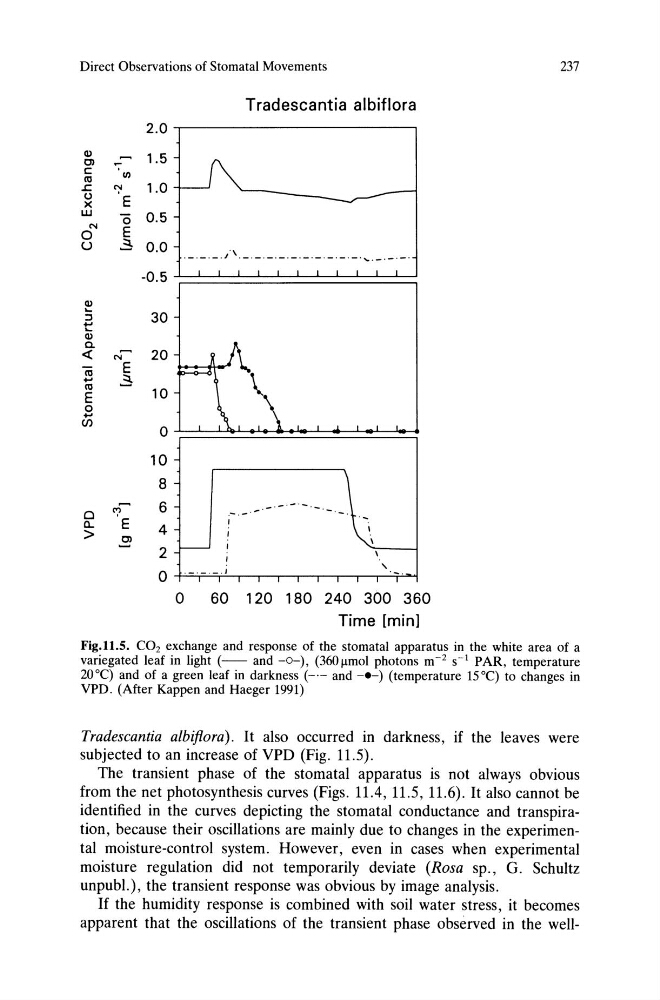
Fig.U.S. CO2 exchange and response of the stomatal apparatus in the white area of a
variegated leaf in light ( - and -0-), (360llmol photons m- 2 S-l PAR, temperature
20°C) and of a green leaf in darkness (_.- and -e-) (temperature 15°C) to changes in
VPD. (After Kappen and Haeger 1991)
Tradescantia albifiora). It also occurred in darkness, if the leaves were
subjected to an increase of VPD (Fig. 11.5).
The transient phase of the stomatal apparatus is not always obvious
from the net photosynthesis curves (Figs. 11.4, 11.5, 11.6). It also cannot be
identified in the curves depicting the stomatal conductance and transpiration, because their oscillations are mainly due to changes in the experimental moisture-control system. However, even in cases when experimental
moisture regulation did not temporarily deviate (Rosa sp., G. Schultz
unpubl.), the transient response was obvious by image analysis.
If the humidity response is combined with soil water stress, it becomes
apparent that the oscillations of the transient phase observed in the well-
Q)
CI
C
III
.r.
u
x
w
N
0
u
Q)
...
:J
t
Q)
0.
«
III
.....
III
E
o
.....
(J)
o
a..
>
~
'7 Ul
~ E
(5
E
3
Tradescantia albiflora
2.0 . . . - - - - - - - - - - - - - - - ,
1.5
1.0
0.5
0.0
.,
._. ___ .1 '_'_'_'_'_'_'_'_'_'_'~._._'_'
-0.5 ~======:::::::::==~
30
N
20
E
3
E
CI
10
o~=~~~~~~~~
10
8
6
4
2
,
o ~-~·r-=-r·J~-.--r-.-.-.--r-.~~
o 60 120 180 240 300 360
Time [min]
237
Fig.U.S. CO2 exchange and response of the stomatal apparatus in the white area of a
variegated leaf in light ( - and -0-), (360llmol photons m- 2 S-l PAR, temperature
20°C) and of a green leaf in darkness (_.- and -e-) (temperature 15°C) to changes in
VPD. (After Kappen and Haeger 1991)
Tradescantia albifiora). It also occurred in darkness, if the leaves were
subjected to an increase of VPD (Fig. 11.5).
The transient phase of the stomatal apparatus is not always obvious
from the net photosynthesis curves (Figs. 11.4, 11.5, 11.6). It also cannot be
identified in the curves depicting the stomatal conductance and transpiration, because their oscillations are mainly due to changes in the experimental moisture-control system. However, even in cases when experimental
moisture regulation did not temporarily deviate (Rosa sp., G. Schultz
unpubl.), the transient response was obvious by image analysis.
If the humidity response is combined with soil water stress, it becomes
apparent that the oscillations of the transient phase observed in the well-