

Direct Observations of Stomatal Movements
'#.
Q)
...
::J
.... ...
Q)
c.
«
iii .... 10
E
0
....
(/)
100
80
60
40
20
0
0
20
40
60
• Aegopodium podagra ria
y
Atropa belladonna
a
Avena sativa
" Betula occidentalis
80
100
120
Time [min]
o Betula pubescens
• Rosa spec.
v
Sambucus nigra
235
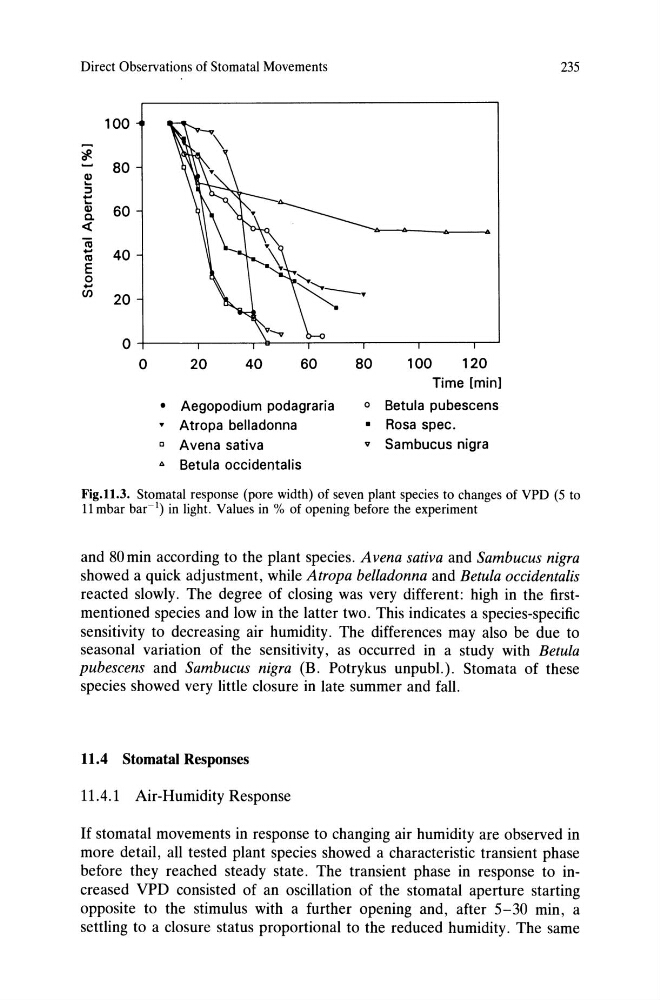
Fig. 11.3. Stomatal response (pore width) of seven plant species to changes of VPD (5 to
11 mbar bar-I) in light. Values in % of opening before the experiment
and 80 min according to the plant species. A vena sativa and Sambucus nigra
showed a quick adjustment, while Atropa belladonna and Betula occidentalis
reacted slowly. The degree of closing was very different: high in the firstmentioned species and low in the latter two. This indicates a species-specific
sensitivity to decreasing air humidity. The differences may also be due to
seasonal variation of the sensitivity, as occurred in a study with Betula
pubescens and Sambucus nigra (B. Potrykus unpubl.). Stomata of these
species showed very little closure in late summer and fall.
11.4 Stomatal Responses
11.4.1 Air-Humidity Response
If stomatal movements in response to changing air humidity are observed in
more detail, all tested plant species showed a characteristic transient phase
before they reached steady state. The transient phase in response to increased VPD consisted of an oscillation of the stomatal aperture starting
opposite to the stimulus with a further opening and, after 5-30 min, a
settling to a closure status proportional to the reduced humidity. The same
'#.
Q)
...
::J
.... ...
Q)
c.
«
iii .... 10
E
0
....
(/)
100
80
60
40
20
0
0
20
40
60
• Aegopodium podagra ria
y
Atropa belladonna
a
Avena sativa
" Betula occidentalis
80
100
120
Time [min]
o Betula pubescens
• Rosa spec.
v
Sambucus nigra
235
Fig. 11.3. Stomatal response (pore width) of seven plant species to changes of VPD (5 to
11 mbar bar-I) in light. Values in % of opening before the experiment
and 80 min according to the plant species. A vena sativa and Sambucus nigra
showed a quick adjustment, while Atropa belladonna and Betula occidentalis
reacted slowly. The degree of closing was very different: high in the firstmentioned species and low in the latter two. This indicates a species-specific
sensitivity to decreasing air humidity. The differences may also be due to
seasonal variation of the sensitivity, as occurred in a study with Betula
pubescens and Sambucus nigra (B. Potrykus unpubl.). Stomata of these
species showed very little closure in late summer and fall.
11.4 Stomatal Responses
11.4.1 Air-Humidity Response
If stomatal movements in response to changing air humidity are observed in
more detail, all tested plant species showed a characteristic transient phase
before they reached steady state. The transient phase in response to increased VPD consisted of an oscillation of the stomatal aperture starting
opposite to the stimulus with a further opening and, after 5-30 min, a
settling to a closure status proportional to the reduced humidity. The same