

220
I.R. Cowan
160
E
120
E
P _V- 1 /3
M
•
,.> 80
40
10
20
30
40
50
60
P mbar
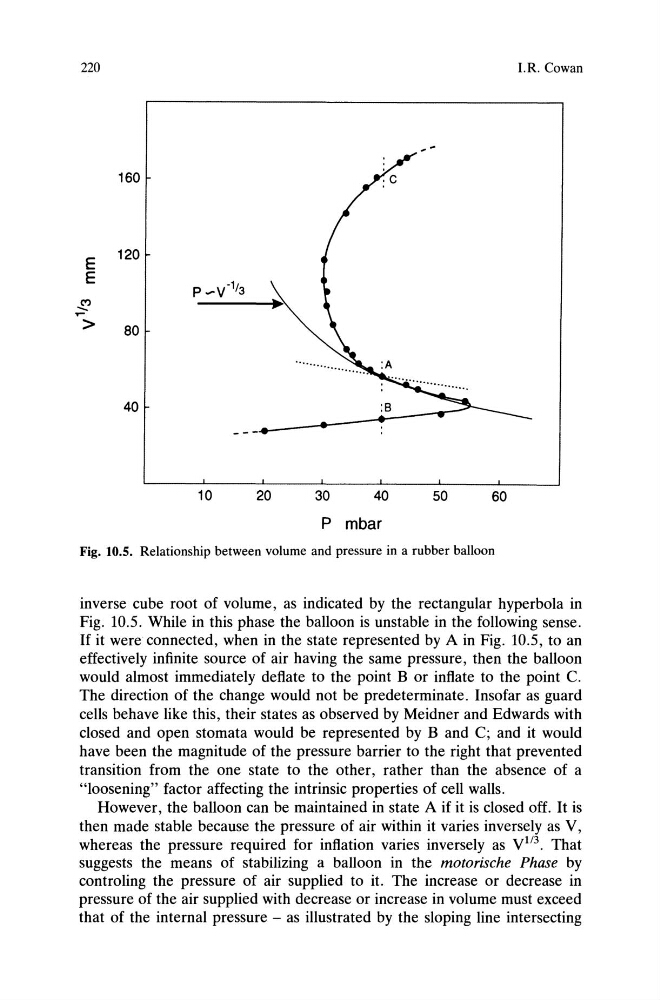
Fig. 10.5. Relationship between volume and pressure in a rubber balloon
inverse cube root of volume, as indicated by the rectangular hyperbola in
Fig. 10.5. While in this phase the balloon is unstable in the following sense.
If it were connected, when in the state represented by A in Fig. 10.5, to an
effectively infinite source of air having the same pressure, then the balloon
would almost immediately deflate to the point B or inflate to the point C.
The direction of the change would not be predeterminate. Insofar as guard
cells behave like this, their states as observed by Meidner and Edwards with
closed and open stomata would be represented by Band C; and it would
have been the magnitude of the pressure barrier to the right that prevented
transition from the one state to the other, rather than the absence of a
"loosening" factor affecting the intrinsic properties of cell walls.
However, the balloon can be maintained in state A if it is closed off. It is
then made stable because the pressure of air within it varies inversely as Y,
whereas the pressure required for inflation varies inversely as y1I3. That
suggests the means of stabilizing a balloon in the motorische Phase by
controling the pressure of air supplied to it. The increase or decrease in
pressure of the air supplied with decrease or increase in volume must exceed
that of the internal pressure - as illustrated by the sloping line intersecting
I.R. Cowan
160
E
120
E
P _V- 1 /3
M
•
,.> 80
40
10
20
30
40
50
60
P mbar
Fig. 10.5. Relationship between volume and pressure in a rubber balloon
inverse cube root of volume, as indicated by the rectangular hyperbola in
Fig. 10.5. While in this phase the balloon is unstable in the following sense.
If it were connected, when in the state represented by A in Fig. 10.5, to an
effectively infinite source of air having the same pressure, then the balloon
would almost immediately deflate to the point B or inflate to the point C.
The direction of the change would not be predeterminate. Insofar as guard
cells behave like this, their states as observed by Meidner and Edwards with
closed and open stomata would be represented by Band C; and it would
have been the magnitude of the pressure barrier to the right that prevented
transition from the one state to the other, rather than the absence of a
"loosening" factor affecting the intrinsic properties of cell walls.
However, the balloon can be maintained in state A if it is closed off. It is
then made stable because the pressure of air within it varies inversely as Y,
whereas the pressure required for inflation varies inversely as y1I3. That
suggests the means of stabilizing a balloon in the motorische Phase by
controling the pressure of air supplied to it. The increase or decrease in
pressure of the air supplied with decrease or increase in volume must exceed
that of the internal pressure - as illustrated by the sloping line intersecting