

As to the Mode of Action of the Guard Cells in Dry Air
207
af
u
C .....
Ol!....
.... 0
JgE
'0- o
~E
'0 E
·E t.O
:J
I
_ .....
Ol'
U (/)
CN
al'
t5 E
-5- C 0
o E
°Ol
af .....
«i ' (/)
....
c~
.Q E
- a l -
.~ 0
Q.E
~ E
al
t=W
30
20
10
O~~----~----~----~--~----~----~----~~
0.4
0.2
•
•••
. . -.' ,
. """'"
", ·11 -' ".~'" .' ........... .
.......
·
·
·
·
~
·
·
·
O~~----~--~----~--~-----L----~--~~
r---------------------------· • .-----------~0.9
E
~ ... ~ ...
~..
I"· ",
cP
0"'"
,:
... ~
'"~,,
',,'
0
. ...~- .. ,
,' ..
. ... "' •..... ~ ,/ '~
........ ......... . . , , ' "
•
..,.
' - a : f X 1 .
0.8
5
4
3
10
11
12
13
14
15
16
18
Time of day, h
....
~~
3: -
Ole
> Ol
.- -
- C
.!"!;!o
Ol U
cr.
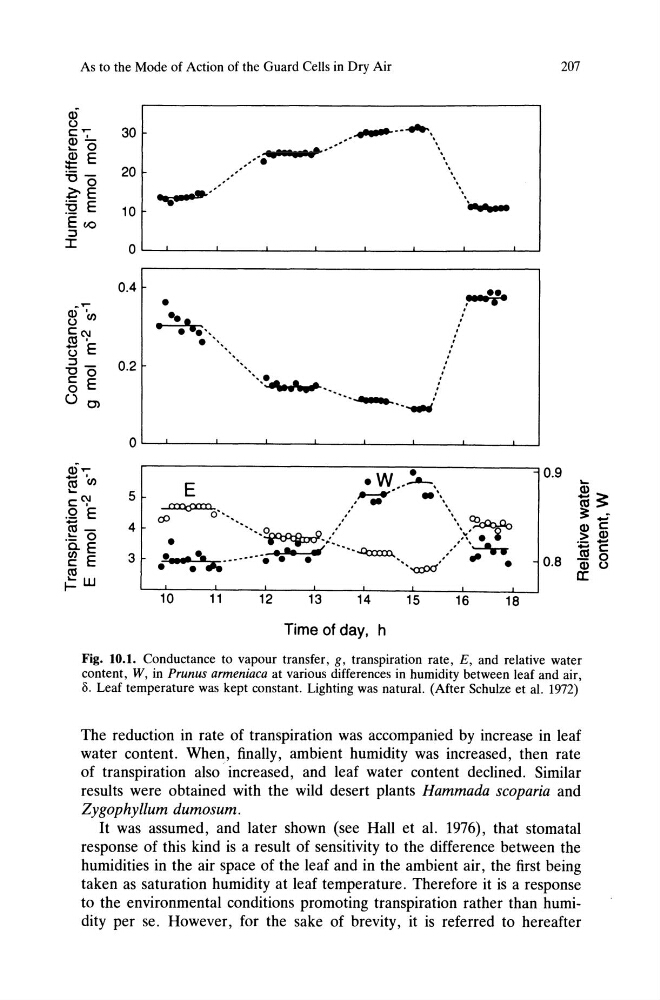
Fig. 10.1. Conductance to vapour transfer, g, transpiration rate, E, and relative water
content, W, in Prunus armeniaca at various differences in humidity between leaf and air,
o. Leaf temperature was kept constant. Lighting was natural. (After Schulze et al. 1972)
The reduction in rate of transpiration was accompanied by increase in leaf
water content. When, finally, ambient humidity was increased, then rate
of transpiration also increased, and leaf water content declined. Similar
results were obtained with the wild desert plants Hammada scoparia and
Zygophyllum dumosum.
It was assumed, and later shown (see Hall et al. 1976), that stomatal
response of this kind is a result of sensitivity to the difference between the
humidities in the air space of the leaf and in the ambient air, the first being
taken as saturation humidity at leaf temperature. Therefore it is a response
to the environmental conditions promoting transpiration rather than humidity per se. However, for the sake of brevity, it is referred to hereafter
207
af
u
C .....
Ol!....
.... 0
JgE
'0- o
~E
'0 E
·E t.O
:J
I
_ .....
Ol'
U (/)
CN
al'
t5 E
-5- C 0
o E
°Ol
af .....
«i ' (/)
....
c~
.Q E
- a l -
.~ 0
Q.E
~ E
al
t=W
30
20
10
O~~----~----~----~--~----~----~----~~
0.4
0.2
•
•••
. . -.' ,
. """'"
", ·11 -' ".~'" .' ........... .
.......
·
·
·
·
~
·
·
·
O~~----~--~----~--~-----L----~--~~
r---------------------------· • .-----------~0.9
E
~ ... ~ ...
~..
I"· ",
cP
0"'"
,:
... ~
'"~,,
',,'
0
. ...~- .. ,
,' ..
. ... "' •..... ~ ,/ '~
........ ......... . . , , ' "
•
..,.
' - a : f X 1 .
0.8
5
4
3
10
11
12
13
14
15
16
18
Time of day, h
....
~~
3: -
Ole
> Ol
.- -
- C
.!"!;!o
Ol U
cr.
Fig. 10.1. Conductance to vapour transfer, g, transpiration rate, E, and relative water
content, W, in Prunus armeniaca at various differences in humidity between leaf and air,
o. Leaf temperature was kept constant. Lighting was natural. (After Schulze et al. 1972)
The reduction in rate of transpiration was accompanied by increase in leaf
water content. When, finally, ambient humidity was increased, then rate
of transpiration also increased, and leaf water content declined. Similar
results were obtained with the wild desert plants Hammada scoparia and
Zygophyllum dumosum.
It was assumed, and later shown (see Hall et al. 1976), that stomatal
response of this kind is a result of sensitivity to the difference between the
humidities in the air space of the leaf and in the ambient air, the first being
taken as saturation humidity at leaf temperature. Therefore it is a response
to the environmental conditions promoting transpiration rather than humidity per se. However, for the sake of brevity, it is referred to hereafter