

Internal Coordination of Plant Responses to Drought and Evaporational Demand
199
• N.bca
•
x N.menziell
•
A
•
x • ,.
x
•
x
•
.,.
0.05
0.1
Sapwood area (m 2 tree-1)
• N.1uIca
I
x N.nrrzi8111
-
B
-
o
New ZealaneJ,1991
x ••
x •
x •
•
•
x
I
I
1.0
2.0
Circunference (m tree -1 )
•
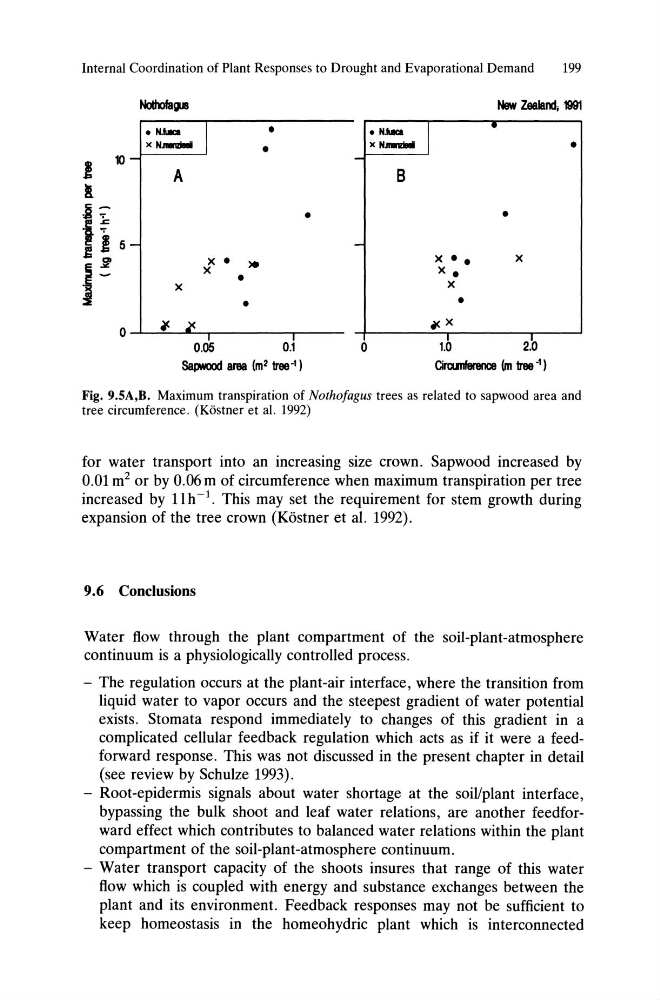
Fig. 9.SA,B. Maximum transpiration of Nothofagus trees as related to sapwood area and
tree circumference. (Kostner et al. 1992)
for water transport into an increasing size crown. Sapwood increased by
0.01 m 2 or by 0.06 m of circumference when maximum transpiration per tree
increased by 11 h -1. This may set the requirement for stem growth during
expansion of the tree crown (Kastner et at. 1992).
9.6 Conclusions
Water flow through the plant compartment of the soil-plant-atmosphere
continuum is a physiologically controlled process.
- The regulation occurs at the plant-air interface, where the transition from
liquid water to vapor occurs and the steepest gradient of water potential
exists. Stomata respond immediately to changes of this gradient in a
complicated cellular feedback regulation which acts as if it were a feedforward response. This was not discussed in the present chapter in detail
(see review by Schulze 1993).
- Root-epidermis signals about water shortage at the soil/plant interface,
bypassing the bulk shoot and leaf water relations, are another feedforward effect which contributes to balanced water relations within the plant
compartment of the soil-plant-atmosphere continuum.
- Water transport capacity of the shoots insures that range of this water
flow which is coupled with energy and substance exchanges between the
plant and its environment. Feedback responses may not be sufficient to
keep homeostasis in the homeohydric plant which is interconnected
199
• N.bca
•
x N.menziell
•
A
•
x • ,.
x
•
x
•
.,.
0.05
0.1
Sapwood area (m 2 tree-1)
• N.1uIca
I
x N.nrrzi8111
-
B
-
o
New ZealaneJ,1991
x ••
x •
x •
•
•
x
I
I
1.0
2.0
Circunference (m tree -1 )
•
Fig. 9.SA,B. Maximum transpiration of Nothofagus trees as related to sapwood area and
tree circumference. (Kostner et al. 1992)
for water transport into an increasing size crown. Sapwood increased by
0.01 m 2 or by 0.06 m of circumference when maximum transpiration per tree
increased by 11 h -1. This may set the requirement for stem growth during
expansion of the tree crown (Kastner et at. 1992).
9.6 Conclusions
Water flow through the plant compartment of the soil-plant-atmosphere
continuum is a physiologically controlled process.
- The regulation occurs at the plant-air interface, where the transition from
liquid water to vapor occurs and the steepest gradient of water potential
exists. Stomata respond immediately to changes of this gradient in a
complicated cellular feedback regulation which acts as if it were a feedforward response. This was not discussed in the present chapter in detail
(see review by Schulze 1993).
- Root-epidermis signals about water shortage at the soil/plant interface,
bypassing the bulk shoot and leaf water relations, are another feedforward effect which contributes to balanced water relations within the plant
compartment of the soil-plant-atmosphere continuum.
- Water transport capacity of the shoots insures that range of this water
flow which is coupled with energy and substance exchanges between the
plant and its environment. Feedback responses may not be sufficient to
keep homeostasis in the homeohydric plant which is interconnected