

190
R. Losch and E.-D. Schulze
Commelina communis
Lancaster, 1986
'-Itp
• watered
root leaf
0.5
o haH of root drying
watered control
• •
~
wet part of split root f::,.
0
0.4
~
dry part of split root 0
70
0.3
C
0.2
~ 60
~
0
6
'-It
0
50
-0.2
~
III
~
m 40
c: -0.3
-<
~
' "
-0.4
01
30
~
c:
~
-0.5
20
'-Its
10
-0.5
-0.6
P#,~
i
-0.7
C
01
80
-0.8
E
0
70
0
.. 0.7
,
UJ
01
60
.s
E 0.6
2
~ 50
8
0.5
-<
c: 0.4
~
40
~ :J 0.3
~ 30
"0
c: 0.2
'is.
8
w
3
5
7
9
2
3
4
5
6
7
8
Days
Days
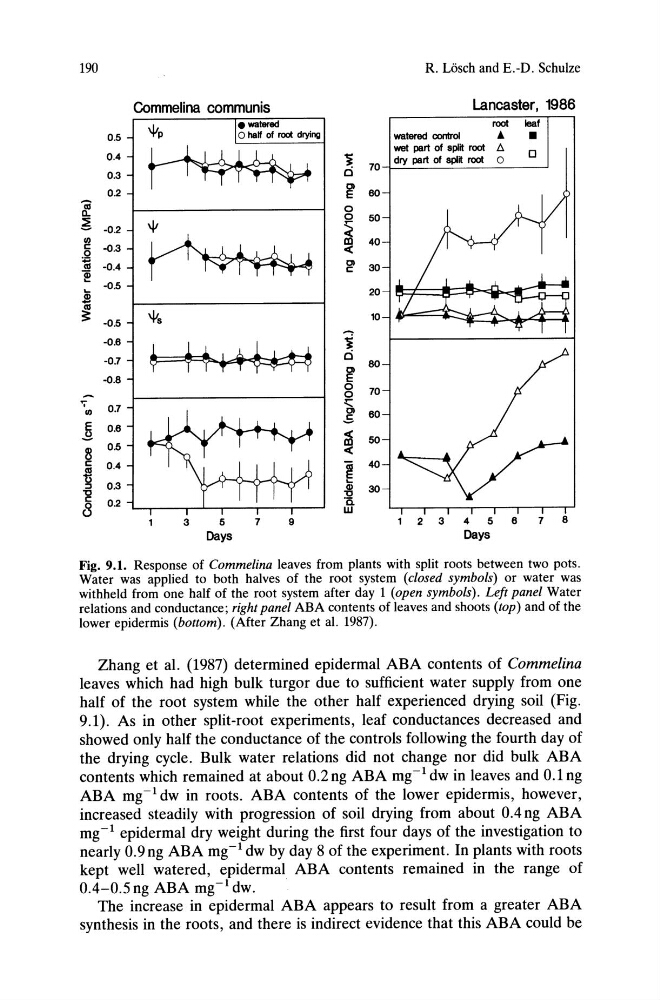
Fig. 9.1. Response of Commelina leaves from plants with split roots between two pots.
Water was applied to both halves of the root system (closed symbols) or water was
withheld from one half of the root system after day 1 (open symbols). Left panel Water
relations and conductance; right panel ABA contents of leaves and shoots (top) and of the
lower epidermis (bottom). (After Zhang et al. 1987).
Zhang et al. (1987) determined epidermal ABA contents of Commelina
leaves which had high bulk turgor due to sufficient water supply from one
half of the root system while the other half experienced drying soil (Fig.
9.1). As in other split-root experiments, leaf conductances decreased and
showed only half the conductance of the controls following the fourth day of
the drying cycle. Bulk water relations did not change nor did bulk ABA
contents which remained at about 0.2ng ABA mg- 1 dw in leaves and O.lng
ABA mg -1 dw in roots. ABA contents of the lower epidermis, however,
increased steadily with progression of soil drying from about 0.4 ng ABA
mg- 1 epidermal dry weight during the first four days of the investigation to
nearly 0.9 ng ABA mg- 1 dw by day 8 of the experiment. In plants with roots
kept well watered, epidermal ABA contents remained in the range of
0.4-0.5 ng ABA mg- 1 dw.
The increase in epidermal ABA appears to result from a greater ABA
synthesis in the roots, and there is indirect evidence that this ABA could be
R. Losch and E.-D. Schulze
Commelina communis
Lancaster, 1986
'-Itp
• watered
root leaf
0.5
o haH of root drying
watered control
• •
~
wet part of split root f::,.
0
0.4
~
dry part of split root 0
70
0.3
C
0.2
~ 60
~
0
6
'-It
0
50
-0.2
~
III
~
m 40
c: -0.3
-<
~
' "
-0.4
01
30
~
c:
~
-0.5
20
'-Its
10
-0.5
-0.6
P#,~
i
-0.7
C
01
80
-0.8
E
0
70
0
.. 0.7
,
UJ
01
60
.s
E 0.6
2
~ 50
8
0.5
-<
c: 0.4
~
40
~ :J 0.3
~ 30
"0
c: 0.2
'is.
8
w
3
5
7
9
2
3
4
5
6
7
8
Days
Days
Fig. 9.1. Response of Commelina leaves from plants with split roots between two pots.
Water was applied to both halves of the root system (closed symbols) or water was
withheld from one half of the root system after day 1 (open symbols). Left panel Water
relations and conductance; right panel ABA contents of leaves and shoots (top) and of the
lower epidermis (bottom). (After Zhang et al. 1987).
Zhang et al. (1987) determined epidermal ABA contents of Commelina
leaves which had high bulk turgor due to sufficient water supply from one
half of the root system while the other half experienced drying soil (Fig.
9.1). As in other split-root experiments, leaf conductances decreased and
showed only half the conductance of the controls following the fourth day of
the drying cycle. Bulk water relations did not change nor did bulk ABA
contents which remained at about 0.2ng ABA mg- 1 dw in leaves and O.lng
ABA mg -1 dw in roots. ABA contents of the lower epidermis, however,
increased steadily with progression of soil drying from about 0.4 ng ABA
mg- 1 epidermal dry weight during the first four days of the investigation to
nearly 0.9 ng ABA mg- 1 dw by day 8 of the experiment. In plants with roots
kept well watered, epidermal ABA contents remained in the range of
0.4-0.5 ng ABA mg- 1 dw.
The increase in epidermal ABA appears to result from a greater ABA
synthesis in the roots, and there is indirect evidence that this ABA could be