

168
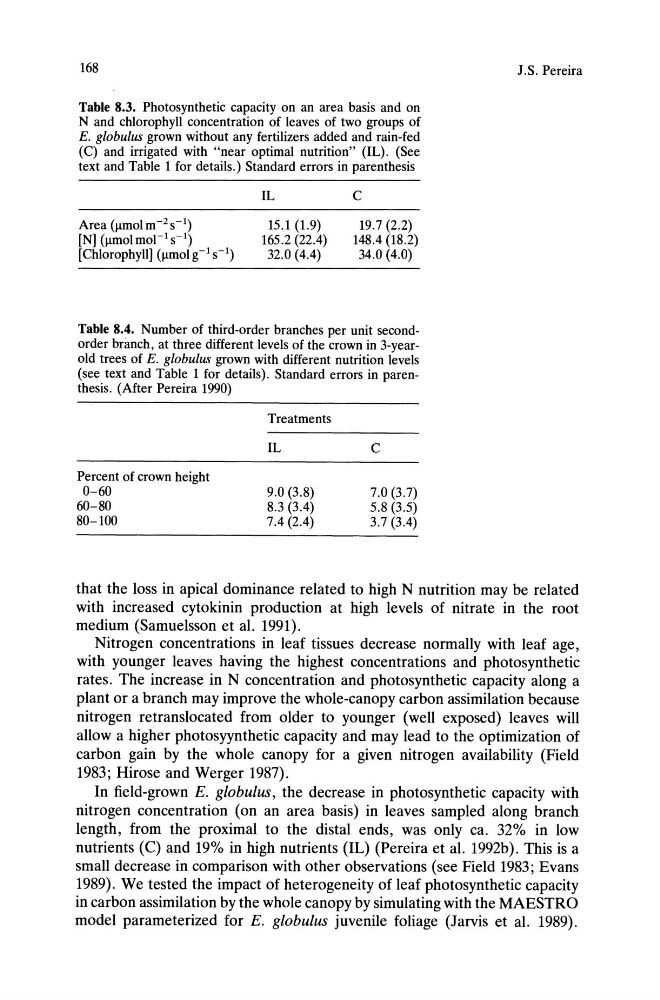
Table 8.3. Photosynthetic capacity on an area basis and on
N and chlorophyll concentration of leaves of two groups of
E. globulus grown without any fertilizers added and rain-fed
(C) and irrigated with "near optimal nutrition" (IL). (See
text and Table 1 for details.) Standard errors in parenthesis
Area (Ilmol m- 2 S-I)
[N] (Ilmolmol-1s- l )
[Chlorophyll] (Ilmolg-1s- l )
IL
15.1 (1.9)
165.2 (22.4)
32.0 (4.4)
C
19.7 (2.2)
148.4 (18.2)
34.0 (4.0)
Table 8.4. Number of third-order branches per unit secondorder branch, at three different levels of the crown in 3-yearold trees of E. globulus grown with different nutrition levels
(see text and Table 1 for details). Standard errors in parenthesis. (After Pereira 1990)
Percent of crown height
0-60
60-80
80-100
Treatments
IL
9.0 (3.8)
8.3 (3.4)
7.4 (2.4)
C
7.0 (3.7)
5.8 (3.5)
3.7 (3.4)
J.S. Pereira
that the loss in apical dominance related to high N nutrition may be related
with increased cytokinin production at high levels of nitrate in the root
medium (Samuelsson et al. 1991).
Nitrogen concentrations in leaf tissues decrease normally with leaf age,
with younger leaves having the highest concentrations and photosynthetic
rates. The increase in N concentration and photosynthetic capacity along a
plant or a branch may improve the whole-canopy carbon assimilation because
nitrogen retranslocated from older to younger (well exposed) leaves will
allow a higher photosyynthetic capacity and may lead to the optimization of
carbon gain by the whole canopy for a given nitrogen availability (Field
1983; Hirose and Werger 1987).
In field-grown E. globulus, the decrease in photosynthetic capacity with
nitrogen concentration (on an area basis) in leaves sampled along branch
length, from the proximal to the distal ends, was only ca. 32% in low
nutrients (C) and 19% in high nutrients (IL) (Pereira et al. 1992b). This is a
small decrease in comparison with other observations (see Field 1983; Evans
1989). We tested the impact of heterogeneity of leaf photosynthetic capacity
in carbon assimilation by the whole canopy by simulating with the MAESTRO
model parameterized for E. globulus juvenile foliage (Jarvis et al. 1989).
Table 8.3. Photosynthetic capacity on an area basis and on
N and chlorophyll concentration of leaves of two groups of
E. globulus grown without any fertilizers added and rain-fed
(C) and irrigated with "near optimal nutrition" (IL). (See
text and Table 1 for details.) Standard errors in parenthesis
Area (Ilmol m- 2 S-I)
[N] (Ilmolmol-1s- l )
[Chlorophyll] (Ilmolg-1s- l )
IL
15.1 (1.9)
165.2 (22.4)
32.0 (4.4)
C
19.7 (2.2)
148.4 (18.2)
34.0 (4.0)
Table 8.4. Number of third-order branches per unit secondorder branch, at three different levels of the crown in 3-yearold trees of E. globulus grown with different nutrition levels
(see text and Table 1 for details). Standard errors in parenthesis. (After Pereira 1990)
Percent of crown height
0-60
60-80
80-100
Treatments
IL
9.0 (3.8)
8.3 (3.4)
7.4 (2.4)
C
7.0 (3.7)
5.8 (3.5)
3.7 (3.4)
J.S. Pereira
that the loss in apical dominance related to high N nutrition may be related
with increased cytokinin production at high levels of nitrate in the root
medium (Samuelsson et al. 1991).
Nitrogen concentrations in leaf tissues decrease normally with leaf age,
with younger leaves having the highest concentrations and photosynthetic
rates. The increase in N concentration and photosynthetic capacity along a
plant or a branch may improve the whole-canopy carbon assimilation because
nitrogen retranslocated from older to younger (well exposed) leaves will
allow a higher photosyynthetic capacity and may lead to the optimization of
carbon gain by the whole canopy for a given nitrogen availability (Field
1983; Hirose and Werger 1987).
In field-grown E. globulus, the decrease in photosynthetic capacity with
nitrogen concentration (on an area basis) in leaves sampled along branch
length, from the proximal to the distal ends, was only ca. 32% in low
nutrients (C) and 19% in high nutrients (IL) (Pereira et al. 1992b). This is a
small decrease in comparison with other observations (see Field 1983; Evans
1989). We tested the impact of heterogeneity of leaf photosynthetic capacity
in carbon assimilation by the whole canopy by simulating with the MAESTRO
model parameterized for E. globulus juvenile foliage (Jarvis et al. 1989).