

160
I.S. Pereira
100~------------~---------------=-100
80
80
?fl.
?fl.
CI)
CI)
Q)
60
60
Q)
>
>
ca
ca
Q)
Q)
.....
.....
0
0
.. 40
40 . .
Q)
Q)
.c
.c
E
E
::l
::l
Z
Z
20
20
- - Q. suber
0
0
J
F M A M J
J
A S 0 N D
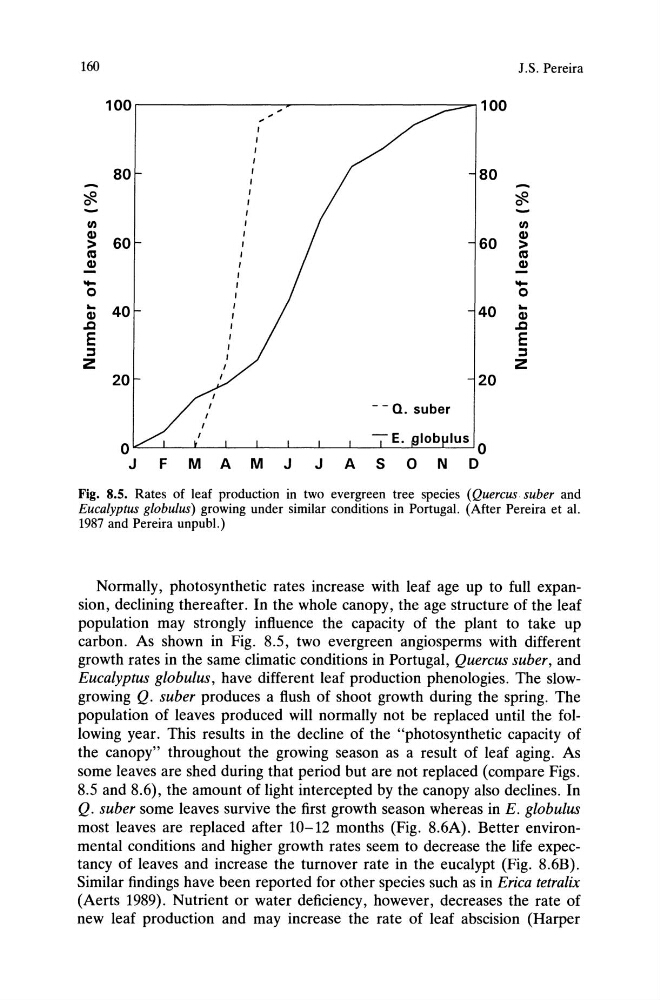
Fig. 8.5. Rates of leaf production in two evergreen tree species (Quercus. suber and
Eucalyptus globulus) growing under similar conditions in Portugal. (After Pereira et al.
1987 and Pereira unpubl.)
Normally, photosynthetic rates increase with leaf age up to full expansion, declining thereafter. In the whole canopy, the age structure of the leaf
population may strongly influence the capacity of the plant to take up
carbon. As shown in Fig. 8.5, two evergreen angiosperms with different
growth rates in the same climatic conditions in Portugal, Quercus suber, and
Eucalyptus globulus, have different leaf production phenologies. The slowgrowing Q. suber produces a flush of shoot growth during the spring. The
population of leaves produced will normally not be replaced until the following year. This results in the decline of the "photosynthetic capacity of
the canopy" throughout the growing season as a result of leaf aging. As
some leaves are shed during that period but are not replaced (compare Figs.
8.5 and 8.6), the amount of light intercepted by the canopy also declines. In
Q. suber some leaves survive the first growth season whereas in E. globulus
most leaves are replaced after 10-12 months (Fig. 8.6A). Better environmental conditions and higher growth rates seem to decrease the life expectancy of leaves and increase the turnover rate in the eucalypt (Fig. 8.6B).
Similar findings have been reported for other species such as in Erica tetralix
(Aerts 1989). Nutrient or water deficiency, however, decreases the rate of
new leaf production and may increase the rate of leaf abscision (Harper
I.S. Pereira
100~------------~---------------=-100
80
80
?fl.
?fl.
CI)
CI)
Q)
60
60
Q)
>
>
ca
ca
Q)
Q)
.....
.....
0
0
.. 40
40 . .
Q)
Q)
.c
.c
E
E
::l
::l
Z
Z
20
20
- - Q. suber
0
0
J
F M A M J
J
A S 0 N D
Fig. 8.5. Rates of leaf production in two evergreen tree species (Quercus. suber and
Eucalyptus globulus) growing under similar conditions in Portugal. (After Pereira et al.
1987 and Pereira unpubl.)
Normally, photosynthetic rates increase with leaf age up to full expansion, declining thereafter. In the whole canopy, the age structure of the leaf
population may strongly influence the capacity of the plant to take up
carbon. As shown in Fig. 8.5, two evergreen angiosperms with different
growth rates in the same climatic conditions in Portugal, Quercus suber, and
Eucalyptus globulus, have different leaf production phenologies. The slowgrowing Q. suber produces a flush of shoot growth during the spring. The
population of leaves produced will normally not be replaced until the following year. This results in the decline of the "photosynthetic capacity of
the canopy" throughout the growing season as a result of leaf aging. As
some leaves are shed during that period but are not replaced (compare Figs.
8.5 and 8.6), the amount of light intercepted by the canopy also declines. In
Q. suber some leaves survive the first growth season whereas in E. globulus
most leaves are replaced after 10-12 months (Fig. 8.6A). Better environmental conditions and higher growth rates seem to decrease the life expectancy of leaves and increase the turnover rate in the eucalypt (Fig. 8.6B).
Similar findings have been reported for other species such as in Erica tetralix
(Aerts 1989). Nutrient or water deficiency, however, decreases the rate of
new leaf production and may increase the rate of leaf abscision (Harper